
Connect
© 2026 Kyekyekule Africa. All rights reserved.
kyekyekule.africa
© 2026 Kyekyekule Africa. All rights reserved.
kyekyekule.africa
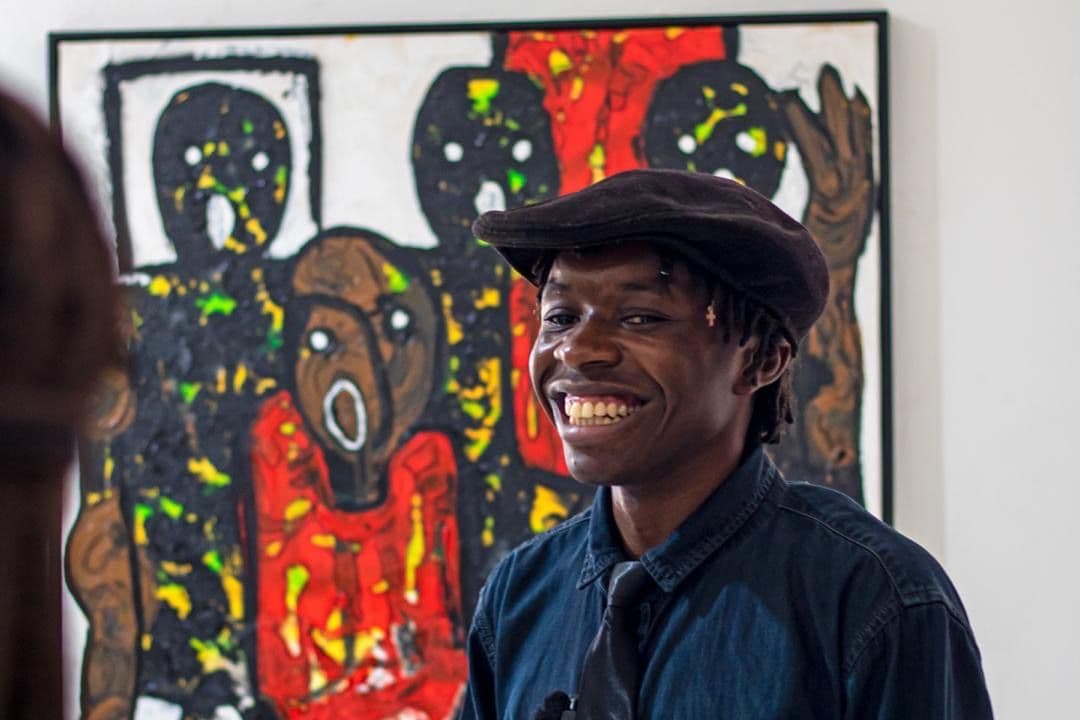
Autodidact Artist
Congo
Mixed media

Emmanuel Agyapong
Author
Published on:
October 19, 2026
Aksanti Bafunyempaka Bienfait Turns the Material Traces of Displacement Into Art
Burnt clothing, newspaper fragments and expressive marks form the material language of Congolese artist Aksanti Bafunyempaka Bienfait. Working across painting, drawing and mixed media, he examines displacement, identity and social justice through surfaces that hold traces of both damage and reconstruction.
Based in Kampala, Uganda, where he has lived in exile since 2016, Bienfait draws on personal experience without limiting his work to autobiography. His paintings connect the fragile conditions of individual life to broader questions of belonging, human dignity and collective responsibility.
What Materials Remember
In Bienfait’s practice, materials carry histories beyond their immediate physical properties. Discarded clothing, newspapers and other found elements enter his compositions as fragments of lived experience, bringing the material conditions of displacement into the work. Rather than treating these objects as neutral supports, he uses their existing associations to complicate the relationship between an image and the world from which it emerges.
Burnt fabric is particularly significant. Fire alters the material, leaving irregular edges, holes and darkened surfaces that record a physical process. Bienfait uses these traces to evoke the hardship and uncertainty associated with migration and exile, while resisting a representation of displaced people solely through suffering. The damaged material remains present, but it also becomes part of a new construction.
This transformation does not erase what came before. The fabric retains evidence of its alteration, making the process of change visible within the finished work. The resulting surface holds a tension between destruction and continuation: the material has been damaged, but it has not disappeared.
That tension offers a way to approach displacement without reducing it to a single image of loss. Clothing ordinarily exists close to the body, carrying associations with identity, familiarity and everyday life. Once burnt and incorporated into an artwork, it acquires another role, connecting individual experience to the wider conditions that shape movement, exclusion and belonging.
Between Personal Memory and Collective Experience

Aksanti Bafunyempaka Bienfait , ‘UPS and DOWNS’ '2025' Mixed medium on canvas Size: 95cm x 100cm Courtesy of the Artist
Bienfait describes his art as both a mirror and a window: a reflection of his inner life and an opening onto collective experience. The distinction is important to his approach. His work emerges from the circumstances of a Congolese artist living in exile, but its concerns extend beyond the representation of his own biography.
Born in 2003 and raised amid armed conflict and systemic injustice in the Democratic Republic of Congo, Bienfait brings lived experience to questions of identity, migration, cultural heritage and social responsibility. In Kampala, these concerns enter a practice shaped by drawing, painting and the assembly of found materials. Personal memory becomes a point of departure for considering the conditions under which people preserve a sense of self while navigating displacement.
His compositions do not need to narrate a particular event to address these experiences. Layered surfaces and expressive mark-making allow different visual elements to coexist without resolving into a single account. Newspaper fragments introduce printed information and public narratives; painted marks interrupt or redirect the image; found materials retain traces of their previous use.
Through these combinations, Bienfait places individual experience in relation to the social and political structures surrounding it. The work asks how identity is maintained when familiar environments and relationships are disrupted, and how private memories intersect with the histories communities carry collectively.
Newspaper, Paint and the Construction of an Image

Aksanti Bafunyempaka Bienfait , ‘RESISTANCE MONUMENT’ acrylic paint, newspapers, spray paint, and marker on canvas 95cm x 100cm 2026 Courtesy of the Artist
Newspapers introduce a distinct dimension to Bienfait’s material practice. They carry information about public events, political developments and social conditions, but they are also ordinary, disposable objects whose relevance often depends on the moment in which they circulate. When incorporated into a painting or collage, they move from the circulation of information into the construction of an image.
Bienfait combines newspaper with acrylic paint, spray paint and marker, working across canvas and Manila paper. These materials create different kinds of visual information within the same composition. Printed fragments coexist with gestural marks and painted forms, allowing the surface to register both the presence of existing narratives and the artist’s intervention in them.
The process creates a relationship between what is already recorded and what is newly made. Newspaper fragments bring traces of the world beyond the studio into the artwork, while painting and drawing reorganise those traces according to the logic of the composition. The resulting image does not simply reproduce its source material. It changes the way that material can be encountered.

Aksanti Bafunyempaka Bienfait , ‘I SEE ME IN YOU’ acrylic paint, newspapers, spray paint, and marker on manila paper 75cm x 50cm Courtesy of the Artist
This interplay is evident in works such as I See Me in You (2026), made with acrylic paint, newspapers, spray paint and marker on Manila paper, and Resistance Monument (2026), which combines similar materials on canvas. Their titles suggest different points of entry into questions of recognition and resistance, although the precise interpretation of each work depends on its visual details.
What connects these material choices is the refusal to treat the image as a closed surface. Paint, printed matter and found elements retain their differences while contributing to a larger composition. Meaning emerges through their interaction.
The Politics of Damage and Repair
Bienfait’s use of burnt clothing brings the physical transformation of materials into contact with the social realities of forced displacement. The work does not present damage as an abstract metaphor detached from lived conditions. Instead, the altered material provides a tangible record of a process, allowing the viewer to encounter traces of destruction within an object that has been given another form.
Yet the work is not defined by damage alone. The act of incorporating discarded fabric into a new composition also introduces questions of agency and continuation. The material is neither returned to its original state nor stripped of its history. Its transformation becomes part of what the artwork communicates.
This distinction matters when considering how displaced people are represented. Images of migration often concentrate on crisis, vulnerability and loss. Bienfait’s practice engages with these realities while also directing attention towards dignity, identity and the possibility of rebuilding. The materials do not offer a simple narrative of recovery; they hold the evidence of hardship alongside the possibility of making something from what remains.
His broader interest in human rights and social justice extends into his work beyond the studio. Through Last Change, the refugee-led organisation he founded, he uses art in connection with advocacy, mental well-being and social engagement. This work shares concerns with his artistic practice, though the two operate through different means: one creates spaces for participation and collective action, while the other constructs images through which experiences and social conditions can be considered.
Figures of Recognition and Resistance
Bienfait’s 2026 works also include Plaint Me, The Leader and The Wiser, the Quieter. Together with I See Me in You and Resistance Monument, these titles establish a body of work that repeatedly invokes recognition, authority, resistance and judgement.
The titles offer useful points of entry, but they should not be treated as complete explanations of the images. The Leader, for instance, raises questions about the relationship between authority and responsibility; The Wiser, the Quieter suggests a connection between knowledge and restraint. Their implications depend on how the figures, marks and materials are arranged within each composition.
What matters is the relationship between these questions and the material language that runs through Bienfait’s practice. Newspapers place the work in proximity to public discourse, while expressive painting and collage complicate the authority of any single image or account. The resulting compositions can be approached as spaces in which individual identity and collective life intersect.
These works also broaden the focus beyond displacement as a biographical subject. Questions of leadership, resistance and recognition concern how societies organise themselves, whose voices are heard and how people are represented. Bienfait’s practice brings such concerns into a visual language grounded in material experimentation rather than explanatory text.
From Kampala to International Exhibition Contexts
Bienfait’s practice has developed through exhibitions and projects in Uganda and beyond. In 2023, his work appeared in The Art of Equality – A Journey to Justice, presented at the United Nations Office in Geneva and associated with the Maison de la Paix. The project recognised his work in the Climate Change category, while he also won the National Art Contest organised by Faces Up Uganda in partnership with FAO Uganda in 2022.
His 2025 exhibition activity included Culture Tapestries: Threads of Pan-African Identity at the Nairobi National Museum, Resilience in Exile at Berlin Global Village, and group exhibitions at Xenson Art Space and The Drop Canvas in Uganda. He also presented Squatters as a virtual solo exhibition. These contexts place his work in conversations spanning displacement, cultural identity and social engagement, while providing different settings in which audiences can encounter his material practice.
In 2025, Bienfait also took part in the Eava Artists Residency. Alongside his exhibitions, these experiences form part of a developing practice that connects studio production with research and community-oriented work.
His exhibition history is relevant not simply as a record of professional recognition, but because it shows the range of contexts in which his work has circulated. The material questions at the centre of his practice remain grounded in lived conditions, even as the works enter institutional and international settings.
What Remains in the Surface
Bienfait’s work begins with materials that have already passed through other lives: clothing that has been worn, newspapers that have circulated and surfaces altered by fire or use. He does not conceal these histories beneath a seamless finish. Instead, he allows fragments, marks and damage to remain visible, making the process of transformation part of the image.
This approach gives his practice a particular way of addressing displacement. The work does not attempt to restore an untouched past or turn hardship into a simple story of resilience. It considers how identity and memory persist through rupture, and how the remains of one condition can become the materials for another.
His paintings hold personal experience alongside questions of public responsibility, without collapsing the two into a single narrative. The work’s significance lies in this movement between the individual and the collective, the damaged material and its new configuration, the record of what has happened and the possibility of what can still be made.
In Bienfait’s hands, the surface becomes more than a place where images are assembled. It becomes a record of what materials endure, what they carry forward and what their transformation makes possible.