
Connect
© 2026 Kyekyekule Africa. All rights reserved.
kyekyekule.africa
© 2026 Kyekyekule Africa. All rights reserved.
kyekyekule.africa
Visual Artists
Kenya
Oil painting

Emmanuel Agyapong
Author
Published on:
November 11, 2026
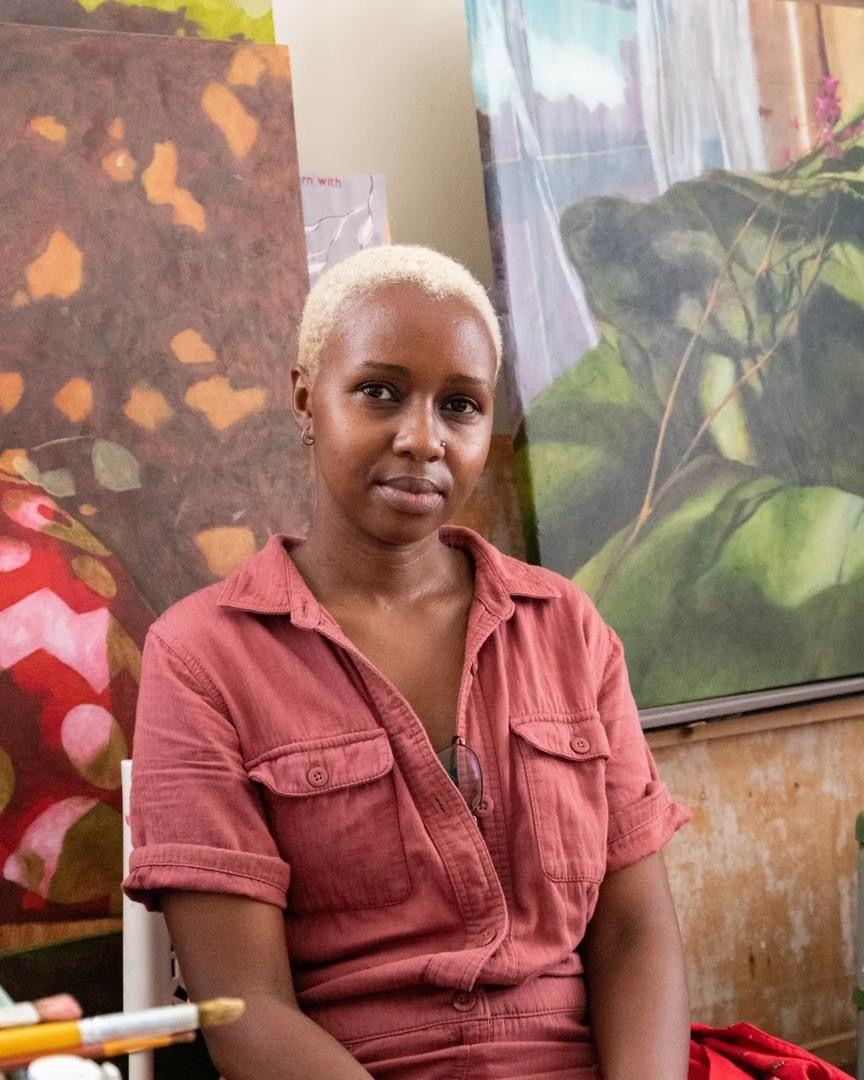
Born in 1988 and raised in Nairobi, Kenya, April Kamunde is a self-taught visual artist whose practice explores the everyday experiences of African women, with particular attention to rest, labour, identity and self-expression. Working primarily in oil painting, she creates intimate scenes in which women occupy moments of stillness, often surrounded by lush natural environments. Through careful attention to gesture, clothing, color and setting, Kamunde brings ordinary experiences into focus, placing Black women at the centre of their own narratives.
Before becoming a full-time artist in late 2020, Kamunde spent seventeen years producing portrait commissions, developing her technical skills in oils and pastels. This extended period of working through commissioned portraiture shaped her understanding of representation and the painted figure. Her transition into an independent practice allowed her to move beyond commissioned likenesses towards subjects drawn from personal reflection and the experiences of women around her.
Rest; Pursuit of Peace: Making Space for Rest

April Kamunde, Usidhubutu (Don_t You Dare), 2022, Oil on Canvas, 120x90cm, Courtesy of Afriart Gallery
Kamunde’s first major body of work, Rest; Pursuit of Peace, emerged during a three-month residency at Afriart Gallery’s Silhouette Projects in Kampala in 2022. Through mentorship and critical engagement, the residency provided an opportunity to develop the conceptual direction of her painting practice. The resulting work grew from her own experience of deep fatigue, as well as conversations with women in her immediate circle about the difficulty of finding time for themselves.

April Kamunde, Tafakari Ya Mama Max III_ We Move, 2022, Oil on Canvas, Image Courtesy of Afriart Gallery
In these paintings, rest is not presented as an extraordinary escape or an indulgence reserved for special occasions. Instead, Kamunde focuses on accessible moments: sitting outdoors, enjoying sunlight, spending time in nature or simply being alone. Her subjects are often depicted in vivid colour and with soft, delicate brushwork, their presence conveying a sense of ease without turning rest into an idealised state. The paintings draw attention to time that is not organized around work, domestic responsibilities or the expectations of others.

April Kamunde, Creation of Pockets of Peace, 2024, Oil on Canvas, 116.5x80cm, Courtesy of Afriart Gallery
A recurring element in this body of work is the dera, a loose-fitting dress also known in some contexts as a dirac or baahti. Worn by women in parts of East Africa, the garment is valued for its comfort, ventilation and freedom of movement. In Nairobi, it has become increasingly familiar as loungewear.
For Kamunde, the dera functions as a visual marker of personal time, a kind of “Do Not Disturb” sign through which women signal a moment of withdrawal and reclaim their energy. Its presence gives the paintings a recognizable cultural and domestic context, grounding their exploration of rest in an everyday experience.
Fabric of Our Being: Beyond the Boundaries of Rest

April Kamunde_Utamu Flani Hauwezi Elewa (A Certain Deliciousness Difficult to Comprehend and or Explain_ Like Salted Oranges 1_116x80cm_2025_Oil on canvas. Courtesy of Afriart Gallery
In 2025, Kamunde expanded these questions through Fabric of Our Being, her inaugural solo exhibition, presented at The African Arts Trust in Nairobi and Afriart Gallery in Kampala. While the dera remained central, the work moved beyond its association with leisure to examine the garment’s more complex place in women’s lives.
Through conversations with friends, family and colleagues, alongside newspaper articles and community blog posts, Kamunde explored the different ways women wear, understand and navigate the meanings attached to it.

April Kamunde _Ode to Somalia 1_2024_Oil on canvas_75x75cm. Courtesy-of-Afriart-Gallery
The dera that once signaled rest also serves as a working dress. It is worn while preparing meals, carrying out household chores and working from home. Its comfort does not necessarily mean that the wearer is free from responsibility. Instead, the garment moves between moments of relaxation and labour, revealing how closely these experiences can overlap within domestic life.
Kamunde also considers the social expectations attached to women’s appearance. The dera can signify modesty and respectability, while its loose silhouette raises questions about sensuality and how women’s bodies are perceived. These meanings are not always consistent.
A garment associated with privacy and comfort can also become subject to judgements about presentation and propriety. By examining these contradictions, Kamunde uses the dera as a lens through which to explore the varied and sometimes conflicting experiences of Black women in East Africa.
Expanding the Language of the Work
The development of Fabric of Our Being also marks a shift in Kamunde’s approach to making. While her earlier work was centred on oil painting, she has incorporated video, installation and sound to explore the subject beyond the painted image. These additional mediums allow her to consider movement, everyday activity and the environments in which the garment is worn.
Her film DIRAC – The Working Dress extends this investigation, bringing the relationship between clothing and labour into moving image. The expansion is significant because it allows Kamunde to approach the dera not only as a motif within a painting, but as an object embedded in lived experience. The garment becomes a point of connection between the individual and the social spaces she occupies, carrying different meanings across domestic routines, personal time and public expectations.
Exhibitions and Recognition
Kamunde’s practice has developed through exhibitions and art platforms in East Africa and internationally. Her group exhibitions include Walking the Edge at Afriart Gallery in Kampala in 2022, Shapes of Water at the same gallery in 2023, and Eastern Voices: Contemporary Art from East Africa at Addis Fine Art in London in 2023. She has also participated in 1-54 Contemporary African Art Fair in London, ART X Lagos and Investec Cape Town Art Fair, alongside presentations through Artsy’s African Galleries Now and Black Owned Galleries Now programs.
In 2025, Fabric of Our Being was presented first at The African Arts Trust in Nairobi from 6 June to 2 August, before travelling to Afriart Gallery in Kampala from 20 September to 8 November. The two presentations brought the project into distinct East African exhibition contexts, extending the conversation around the garment and the experiences it represents. In 2024, Kamunde was awarded the Writer’s and Artist Fellowship for Travel (WAFT), facilitated by Wangechi Mutu Studio. Her 2025 participation in RMB Latitudes CuratorLab’s What We Don’t See: A Sensory Rebellion further contributed to her exhibition history.
The Everyday as a Site of Inquiry
Across Rest; Pursuit of Peace and Fabric of Our Being, Kamunde’s practice moves from the desire for rest towards a broader examination of the conditions shaping women’s everyday lives. What begins with the image of a woman taking time for herself develops into an exploration of how rest and labour coexist, how clothing carries social expectations, and how women negotiate the meanings assigned to their bodies.
The dera remains central to this inquiry because it is never only one thing. It can offer comfort while accompanying work, suggest modesty while raising questions about sensuality, and mark private time without removing the responsibilities that surround it. Through painting and an expanding use of other mediums, Kamunde gives these familiar experiences sustained attention, asking what becomes visible when the ordinary details of women’s lives are treated as subjects worthy of close examination.