
Connect
© 2026 Kyekyekule Africa. All rights reserved.
kyekyekule.africa
© 2026 Kyekyekule Africa. All rights reserved.
kyekyekule.africa
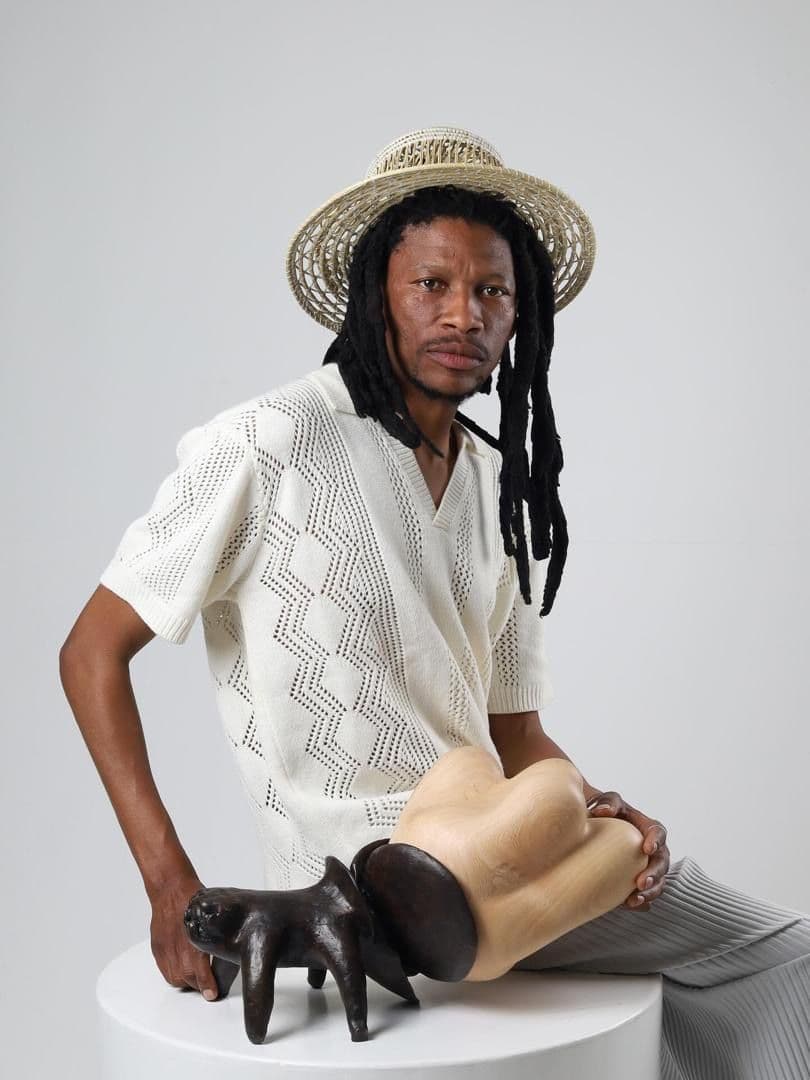
Multidisciplinary Artist
South Africa
Sculpture, Installation & Illustration

Emmanuel Agyapong
Author
Published on:
October 26, 2026
Atang Tshikare Reworks Indigenous Knowledge Through Sculpture and Design
Atang Tshikare’s multidisciplinary practice brings Tswana heritage and wider Southern African knowledge systems into contemporary sculpture, collectible design and spatial installation. Working across wood, bronze, ceramics, textiles and other materials, he draws on inherited techniques, oral traditions and organic forms to examine how cultural knowledge survives, changes and finds expression in the present.
Through sculpture and design, his work moves between the functional object and the symbolic form, treating the act of making as a way of carrying knowledge forward.
The Knowledge Embedded in an Object
For Tshikare, an object can hold histories that extend beyond its immediate function. Materials, construction methods and decorative patterns become ways of transmitting knowledge, connecting contemporary practice to techniques developed and passed down across generations. His work draws on Tswana cultural references while engaging a wider Southern African context, bringing these traditions into dialogue with contemporary design.

Atang Tshikare, “Mollo oa Leifo, Mme and Ngoanana”. Materials: bronze, glass beads, grass, textile, wood. Dimensions: 98 × 53 × 43 cm. Courtesy of the Artist.
This relationship is particularly evident in Mollo Oa Leifo, a pair of chairs whose title refers to the fire of a hearth. The works, named Mme and Ngoanana, draw on the cultural associations of mothers, daughters and domestic gathering. Their forms bring furniture into conversation with questions of kinship, inheritance and the knowledge carried through everyday objects.
The chairs incorporate bronze, glass beads, grass, textile and wood, combining materials associated with different processes of making. Charring and weaving techniques passed down through Tshikare’s grandmother connect the works to intergenerational knowledge, while their references to Tswana patterns and adornment establish a cultural framework beyond conventional furniture design.
The chair is also a historically loaded form. By reworking a type associated with European furniture traditions through Tswana references and inherited techniques, Tshikare unsettles the assumption that design history moves in a single direction, from European innovation to African adaptation. Mollo Oa Leifo instead places Indigenous knowledge at the centre of the object’s construction and meaning.
From the Familiar to the Unfamiliar
Tshikare’s sculptures frequently combine forms drawn from the animal and plant worlds. Rather than reproduce nature literally, he creates hybrid figures in which recognisable features become the basis for new visual possibilities. These combinations give his work a distinctive relationship to the natural environment: plants, animals and landscape become active elements in the construction of cultural meaning.

Atang Tshikare, Puruma, 2025. Photo Credit; Robert Damisch
Puruma, presented at Wanås Konst in Sweden in 2025, develops this approach on a public scale. Its form combines references to a lion and South Africa’s king protea, bringing an animal associated with strength together with the country’s national flower. The title, meaning “roar” in Setswana, reinforces the work’s connection to language and cultural context.
Installed above a pond, the sculpture enters into a relationship with its surroundings. Water, landscape and the hybrid figure become part of the encounter, shifting the work beyond the boundaries of an isolated object. Its placement also marks an important development in Tshikare’s practice: the sculpture must be understood not only through its form and materials, but through the environment in which it appears.
This approach to hybrid form does not simply merge two natural references. It creates a figure that belongs to neither category alone, allowing cultural imagination to operate through the physical properties of sculpture. The result is a visual language in which the familiar becomes a means of approaching forms of knowledge that cannot be reduced to straightforward representation.
Mowa: Sculpture and Spiritual Relationships

Atang Tshikare, “Mowa” 2026. Photo Credit; Anthea Pokroy
In Mowa, presented at Everard Read in Johannesburg in 2026, Tshikare develops the relationship between sculptural form and spiritual thought. Birds, trees and fruits appear within a visual framework informed by Tswana, Sotho and Pedi traditions. These forms carry associations with ancestral presence, fertility, lineage and the connections between the earthly and spiritual realms.
The exhibition’s significance lies in how these ideas enter the physical arrangement of the works. A bird, tree or fruit is not merely a motif applied to a sculpture; each can establish a relationship between form, place and a wider system of meaning. Sculpture becomes a way to give material presence to ideas that are otherwise transmitted through oral tradition, ritual and shared cultural knowledge.
This approach also places Tshikare’s practice in conversation with contemporary debates about how Indigenous knowledge is represented. His work does not rely exclusively on explanatory text to establish its cultural references. Instead, materials, textures, silhouettes and relationships between objects carry part of the argument. The viewer encounters a constructed world whose meanings emerge through looking, spatial experience and an understanding of the traditions from which its forms draw.
Between Craft, Design and Contemporary Art

Atang Tshikare, “ Moipone” (2025) Edition | 1/1 Medium | soil, wood & beads Size | W 18 × D 28 x H 58 cm Courtesy of the Artist.
Tshikare’s work moves across categories that are often treated separately. His practice encompasses sculpture, illustration, pattern, furniture and collectible design, while his material choices range from wood, grass and textiles to bronze, ceramics and manufactured substances. Each medium presents a different set of possibilities for shaping form and communicating ideas.
His earlier work through Zabalazaa Designs, established in 2010, developed a visual language that brings African references into contemporary design. Commercial collaborations and independent artistic projects have formed different parts of his career, demonstrating the range of contexts in which his approach to form and material operates. These contexts are not interchangeable, however: the demands of a commissioned design project differ from those of a sculpture developed for an exhibition or public landscape.
What connects these areas is his attention to touch, surface and the transformation of materials. Organic shapes and layered textures give objects a physical presence that invites close attention, while the cultural references embedded in their construction complicate the distinction between function and symbolism. A chair can carry a history of inherited techniques; a public sculpture can bring mythology into a landscape; a group of forms can establish a spatial relationship with ancestral thought.
A Practice of Continuity and Change
Tshikare’s career includes the Future Found award from the Southern Guild Design Foundation in 2014 and recognition among the Top 200 Young South Africans in 2015. He has also contributed to design education and public discussion through judging, mentoring and talks. These activities place his work within broader conversations about how contemporary African design is produced, presented and understood.
His recent projects trace an expanding engagement with exhibition spaces and public environments. Pula e ya na, presented at Everard Read in Cape Town in 2024, preceded the large-scale public sculpture Puruma in Sweden in 2025. The 2026 exhibition Mowa returned attention to the relationship between sculptural form and spiritual symbolism. Together, these projects show a practice moving between the intimate scale of the designed object and the spatial demands of exhibition and public sculpture.
Across these forms, Tshikare approaches Indigenous knowledge as something that continues to be made and interpreted, rather than preserved in a fixed historical state. His work draws on inherited techniques and cultural references without treating them as static signs of identity. Instead, he places them into new material and spatial relationships, allowing their meanings to develop through contemporary practice.
The question his work leaves open is how design can carry cultural knowledge into the future without separating it from the communities, techniques and systems of thought that give it meaning. In Tshikare’s practice, the answer begins with the object itself: how it is made, what it remembers and what becomes possible when inherited knowledge enters a new form.