
Connect
© 2026 Kyekyekule Africa. All rights reserved.
kyekyekule.africa
© 2026 Kyekyekule Africa. All rights reserved.
kyekyekule.africa
Painter
Cameroon
Acrylic on canvas & Silkscreen

Emmanuel Agyapong
Author
Published on:
June 9, 2026
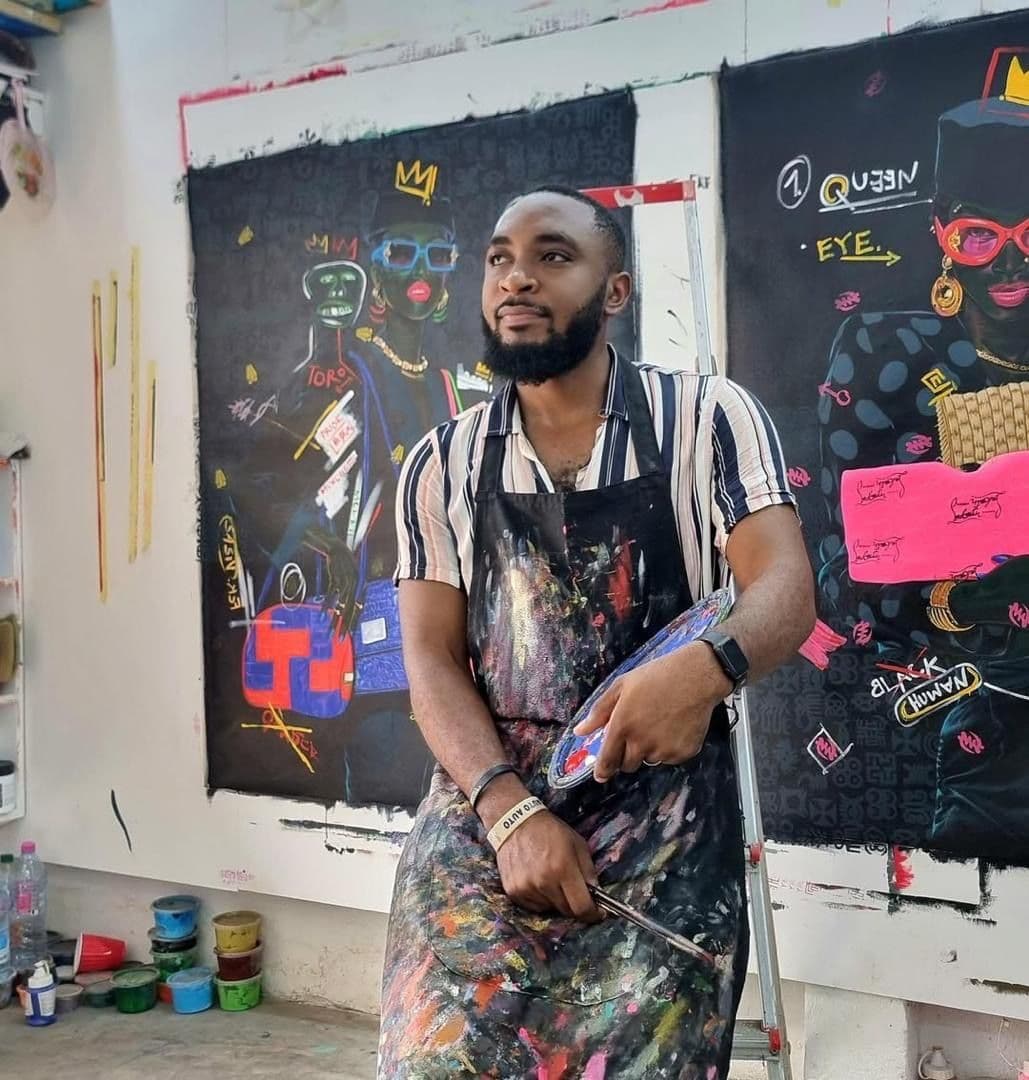
Boris Anje Tabufor, who works under the name Anjel, is a Cameroonian painter whose Neo-Pop practice, developed primarily through acrylic on canvas with silkscreen as a parallel medium, places the African dandy at the centre of an inquiry into Black identity, global consumerism, and the politics of appearance. His paintings bring together two distinct approaches to representation: the Old Masters’ attention to skin, wrinkle, fabric, and the physical evidence of a life lived, and the flattened, repetitive visual language associated with Warhol’s Pop Art. The resulting portraits move between intimacy and iconography, presenting their subjects as both specific individuals and figures within a larger cultural vocabulary.
This formal tension is central to the work’s meaning. Anjel does not simply combine historical painting with Pop Art as a stylistic exercise; he uses their differences to examine how Black subjects are seen, reproduced, and valued. The carefully rendered body insists on individuality, while repetition and graphic reduction introduce the mechanisms of mass culture, where images circulate, identities become consumable, and people can be transformed into symbols. The portrait consequently occupies an unstable position between the person and the image, asking what remains of individual presence when identity enters systems of consumption and representation.
La Sape provides the philosophical foundation for this inquiry. The Congolese tradition of sartorial elegance and self-staging emerges from a history in which dress becomes a means of asserting dignity, identity, and agency under conditions shaped by colonialism and its aftermath. Within the Sapeur tradition, clothing is not simply ornamental. The deliberate construction of appearance becomes a refusal of imposed hierarchies and a means of determining how one enters public space. Anjel carries this logic into painting, treating elegance not as an apolitical surface but as a form of self-definition.
This distinction matters because the figures in his paintings are not presented merely as fashionable subjects. Their clothing, posture, and cultivated appearance become part of a larger negotiation around visibility. To choose how one is seen is to intervene in the terms through which one is seen, particularly within histories in which Black bodies have been classified, stereotyped, or rendered invisible. Anjel’s dandy therefore occupies the canvas with a deliberate self-possession. The figure is not asking to be granted visibility; he is constructing it on his own terms.

Photo Credit: Boris Anje Tabufor
The influence of consumer culture complicates that assertion. The luxury objects, fashion codes, and polished surfaces associated with dandyism exist within global systems of production and desire that can themselves turn identity into commodity. Anjel’s use of Pop Art is therefore particularly suited to the subject. By placing the language of mass reproduction alongside the highly individual act of sartorial self-fashioning, his work holds self-determination and consumption in the same frame. Elegance can function as resistance, but it also exists within economies that continually transform style into something to be bought, circulated, and desired.
His treatment of the painted surface reinforces this contradiction. The attention given to skin, folds, textures, and facial details creates an intimacy that resists the anonymity of mass-produced imagery, while the graphic qualities of Neo-Pop introduce a degree of distance and repetition. The viewer is consequently encouraged to look at the figure as both person and constructed image. This oscillation reflects a broader question within contemporary portraiture: how can an individual remain visible as an individual while also navigating the visual systems through which identity is packaged and consumed?
Anjel’s formal education includes a Master’s degree in Fine Arts from the Institute of Fine Arts in Foumban. His practice has since entered significant international contexts, with works held in the permanent collection of the World Bank in Washington and exhibitions at Zeitz MOCAA in Cape Town, Kunsthal KAdE in the Netherlands, as well as galleries in Barcelona, Dubai, Brussels, and Los Angeles. These contexts place his work within an international contemporary art landscape while retaining its grounding in a distinctly African history of self-fashioning and cultural assertion.
Across Anjel’s paintings and silkscreens, elegance becomes a way of thinking about power. The carefully dressed figure is never only an image of style; he is a subject negotiating visibility, identity, consumption, and the right to define himself. By bringing the philosophy of La Sape into dialogue with the visual languages of Old Master portraiture and Pop Art, Anjel demonstrates that appearance can carry historical weight. How one chooses to be seen may begin with clothing, but under particular conditions, it becomes a claim over who gets to construct the image of the self.