
Connect
© 2026 Kyekyekule Africa. All rights reserved.
kyekyekule.africa
© 2026 Kyekyekule Africa. All rights reserved.
kyekyekule.africa
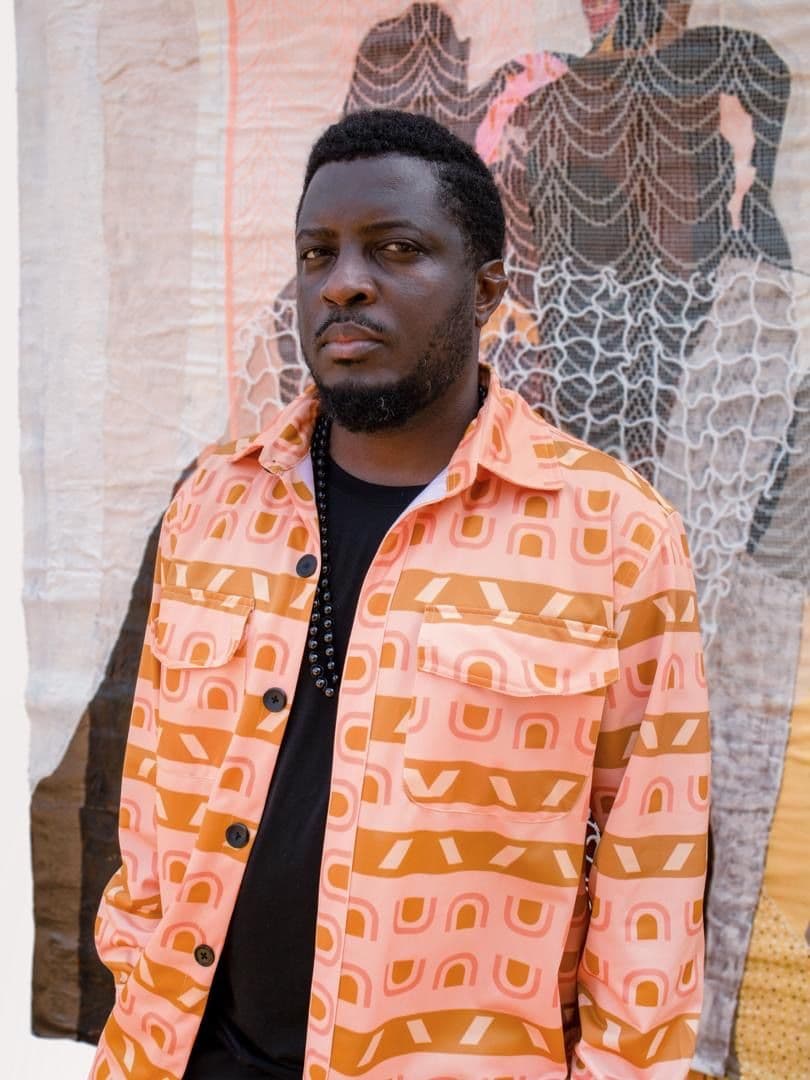
Multidisciplinary Artist
Uganda
Painting, collage, sculpture, installation, performance

Emmanuel Agyapong
Author
Published on:
September 16, 2026
Collin Sekajugo is a Rwandan Ugandan multidisciplinary artist whose practice extends across painting, collage, sculpture, installation, and performance, but his contribution to contemporary African art cannot be contained within the studio. Born in Masaka, Uganda, in 1980 and based between Kampala and Kigali, Sekajugo has spent much of his career building the conditions in which art can be produced, shared, and developed. His work as an artist and his work as an institution builder are therefore part of the same proposition: that artistic practice can create not only images and objects, but also spaces for other forms of cultural life to emerge.
Sekajugo is self-taught, with no formal art training, and his 2006 study tour through Eastern and Southern Africa became an important formative experience. After the journey, he returned to Rwanda in 2007 with the idea of “Using Art to Change Lives.” That principle developed into the founding of Ivuka Arts, described as Rwanda’s first contemporary visual arts centre, and later Weaver Bird Arts Community in Uganda. These initiatives place his career within a broader question about infrastructure: what happens when artists do not wait for established institutions to provide the spaces they need, but begin creating those spaces themselves?
This question is important in the context of African contemporary art, where artist-led spaces and independent cultural communities have often played a significant role in developing practices outside established institutional structures. Sekajugo’s trajectory demonstrates that institution building does not necessarily sit outside an artist’s practice. The studio, the exhibition space, the community, and the networks around them can become interconnected parts of the same cultural work.
His own artworks similarly resist being separated from their material and social contexts. Sekajugo works with found and locally sourced materials, gunny sack, manipulated stock imagery, and other forms of mixed media. These materials are not simply selected for their visual qualities. Gunny sack, for instance, carries associations with agriculture and Uganda’s colonial history, while manipulated stock images bring the language of contemporary popular and consumer culture into the work. The collision between these materials creates a visual field in which different histories of labour, commerce, representation, and consumption occupy the same surface.

Image Credit: Courtesy of the Artist
This approach becomes particularly significant in his collages. Sekajugo frequently uses images of bodies, including his own figure, within compositions assembled from found materials and imagery. The resulting works are concerned with how identities are constructed, categorised, and read. His position as someone born to a Ugandan father and Rwandese mother gives this inquiry a personal dimension, but the work moves beyond autobiography. It considers the assumptions attached to ethnicity and multicultural identity, and the ways migration and belonging can complicate the categories through which people are understood.
His 2023 exhibition Dream in Abidjan developed these concerns through figurative collage, examining cultural identity, assimilation, migration, belonging, and multiculturalism alongside the visual language of consumer culture. The fragmented construction of the works reflects an identity that is not presented as singular or fixed. Found images and objects become components that can be rearranged, producing bodies and identities that exist between inherited histories, contemporary environments, and competing cultural expectations.
The relationship between material and identity also connects earlier bodies of work to his more recent practice. Sekaplastic, presented at Kuona Trust Art Center in Nairobi in 2012, foregrounded plastic and discarded material, while Baba Mweusi, shown at Ivuka Arts Center in Kigali in 2013, continued his engagement with identity and representation. Across these works, material is treated as something that arrives with a history. Plastic, fabric, stock imagery, and other found elements carry associations before they enter the composition, allowing the act of assembling them to become a way of negotiating those histories.
In 2022, this practice entered a major international context when Sekajugo and Acaye Kerunen represented Uganda in the country’s inaugural national pavilion at the Venice Biennale. Radiance: They Dream in Time, presented at Palazzo Palumbo Fossati, received a Special Mention for the national participation. The pavilion placed Sekajugo’s work within a national representation that was itself historically significant: Uganda was establishing its presence at one of the world’s most visible international art exhibitions for the first time.
The trajectory from Ivuka Arts to Venice is therefore more than a sequence of career milestones. It reveals a sustained relationship between making art and creating platforms through which art can circulate. Sekajugo’s later international activity, including the 2025 Norval Sovereign African Art Prize shortlist, 1-54 Marrakech, Africa Rising in Seoul, and his presentation at 1-54 London with 50 Golborne, places his work within an expanding international conversation. Yet these exhibitions remain connected to an earlier commitment to building cultural infrastructure closer to home.
His recent works, including Advisors, If Equality Was Human, and The Awarded from 2025, continue his use of collage to examine bodies, institutions, status, and social relationships. The works do not abandon the questions that have shaped his practice; they extend them through new combinations of image and material. Across his career, the act of assembling becomes both a formal and social method: fragments can be brought together, relationships reconsidered, and new structures made from what already exists.
Sekajugo’s career consequently offers a different way of thinking about what an artist contributes to an art ecosystem. The paintings and collages are one part of the record. The spaces he has founded, the communities he has supported, and the networks he has helped establish form another. His practice asks what it means not only to produce contemporary African art, but to participate in building the environments in which that art—and the artists who make it—can continue to exist.