
Connect
© 2026 Kyekyekule Africa. All rights reserved.
kyekyekule.africa
© 2026 Kyekyekule Africa. All rights reserved.
kyekyekule.africa
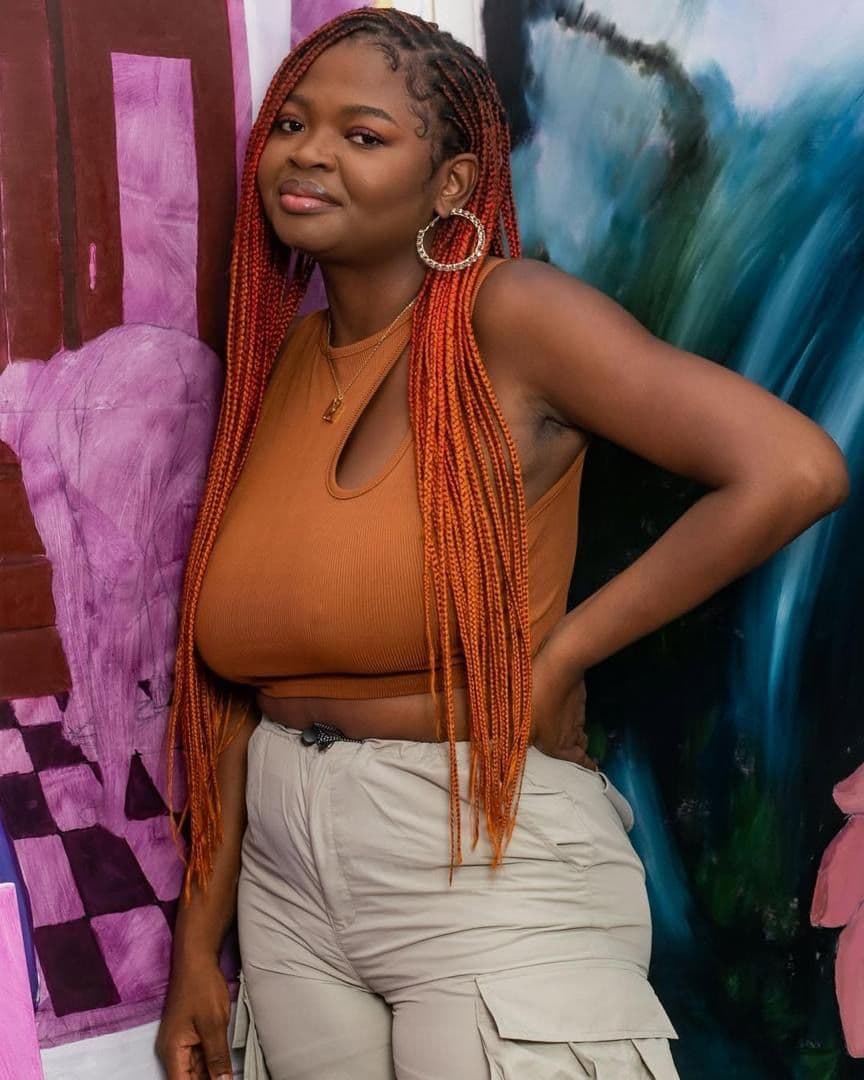
Painter
Ghana
Acrylic Oil & Oil Pastel with Finger Painting

Emmanuel Agyapong
Author
Published on:
July 9, 2026
Crystal Yayra Anthony is a Ghanaian painter born in 1997 whose self-taught practice combines acrylic, oil, oil pastel, and finger painting to examine Black identity, femininity, and the ways the African female body continues to be shaped by inherited ideas about propriety and behaviour. Her expressive brushwork and layered surfaces give the figure a physical immediacy, while her recurring images of Black women place questions of visibility and self-determination at the centre of the work. The paintings are concerned not simply with how women are represented, but with who has historically been allowed to determine the terms of that representation.
Finger painting is central to this inquiry. Anthony encountered the technique through research into African rock art and brought it into her contemporary figurative practice, creating a direct material connection between ancestral forms of African image-making and the present. The gesture is significant because it refuses the assumption that African artistic traditions belong primarily to the past or exist outside the languages of contemporary art. By carrying an older method into a current practice, she treats African visual knowledge as something active and available for continued development rather than as an historical reference to be quoted.
Her treatment of the nude female figure extends this challenge into the politics of looking. Anthony places her subjects in ordinary situations rather than constructing them through theatrical or erotic scenarios, allowing the body to exist without being organised around the expectations of an external gaze. The nudity is therefore not primarily a device for provocation. It establishes a condition in which the African female body can be seen outside the familiar frameworks through which it has been sexualised, moralised, or regulated. Everydayness becomes important precisely because it denies the viewer the narrative justification often used to determine when and how a woman’s body is considered acceptable to see.

Photo Credit: Crystal Yayra Anthony
This approach has a particular historical resonance in Ghana and across the African continent, where colonial and post-colonial ideas about decency, gender behaviour, and respectability continue to influence public attitudes toward the body. Anthony’s paintings do not treat these ideas as abstract historical concerns. They are present in the very act of depicting women at ease within their own bodies. The figure occupies space without apology, and the painting does not provide a moral framework through which the viewer is instructed to judge that presence. Instead, the subject establishes its own terms.
Her mark-making reinforces this sense of agency. Brushstrokes remain visible, while finger-painted passages introduce a more immediate physical relationship between artist, pigment, and surface. Acrylic, oil, and oil pastel contribute different textures and densities, allowing the paintings to accumulate rather than resolve into a smooth representation of the body. The surface consequently resists passive consumption. It draws attention to the process of making and gives the figure a material presence that cannot be separated from the gesture of asserting it.
Anthony’s feminist and body-positive position is therefore embedded in the formal structure of the work rather than added as an external statement. The paintings do not simply announce that Black women should be represented differently; they construct images in which the subject’s occupation of space, physical ease, and visual presence enact that proposition. The body is neither idealised nor apologised for. It is allowed to remain particular, ordinary, and fully present.
Her development as an artist has taken place through a combination of informal mentorship and increasingly international contexts. Early experience within Amoako Boafo’s studio in Accra provided an important point of entry into a professional artistic environment, while a residency at the International Studio and Curatorial Program in New York from December 2023 to February 2024 expanded that trajectory. Her first US solo exhibition, A Glimpse of Us, followed in 2024, alongside exhibitions at Kunsthalle Krems in Austria, PM/AM Gallery and Gallery OCA in London, Dot Ateliers in Accra, and Mitochondria Gallery in Houston. Representation by AFIKARIS Gallery in Paris further places her work within an expanding international network of contemporary art.
The speed of this development is notable, but the significance of Anthony’s practice lies less in its trajectory than in the consistency of the question at its centre. Her paintings connect ancestral African mark-making with contemporary figurative practice while using the female body to examine the cultural assumptions that continue to govern visibility. Across the finger-painted surface and the everyday nude figure, she insists that representation is never neutral: someone is always deciding how a body should appear, what it should conceal, and what it is permitted to mean. Anthony’s work takes that decision back into the act of painting, leaving the African woman’s body not as an object awaiting interpretation, but as a presence capable of defining the terms on which it is seen.