
Connect
© 2026 Kyekyekule Africa. All rights reserved.
kyekyekule.africa
© 2026 Kyekyekule Africa. All rights reserved.
kyekyekule.africa
Visual Artist
Benin
Drawing, Painting , Sculpture , & Installation

Emmanuel Agyapong
Author
Published on:
July 29, 2026
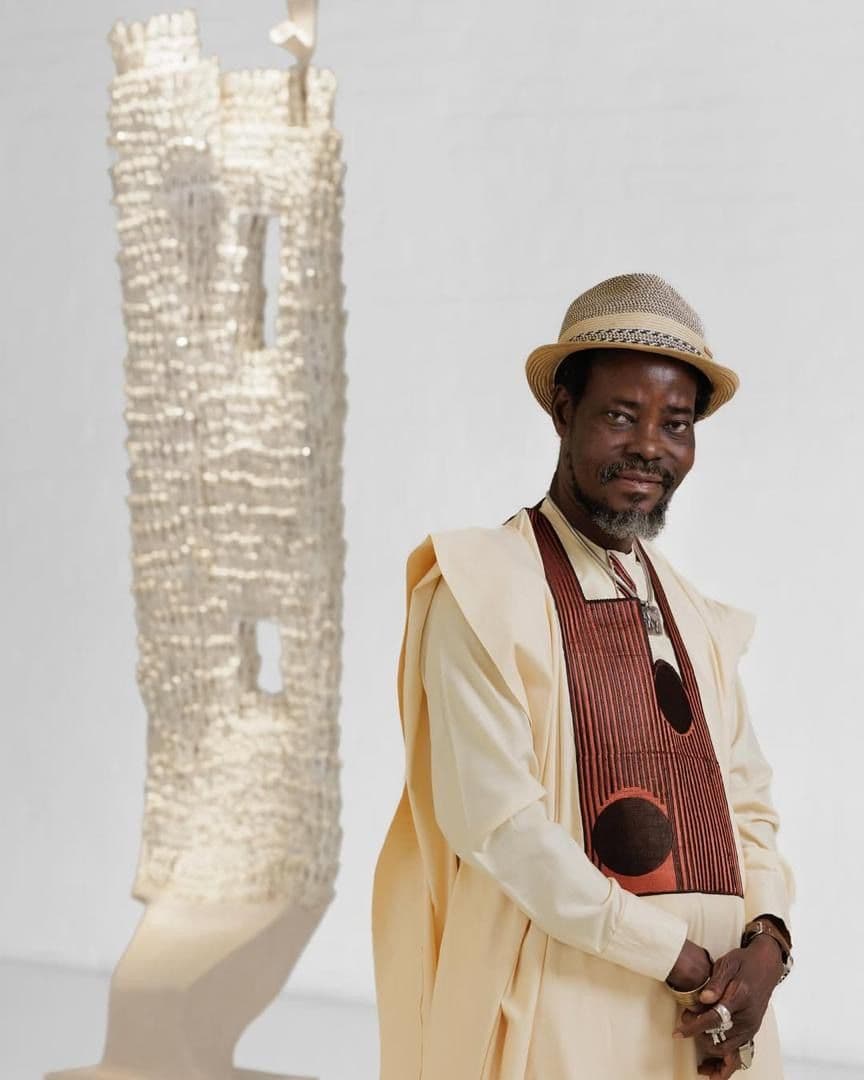
Dominique Zinkpè is a self-taught Beninese visual artist whose practice spans drawing, painting, sculpture, and installation, constructing a world of hybrid figures, mythical creatures, and spiritual presences that unsettles distinctions between human and non-human, sacred and ironic, personal and political. His imagery developed through a sustained engagement with the histories and belief systems around him, including Benin’s colonial past, its movement toward independence, and the mythological traditions that continue to shape cultural life. Rather than treating mythology as a separate realm from contemporary experience, Zinkpè uses it as a language through which the contradictions of everyday life can be examined.
The surreal qualities of his paintings emerge from this position. His chimeras and human-animal figures are not simply imaginative inventions; they allow multiple identities and opposing conditions to occupy the same body. Humour, unease, spirituality, sexuality, and social critique can coexist within a single figure, creating images that resist the explanatory limits of realism. The hybrid becomes a way of showing what ordinary categories cannot: the instability of identity, the persistence of belief, and the contradictions produced when different histories and social forces meet.
This capacity to hold contradiction also shapes Zinkpè’s sculptural practice. His large-scale installations made from hundreds of individually carved wooden statuettes draw from the Yoruba tradition of Ibéji figures, which are associated with the spiritual presence of deceased twins. Transformed into collective installations, the individual figures become part of something larger than themselves. Repetition produces accumulation, while the sheer number of bodies changes the relationship between sculpture and viewer. Rather than encountering a singular object, the viewer faces a gathering of figures whose collective presence suggests community, memory, and witness.

Photo Credit: Dominique Zinkpè
The reference to Ibéji is therefore part of a wider engagement with spiritual and cultural systems in which the boundary between the physical and the unseen remains porous. Zinkpè does not isolate these traditions as historical material. He places them within contemporary compositions and installations where questions of race, religion, sexuality, and power remain active. Spirituality and social critique consequently operate alongside one another, rather than occupying separate territories within the practice.
Satire is another means through which these tensions become visible. The exaggerated bodies and improbable creatures in Zinkpè’s work can appear humorous, but their distortions often direct attention toward social contradictions that are difficult to address through direct representation. The absurd becomes analytical. By altering the human figure, he creates enough distance to examine behaviours, beliefs, and power structures that might otherwise remain familiar and unquestioned.
His commitment to public access extends this impulse beyond the studio. In 1999, Zinkpè founded the Ayïzo — Œuvre de l’Esprit association and launched Boulev’art: Artists in the Street, bringing contemporary art into public spaces and closer to audiences in Benin. The project challenged the assumption that contemporary art belongs primarily within institutional spaces, creating another context in which artistic practice could encounter everyday life. This movement between gallery, street, sculpture, and painting reflects the openness of his practice itself, which resists confinement to a single medium or audience.
Over more than three decades, Zinkpè’s work has entered major international contexts, including exhibitions at Zeitz MOCAA in Cape Town, the Stedelijk Museum in Amsterdam, Kunsthalle Wien in Vienna, and the Havana Biennial. He received the Young African Talent Prize at the 1993 Grapholies Art Festival in Abidjan and the UEMOA Prize at the 2002 Dak’Art Biennial in Dakar for Malgré Tout!. In 2023, The Watchers was selected as a finalist for the LOEWE Foundation Craft Prize and received a special mention, extending the recognition of a practice that has continued to move between inherited traditions and contemporary forms.
Across Zinkpè’s work, mythology functions less as an escape from reality than as a way of entering it from another direction. The chimera, the hybrid body, the carved figure, and the satirical image allow histories and contradictions to exist simultaneously, without requiring them to settle into a single explanation. His practice suggests that myth can remain a living analytical language—one capable of carrying spiritual belief, cultural memory, humour, and political critique within the same form.