
Connect
© 2026 Kyekyekule Africa. All rights reserved.
kyekyekule.africa
© 2026 Kyekyekule Africa. All rights reserved.
kyekyekule.africa
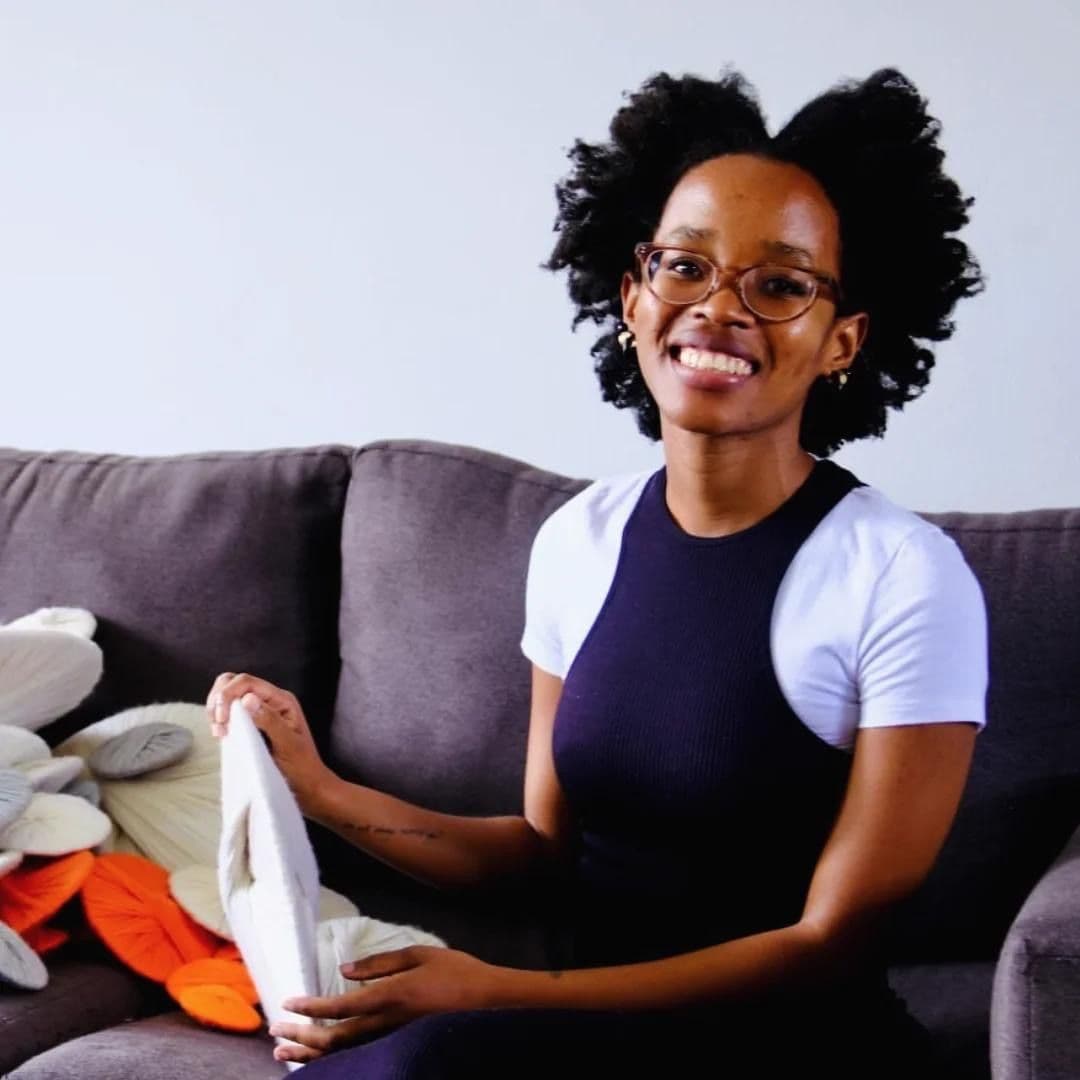
Textile Artist
South Africa
Wool, thread and fabric

Emmanuel Agyapong
Author
Published on:
September 18, 2026
DuduBloom More is a South African textile artist and printmaker whose practice uses wool, thread, fabric, and other textile materials to examine memory, identity, vulnerability, and self-understanding. Born in Soweto in 1990 and based in Johannesburg, More approaches these questions through processes of stitching, layering, building, and repetition, turning materials associated with softness and fragility into structures that can hold emotional and psychological weight. Her movement from printmaking into textile has become central to the way she gives physical form to experiences that are often difficult to articulate.
More trained at Artist Proof Studio, graduating as a printmaker in 2018 before completing a fourth year in Professional Practice in 2019. Her early engagement with drawing developed into printmaking, followed by experiments that brought painting and photography into conversation with thread. Rather than treating these shifts as separate stages, her practice shows an increasing interest in what happens when different materials and processes are brought together. Textile eventually became a primary language through which she could work with the relationship between vulnerability and strength.

Photo Credit: Courtesy of the Artist
That relationship is embedded in the physical act of making. More describes stitching and constructing with wool, thread, and fabric as a cathartic process. The materials can stretch, fray, knot, and break, but they can also be joined, reinforced, and built into something more durable. This tension gives the work its conceptual structure. Fragility is not presented as the opposite of strength; the two conditions exist within the same material and within the same process.
The circle is another recurring element in this vocabulary. Connected to growth and the cyclical nature of healing, the form introduces repetition and return into the work. A circle has no obvious beginning or end, making it useful for thinking about experiences that are not resolved in a single movement from difficulty to recovery. In More’s work, healing can instead be understood as something ongoing, involving revisiting, reconstruction, and change.
This emphasis on process also distinguishes her textile practice from an understanding of fabric as simply decorative or culturally referential. Thread records labour through every stitch, while layering creates accumulation over time. The physical construction of the work becomes inseparable from what it is trying to communicate. Memory, vulnerability, and self-understanding are not only subjects represented within the work; they are conditions enacted through the act of making.
Her 2020 body of work Delicate / Tendency / Response, developed during her Cassirer Welz Award residency and presented in a solo exhibition at Kalashnikov Gallery, marked an important point in this development. By the time of What Do I Dare To Say Out Loud? at Berman Contemporary in 2024, More’s practice had further consolidated its engagement with personal and emotional experience. The question embedded in that exhibition title points toward a recurring concern: the distance between what is experienced internally and what can be made visible or spoken.
In 2025, Contending With Control received the FAMM Women’s Prize as part of the Norval Sovereign African Art Prize. The recognition placed More among the artists shaping a wider conversation around contemporary African art and followed a period in which textile had become increasingly central to her practice. The award is significant not simply as a career distinction, but because it brings attention to a body of work in which material process is closely tied to questions of agency, vulnerability, and control.
That same year, More expanded her role within the arts through her curatorial debut, Happy Women’s Day, I Guess… at Berman Contemporary. Bringing together women artists to examine the complicated realities of womanhood in South Africa, the exhibition extended concerns already present in her own practice into a broader platform. Curating allowed her to consider these questions through the work of others, shifting her position from making an individual response to creating a space in which multiple perspectives could meet.

Photo Credit: Courtesy of the Artist
Her growing institutional and collection presence further situates the practice within a wider contemporary African art context. Her work is held in collections including the Art Bank of South Africa, the University of Cape Town Art Collection, JP Morgan Chase & Co., and the ARAK Collection in Qatar, while her exhibition history includes 1-54 London and New York, Art Cologne, and Investec Cape Town Art Fair. Her inclusion in the Norval Foundation’s Interior Weather exhibition alongside artists including Nicholas Hlobo, Wole Lagunju, Jody Paulsen, and Cassi Namoda places her textile practice within a broader conversation around interior states, materiality, and contemporary African experience.
More’s trajectory from drawing and printmaking toward textile is therefore not simply a change of medium. It reflects an expanding understanding of what material can do. Wool, thread, and fabric allow her to work slowly, to build through repetition, and to leave evidence of the hand within the finished work. The resulting surfaces hold both the vulnerability of their constituent materials and the strength created through their assembly.
What emerges from More’s practice is an understanding of vulnerability as something that can be constructed rather than merely represented. Each stitch joins one fragment to another; each layer carries the evidence of what came before. In moving from printmaking into textile and, more recently, into curating, More continues to ask how private experiences can become material, shared, and visible without losing their complexity.