
Connect
© 2026 Kyekyekule Africa. All rights reserved.
kyekyekule.africa
© 2026 Kyekyekule Africa. All rights reserved.
kyekyekule.africa
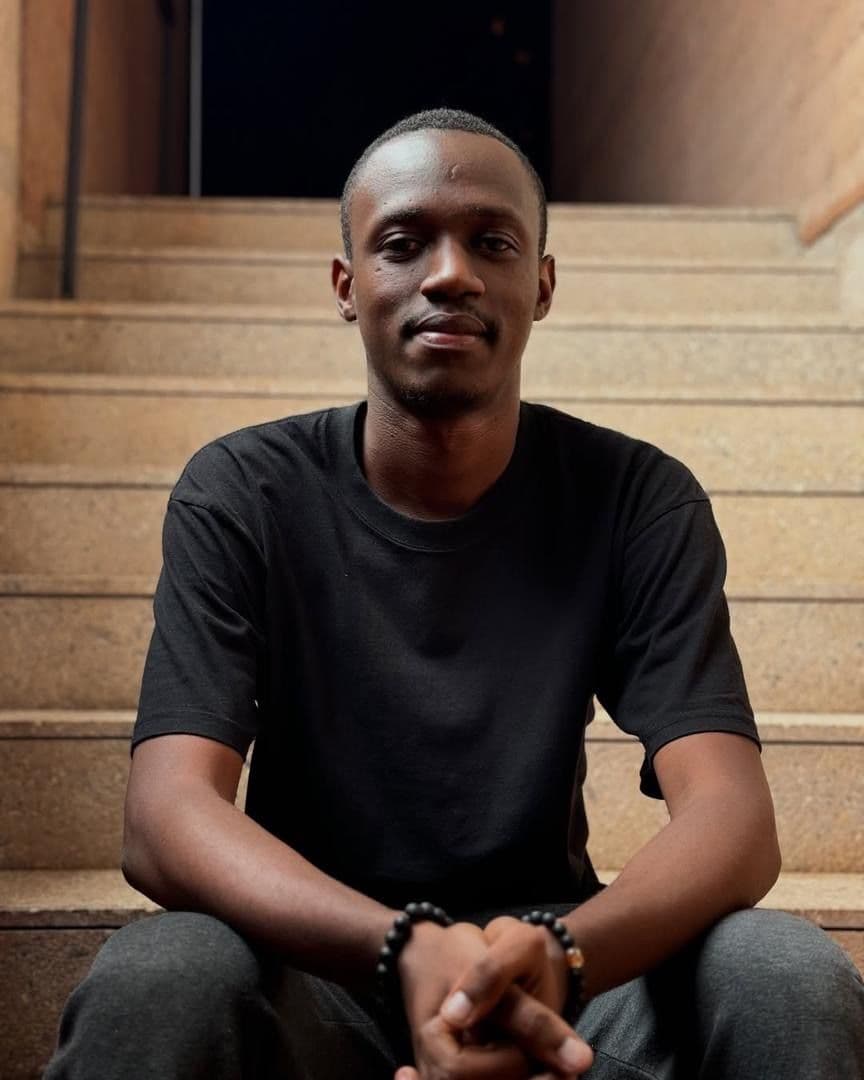
Multidisciplinary Artist
Rwanda
Combination of Oil, Acrylic, & Watercolor

Emmanuel Agyapong
Author
Published on:
July 15, 2026
Dusabe King Christian is a Rwandan multidisciplinary artist born in 1996 whose practice moves across oil, acrylic, watercolour, ballpoint pen drawing, and digital art, with the human figure and portrait at its centre. Across these mediums, he examines social identity, personal history, and fragmented memory as ways of understanding how people construct a sense of who they are and where they come from. His figures remain recognisable even as colour, shape, and surface become increasingly exploratory, creating a tension between the stability of the human form and the instability of the experiences that shape it.
Fragmentation is central to this process. King Christian’s paintings and drawings suggest that memory rarely exists as a complete or orderly record; it arrives through isolated images, sensations, encounters, and inherited stories that must be continually assembled into meaning. His formal evolution reflects this condition. Rather than treating a recognisable figure as a fixed endpoint, he allows it to become a structure through which colour, abstraction, distortion, and interruption can enter. The work therefore remains figurative without becoming dependent on literal representation, allowing the instability of memory to influence the way the figure itself is constructed.
His use of different mediums extends rather than divides this inquiry. Ballpoint pen drawing introduces a controlled accumulation of marks, while digital art allows for another kind of manipulation and reconstruction. Oil, acrylic, and watercolour each offer different relationships to surface, colour, transparency, and gesture. These distinctions matter formally, but they remain connected by the same underlying concern: how experiences become internalised and how those accumulated fragments can be translated into an image of the self. Medium becomes a means of testing different ways that memory and identity might take visual form.

Photo Credit: Dusabe King Christian
Rwandan culture and everyday life provide an important ground for this exploration. King Christian draws from a society whose present remains closely connected to a complex historical inheritance, allowing cultural experience to enter the work without being treated as an archival subject. Everyday life becomes part of how memory is formed and carried, while nostalgia operates not simply as a longing for the past but as a way of negotiating what remains from it. His figures consequently occupy both personal and cultural time, carrying experiences that belong to the individual while remaining shaped by the environment from which that individual emerges.
This relationship between personal memory and collective history gives his portraits their particular tension. The figure can appear intimate while still carrying broader questions about belonging, inheritance, and social identity. Rather than proposing a single, stable definition of what it means to be Rwandan, King Christian allows identity to remain layered and unfinished. Cultural inheritance is present, but it is continually interpreted through individual experience. The work suggests that where we come from is not simply a fact of origin; it is something repeatedly reconstructed through memory, circumstance, and the stories we continue to tell ourselves.
King Christian’s formal training at École d’Arts de Nyundo, where he studied from 2015, provides an important foundation for this development. The institution has played a significant role in Rwanda’s artistic landscape, and his training there established a technical grounding from which his practice could continue to expand across materials and approaches. What has followed is not a departure from figurative practice but a widening of its possibilities, with each formal shift allowing him to examine the figure from another angle.
His exhibition history reflects that development. His participation in the 2020 International Art Biennial in Serbia was followed by exhibitions at the Museum of African Art in Belgrade in 2023, the King’s Palace Museum in Nyanza and the Kigali Triennial in 2024. In 2025, he co-curated Behind the Hills with Mitochondria Gallery in Houston and participated in FUTURE FAIR in New York and the Atlanta Art Fair, extending his practice into international institutional, curatorial, and commercial contexts. These engagements indicate a trajectory that is increasingly international without separating the work from the cultural and personal questions that give it its foundation.
Across King Christian’s practice, the fragment becomes a way of resisting the idea that identity can be reduced to a single image or narrative. Memory is partial, culture is continuously interpreted, and the self changes as experience accumulates. His evolving visual language makes that process visible by allowing the figure to remain recognisable while everything around and within it shifts. What emerges is not a portrait of identity as something already known, but an image of identity as an ongoing construction—assembled from what is remembered, inherited, experienced, and sometimes only partially understood.