
Connect
© 2026 Kyekyekule Africa. All rights reserved.
kyekyekule.africa
© 2026 Kyekyekule Africa. All rights reserved.
kyekyekule.africa
Multidisciplinary Artists
Tunisia
Calligraphy, Graffiti, Murals, Sculpture, & Public Art

Emmanuel Agyapong
Author
Published on:
May 14, 2026
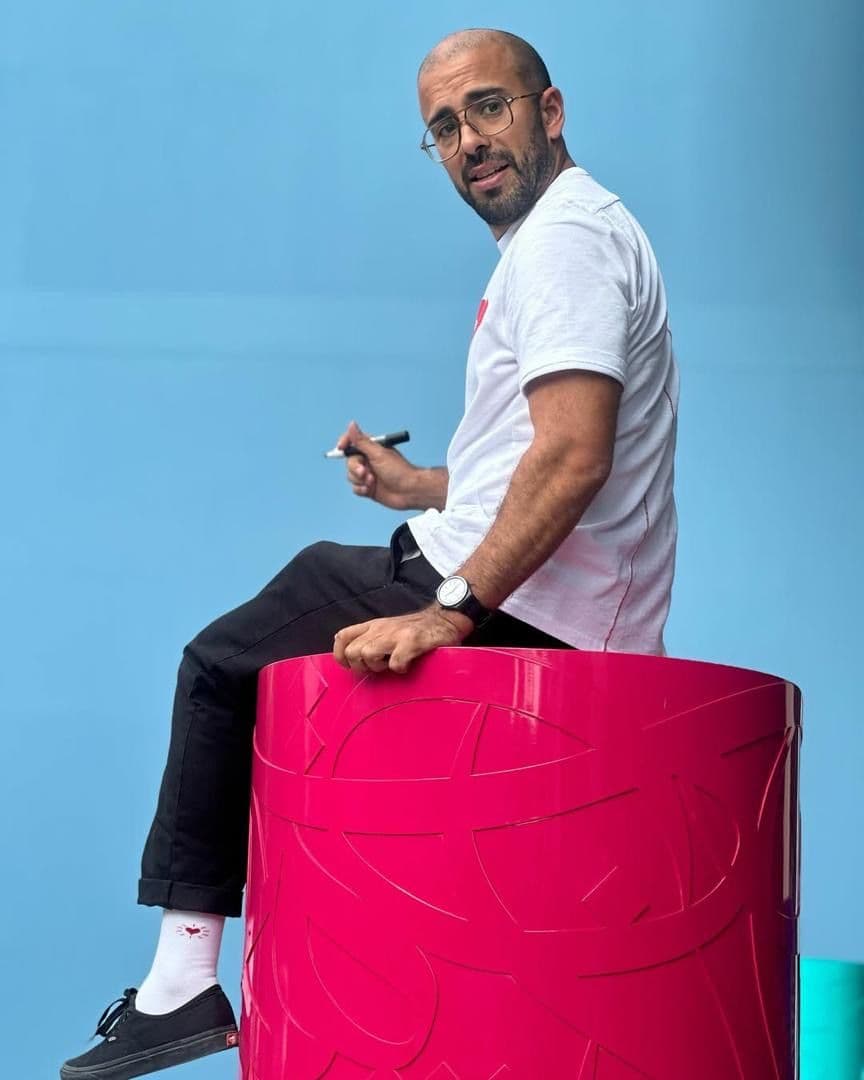
eL Seed is a Franco-Tunisian artist born in Le Chesnay in 1981 whose practice spans calligraffiti, large-scale murals, sculpture, and public intervention, using Arabic script as both visual architecture and a way of questioning how language, culture, and identity occupy public space. Across his work, Arabic is not simply a medium of inscription. It becomes a means of asserting presence in places where the language has often been associated with threat, foreignness, or absence.
Calligraffiti, the form with which eL Seed is closely identified, brings the movement of Arabic calligraphy into conversation with the scale and spatial directness of street art. The relationship is more than formal. Classical calligraphy and graffiti both depend on the act of occupying space, transforming surfaces into sites of expression and making writing visible beyond the institutions traditionally associated with art. eL Seed’s work extends this shared logic into the public realm, where the choice of language carries social and political meaning.
This becomes particularly evident in Perception, his large-scale intervention across approximately fifty buildings in Cairo’s Manshiyat Nasr community. Home to the Zabbaleen, a community whose residents collect and recycle much of the city’s waste, the neighbourhood has often been represented through narratives of poverty, marginality, and disorder. eL Seed approached it differently. His calligraphic composition stretches across the architecture of the community and becomes legible as a unified image only from a specific elevated vantage point.

Photo Credit: eL Seed
The significance of the work lies partly in that requirement. From the ground, the individual buildings appear fragmented; from the correct position, they form a coherent whole. The viewer must physically change their perspective before the image becomes visible. In this sense, Perception does not simply depict a community. It constructs a condition for seeing it differently. The work makes the limitations of the viewer’s initial position part of the subject itself: what appears fragmented from one place can become coherent from another.
That gesture runs through eL Seed’s wider practice. His interventions often place Arabic script within architectural and cultural contexts where it carries histories of migration, belonging, exclusion, and political association. The walls become more than surfaces for calligraphy; they become meeting points between language and place. Writing across them allows a language that is frequently encountered through political representation to exist instead as form, poetry, movement, and public presence.
His recognition has followed the growing international reach of this practice. Named a Global Thinker by Foreign Policy in 2016, a TED Fellow in 2015, and recipient of the UNESCO Sharjah Prize for Arab Culture in 2017, eL Seed has produced work across cities including Paris, London, New York, Cape Town, Rio de Janeiro, Seoul, and Doha. Each location brings a different architectural and political context, but the underlying concern remains consistent: how can art alter the way a place is read, and what happens when language changes the terms through which that place is encountered?
eL Seed’s work ultimately treats perception as something that can be constructed, interrupted, and revised. His calligraphy asks viewers to slow down, decipher, reposition themselves, and recognise meaning where they may not have expected to find it. The invitation to look again is therefore not passive. It is a demand to reconsider the assumptions that shaped the first view—and to recognise that seeing a place, a language, or a community differently may begin with changing where we stand.