
Connect
© 2026 Kyekyekule Africa. All rights reserved.
kyekyekule.africa
© 2026 Kyekyekule Africa. All rights reserved.
kyekyekule.africa
Painter
Ghana
Hyperrealistic Drawing & Painting

Emmanuel Agyapong
Author
Published on:
August 31, 2026
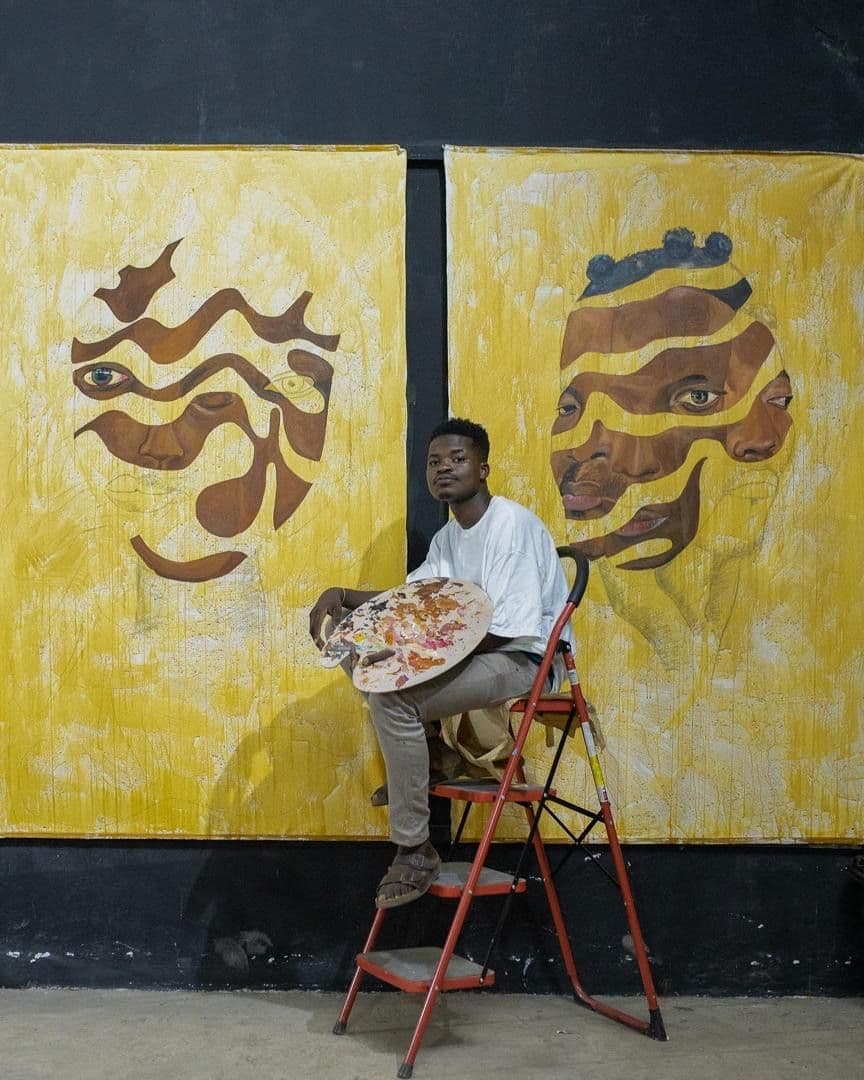
Emmanuel Kwabena Lartey is a Ghanaian painter and visual artist born in 1995 and raised in Ashiaman, Accra, whose practice has developed from hyperrealistic drawing and painting into large-scale mixed media works that use paint, texture, and layered mark-making to bring obscured faces and stories into view. At the centre of this practice is a question that extends beyond portraiture: what does it mean to honour the humanity of Black people whose lives have been diminished or taken by systemic violence, and what can the painted face make visible that a statistic, photograph, or news report cannot?
Lartey’s earlier engagement with hyperrealism remains important to understanding the work he makes now. His attention to facial structure, expression, and individual presence has carried into his layered canvases, even as the surface has become more fragmented and materially complex. The face remains the point at which the viewer encounters the person. What has changed is the way that encounter is constructed. Instead of presenting a subject through a single uninterrupted image, Lartey builds and obscures the surface, requiring the viewer to negotiate what is visible and what remains partially concealed.
That tension between visibility and erasure is central to his treatment of systemic racism and police brutality in West Africa and the United States. The people within these paintings are not presented simply as representatives of a social issue. They are rendered as individuals whose identities precede the circumstances through which they may have become publicly known. This distinction matters. Systems of violence can reduce human lives to numbers, headlines, footage, and categories; Lartey’s paintings move in the opposite direction, returning attention to the face and insisting on the specificity of the person behind the record.

Photo Credit: Emmanuel Kwabena Lartey
The material structure of the paintings reinforces this position. Layers of paint and texture interrupt the image without completely surrendering it, creating surfaces that must be examined rather than immediately consumed. The viewer is asked to look through, around, and into the marks to find the figure. This act of looking becomes part of the work’s meaning. Visibility is not given easily, and neither is recognition. The time required to locate the face echoes the sustained attention Lartey gives to the people he paints.
His own path into the practice adds another dimension to this commitment. Before and alongside his development as an artist, Lartey worked as a shopkeeper and factory maintenance technician, pursuing his artistic practice outside a straightforward institutional pathway. He graduated in Painting and Drawing from Takoradi Technical University in 2017, developing from the technical discipline of drawing and hyperrealistic painting toward the more materially layered language that defines his current work.
The practice has since expanded through exhibitions, residencies, and collaborations in Ghana. His participation in the Noldor Artist Residency, Art x Ink, and the Black Festival in Accra, alongside inclusion in African Everywhere with Fifty Four Magazine and presentations through Art Perspective Gallery, reflects a practice increasingly situated within wider conversations around representation, history, and contemporary Black experience. Yet the paintings remain grounded in the same fundamental act: looking closely at a face and refusing to allow it to disappear into abstraction.
Lartey’s work ultimately makes portraiture a form of resistance. The resistance is not only in the subjects he chooses or the systems he addresses, but in the insistence that every face deserves time, specificity, and attention. His layered canvases do not allow the viewer to move quickly past the people within them. They ask us to look until the figure becomes more than evidence of violence—to encounter, instead, the person that violence could never fully reduce to a statistic.