
Connect
© 2026 Kyekyekule Africa. All rights reserved.
kyekyekule.africa
© 2026 Kyekyekule Africa. All rights reserved.
kyekyekule.africa
Contemporary Painter
Zambia
Acrylic, Plaster, Canvas, & Cloth.

Emmanuel Agyapong
Author
Published on:
May 26, 2026
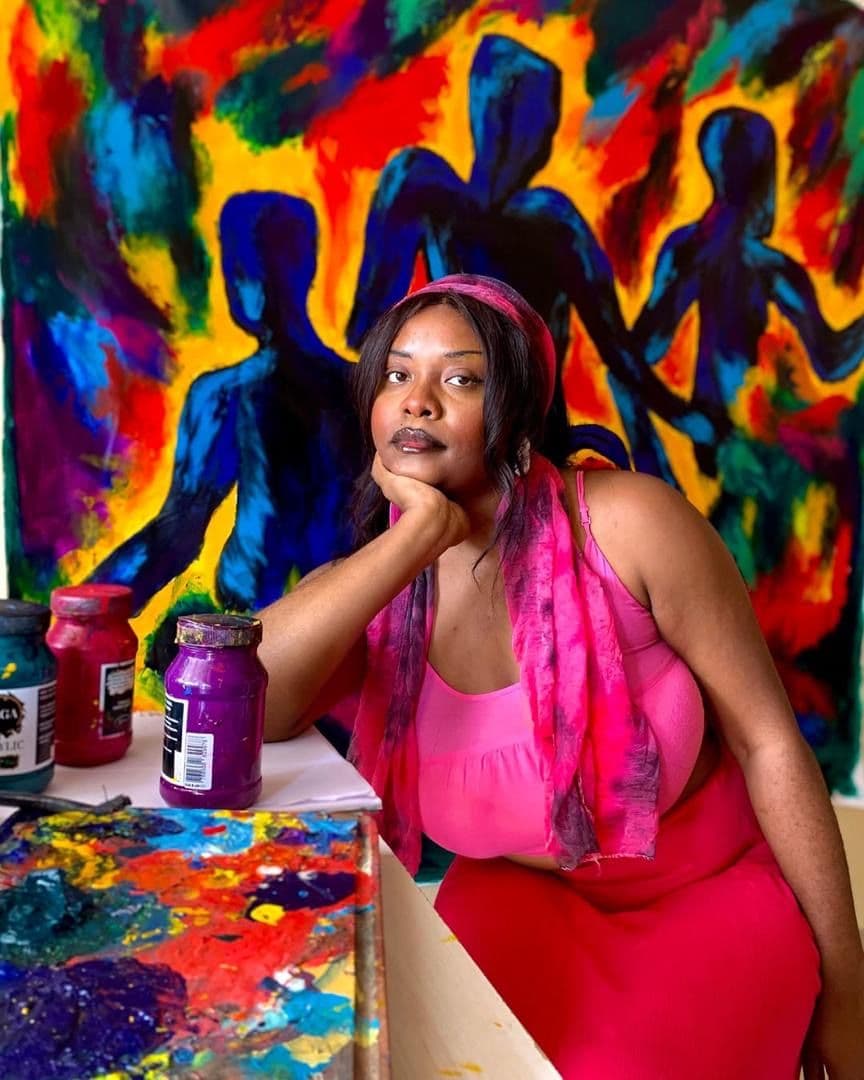
Erica Kapaya is a Zambian painter born in Kabwe in 1998 and based in Lusaka whose practice uses acrylic, plaster, canvas, and cloth to construct large figurative compositions concerned with vulnerability, self-discovery, identity, and the complexity of human relationships.
Kapaya’s surfaces are central to how these concerns take form. Layers of plaster and cloth sit beneath and alongside the paint, giving her compositions a physical depth that resists the flatness of illustration. The materials carry part of the emotional weight of the figures, while expressive brushwork and bold colour translate interior states into something visible without reducing them to a single emotion or narrative.
Her figures and silhouettes occupy the canvas with considerable scale, but their presence is not theatrical. Instead, they create a space for experiences that are often difficult to articulate: uncertainty, intimacy, vulnerability, and the shifting ways people understand themselves in relation to others. Kapaya does not treat these states as fixed subjects. They remain unresolved within the image, allowing the viewer to encounter feeling as something still being formed.

Photo Credit: Erica Kapaya
Self-taught and drawing from a creative practice that began in childhood, Kapaya has developed her approach to painting alongside work as an art teacher and workshop facilitator. That engagement with younger artists extends a central concern of her studio practice—the creation of spaces where questions of identity and expression can be explored without requiring immediate resolution. The act of making and the act of learning therefore occupy related territory in her work: both create conditions for looking inward and making that experience visible.
Her 2024 solo exhibition As We Are at Alliance Française de Lusaka, which attracted more than 400 visitors, brought these concerns together in a sustained presentation of her practice. The title itself points toward one of its central tensions: the distance between how people are perceived and the more complicated reality of how they experience themselves. Rather than resolving that distance, Kapaya’s paintings remain within it, using the figure as a site where private feeling and outward appearance meet.
At this stage of her practice, Kapaya is developing a visual language in which material, scale, and gesture work together to consider what it means to encounter another person without reducing them to what can be immediately understood. Her paintings leave that encounter open, asking not simply how we see others, but what might become visible when we allow a person—and ourselves—to remain unresolved.