
Connect
© 2026 Kyekyekule Africa. All rights reserved.
kyekyekule.africa
© 2026 Kyekyekule Africa. All rights reserved.
kyekyekule.africa
Visual Artist / Sculptor
Togo
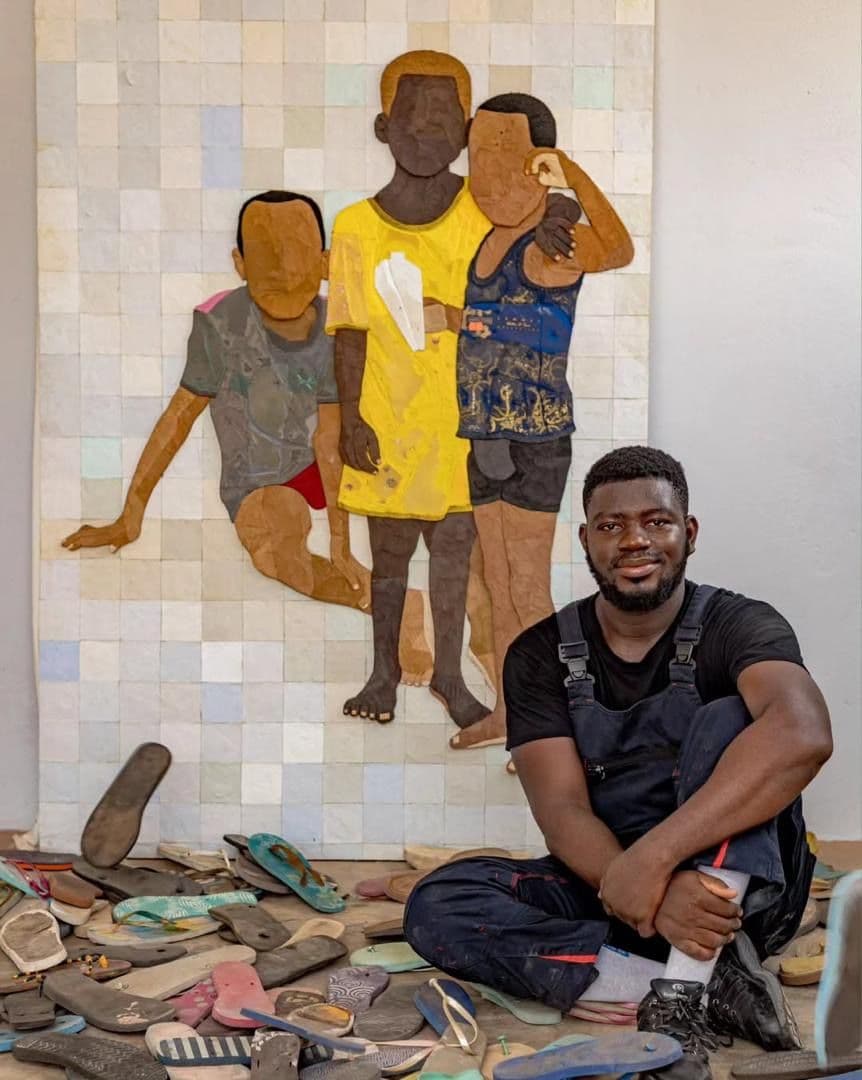
Collected flip-flops and sandals from the streets of Lomé, sculpted, cut, and assembled on canvas to create large figurative portraits.

Emmanuel Agyapong
Author
Published on:
July 31, 2026
Foli Kossi Gérard Tete, is a Togolese visual artist and sculptor whose practice transforms discarded flip-flops and sandals collected from the streets and dumps of Lomé into large-scale figurative works addressing the lives of Togo’s street children. His portraits are constructed from the very material associated with disposal, creating a direct relationship between the objects that society throws away and the people whose lives his work brings into focus. Environmental pollution, child poverty, social invisibility, and the possibility of a different future are therefore not separate subjects within the practice; they are embedded in the material and structure of the work itself.
The method emerged from a practical disruption that became a defining artistic shift. Before 2020, Tesprit worked primarily with acrylic and oil paint, but the COVID-19 pandemic restricted access to conventional art supplies. He turned instead to discarded rubber soles, collecting them from Lomé and experimenting with their potential as a medium. What began as a response to material scarcity developed into a practice in which the physical history of the material became inseparable from the subject being represented. The flip-flop, once worn and abandoned, moves from the street into the studio and is given another function through the act of making.
The faces in Tesprit’s portraits are deliberately obscured. Rubber soles are cut into pieces and assembled across the surface until the figure is recognisable but the face remains hidden, creating a tension between presence and concealment. The decision is particularly significant in relation to the Dzimakplao, the street children of Togo, whose name in Mina, a language spoken in southern Togo, refers to children without education. Their social condition is marked by a contradiction that Tesprit makes physical: they are visible within public space while remaining overlooked within the structures of society.

Photo Credit: Foli Kossi Gérard Tete
His tightly framed, frontal compositions intensify that contradiction. The figures face the viewer directly, but the concealed faces interrupt the conventional exchange expected of portraiture. There is no easy access to individual identity, and no possibility of reducing the subject to a sentimental image of childhood hardship. Instead, the viewer encounters bodies that insist on being seen while withholding the visual information through which recognition is usually established. The obscured face becomes both a representation of social invisibility and a refusal to make that invisibility comfortable.
The material itself extends the argument. Every sole carries a previous history of movement, use, wear, and abandonment before entering the composition. Once cut and assembled, these fragments form bodies and faces, turning objects associated with waste into the primary substance of representation. Pollution and poverty consequently meet on the same surface: the environmental consequences of consumption become materially connected to the social consequences of neglect. The work does not need to illustrate these relationships separately because the material already contains them.
This relationship between material and subject also shifts the idea of value. The discarded flip-flop is treated as something capable of becoming part of a carefully constructed image, while the children represented through that material are positioned at the centre rather than the periphery of the composition. Tesprit’s practice therefore asks questions about what societies classify as disposable, and how those classifications extend beyond objects to people, communities, and futures. Transformation becomes both an artistic process and a social proposition.
Tesprit’s work has been exhibited across Togo, Benin, Ghana, Senegal, France, and Italy, including presentations at Gallery Soview in Accra and Galerie Artco in Brussels. In 2020, he was also selected for Swatch’s Swatch x You project, extending his practice into an international design context. These exhibitions have brought his material language into different cultural settings while retaining its grounding in the streets and social realities of Lomé.
His plans to establish a training centre for street children extend the concerns of the studio into direct community engagement. The initiative connects representation with practical opportunity, continuing a central principle of the practice: that visibility has greater consequence when it is accompanied by the possibility of participation and change.
Across Tesprit’s work, discarded rubber becomes more than an unconventional medium. It becomes evidence of the systems through which objects are consumed and abandoned, while the obscured faces of his figures point toward people who can occupy the same public spaces yet remain socially unseen. By bringing the discarded material and the overlooked subject into the same composition, Tesprit makes their relationship difficult to separate—and asks what it means to recognise value in what a society has learned to overlook.