
Connect
© 2026 Kyekyekule Africa. All rights reserved.
kyekyekule.africa
© 2026 Kyekyekule Africa. All rights reserved.
kyekyekule.africa
Multidisciplinary Artist
Eritrea
Powder pigment, oil stick, acrylic paint, & charcoal

Emmanuel Agyapong
Author
Published on:
September 11, 2026
Freya Tewelde is an Eritrean multidisciplinary artist based in London whose practice has moved across painting, moving image, sound, installation and performance. In recent years, her work has focused primarily on painting. Working with powder pigments, oil stick, acrylic paint, and charcoal, she constructs layered surfaces in which colour, gesture, interruption, and accumulation become ways of approaching experiences that cannot be fully contained by figurative representation. Her paintings do not offer abstraction as an escape from lived reality; they use it as a language for realities that remain partly invisible, remembered through the body, inherited through culture, or encountered through spiritual and psychological experience.
The physical process of making is central to how these paintings develop. Tewelde generally works with her canvases laid across the floor, allowing gravity, movement, orientation, and her own physical relationship to the surface to influence the image. Paint and pigment are accumulated, disrupted, softened, and returned to, creating compositions that carry evidence of repeated intervention rather than a single decisive gesture. The canvas consequently becomes less a passive support than a space of encounter, where the image develops through movement between control and unpredictability.
This relationship between physical process and abstraction is important because Tewelde’s work is concerned with forms of experience that are difficult to locate in a fixed image. Memory does not always arrive as a complete scene; it can emerge through fragments, sensations, colours, associations, and bodily responses. Her layered surfaces operate through a similar logic. A mark can remain visible beneath another; an earlier gesture can be partially obscured without disappearing entirely; colour can suggest a relationship without establishing a literal subject. The paintings therefore behave less like illustrations of memory than like material records of its accumulation.
Her research into psychoanalysis, spirituality, anthropology, hidden energies, and cosmic influence provides another framework for understanding this approach. In the 2024 exhibition Dare to Journey into the Unknown at Bomb Factory, these ideas informed a group of paintings that explored the relationship between psychological experience and forces beyond immediate perception. Works such as Mirage of the Inner World and Exploring the Complexity of Musica Universalis occupy an uncertain territory between the microscopic and the cosmic, the psychological and the spiritual. Their ambiguity is deliberate: the image does not need to identify precisely what is being represented in order to make the experience of searching for it visible.
The idea of the unseen becomes particularly significant within Tewelde’s diasporic experience. Born in Eritrea, raised in Saudi Arabia, and now based in London, her life has unfolded across different cultural and geographical environments. Rather than treating these movements simply as biographical facts, her practice considers how memory and identity persist when a person exists between places. Diaspora can produce distance from an original landscape while simultaneously intensifying its presence in memory. Abstraction gives Tewelde a way to work within that distance, allowing places, histories, and inherited forms of knowledge to remain present without requiring literal reconstruction.
Archival imagery enters this process as another fragment of what has been carried forward. Within her wider multidisciplinary practice, photographs and historical references become material that can be interrupted, layered, and placed into new relationships. The archive is therefore not presented as a complete account of the past. It becomes another unstable surface through which memory can be examined, alongside pigment, gesture, sound, and movement. What is remembered and what is documented do not necessarily coincide, and Tewelde’s practice operates within that gap.
Her development has also involved a gradual movement away from more recognisable figuration toward increasingly abstract forms. This shift is not a rejection of the figure so much as a reconsideration of what the figure can communicate. As her practice has developed, bodily and psychological experience have become increasingly translated into rhythm, colour, surface, and gesture. The move toward abstraction allows her to address transformation and memory without requiring them to be attached to a clearly identifiable body or narrative. The unseen becomes not a subject outside the painting, but something embedded in how the painting is constructed.

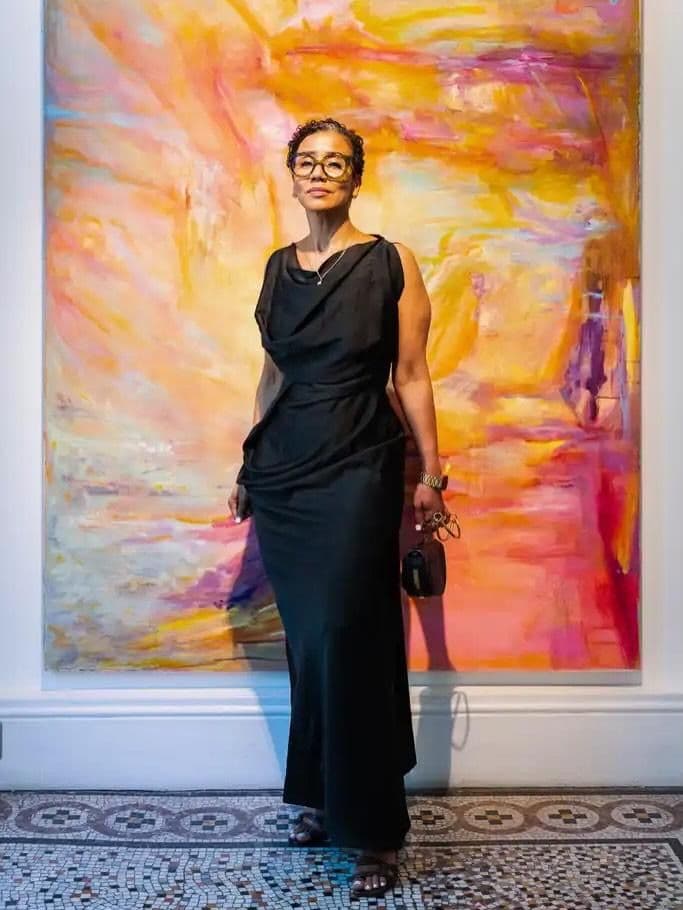
Installation shot of Freya Tewelde’s ‘Geometry of Elsewhere’ exhibition at Gallery 1957, London. Courtesy of the Artist & Green Family Art Foundation.
That development is particularly visible in her recent body of work Geometry of Elsewhere, presented in her 2026 solo exhibition at Gallery 1957 in London. Developed between 2025 and 2026, the paintings mark a significant new direction in her practice, moving further into layered explorations of rhythm, gesture, emotional memory, and transformation. The exhibition’s title itself suggests a tension between structure and displacement: geometry implies order, while elsewhere implies a place that cannot be fully located. Tewelde’s paintings occupy that contradiction, creating visual structures from experiences shaped by movement, uncertainty, and the persistence of memory across distance.
Individual works such as Fragments Toward the Unseen and of water, both from 2025, demonstrate the material range of this direction. Powder pigment, oil sticks, and acrylic are built into surfaces that appear simultaneously worked and unsettled, with layers suggesting processes of addition, erasure, and return. The materials retain their physical presence, but they do not settle into a single descriptive image. Instead, they create conditions in which the viewer moves between recognition and uncertainty, allowing the act of looking to become part of the work’s inquiry.
Tewelde’s growing recognition reflects the development of a practice increasingly engaged with these questions. She completed an MA in Fine Art at Chelsea College of Arts in 2018, and in 2024 was selected by British artist Barbara Walker RA for Flowers Gallery’s Artist of the Day presentation. Her work was subsequently included in wider discussions of emerging contemporary artists, while her 2026 solo exhibition Geometry of Elsewhere at Gallery 1957 provided a substantial platform for the new direction of her painting. These contexts place her work within an expanding international conversation while retaining the specificity of a practice shaped by migration, memory, and the search for forms of knowledge that remain difficult to make visible.
Across Tewelde’s work, abstraction becomes a method of approaching what cannot be adequately described through representation alone. Her paintings do not ask the viewer to identify a single subject and arrive at a fixed interpretation; they create spaces in which memory, spirituality, psychological experience, and inherited histories can coexist without being resolved. The movement from figuration toward the unseen is therefore not a move away from human experience, but deeper into it. Tewelde’s paintings suggest that some of what shapes us cannot be pictured directly, but can still leave a trace—in colour, in gesture, in material, and in the spaces between one layer of memory and the next.