
Connect
© 2026 Kyekyekule Africa. All rights reserved.
kyekyekule.africa
© 2026 Kyekyekule Africa. All rights reserved.
kyekyekule.africa
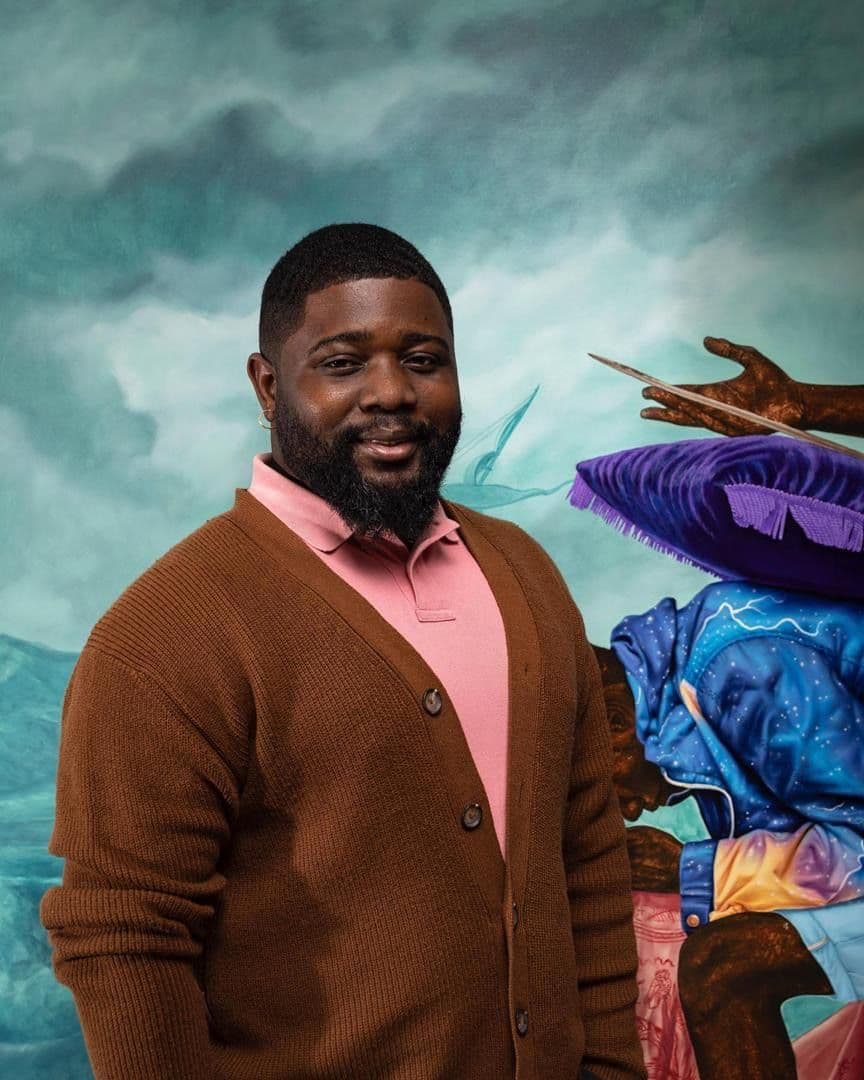
Painter
Congo
Acrylic & Oil on canvas

Emmanuel Agyapong
Author
Published on:
October 30, 2026
Hilary Balu, a Congolese painter examines how colonial history, consumer culture and the circulation of images shape contemporary African identities. Working primarily with acrylic and oil on canvas, he combines carefully rendered figures with objects drawn from everyday life and cultural tradition, constructing scenes in which a tourist bag, a traditional sculpture or a motorcycle helmet can carry histories beyond its immediate use.
His paintings approach migration not simply as movement between places, but as a response to the world’s people are taught to imagine.
The Objects That Tell a Larger Story

Hilary BALU 2019 “(series: Trapped in the dream of the other )” Courtesy of the Artist
Balu’s visual language developed through a reconsideration of the artistic conventions he encountered during his studies at the Academy of Fine Arts in Kinshasa. A conversation with fellow Congolese artist Vitshois Mwilambwe Bondo prompted him to question the Western codes and techniques that had shaped his academic training. He began looking for a language more closely connected to Congolese experience and the wider cultural histories of Africa.
That shift is visible in the objects that populate his paintings. Traditional statuettes appear alongside tourist bags, flip-flops and other products associated with global consumer culture. These things do not occupy separate worlds. Balu places them together, asking how inherited cultural knowledge persists within societies transformed by international markets, political upheaval and changing ideas of progress.
The recurring reference to the Nkisi Mangaaka, an ancestral Kongo power figure, is particularly significant. Its presence alongside consumer goods creates a contrast between objects embedded in cultural and spiritual systems and those circulating through contemporary commerce. Yet the juxtaposition is not simply a contest between tradition and modernity. Balu’s compositions suggest that both belong to the same contemporary reality, where older forms of knowledge continue to exist alongside imported images and aspirations.
His treatment of the painted surface adds another dimension. Balu scratches into acrylic to develop the appearance of skin, making the physical surface of the painting part of its representation of the body. This technique gives his figures a distinct material presence while bringing the question of Black representation into the construction of the image itself.
Voyage vers Mars : Migration as a Journey to Another World

Hilary BALU 2020 “(series: Voyage vers Mars 4 )” Courtesy of the Artist
In Voyage vers Mars (2020), Balu transforms contemporary migration into a journey through outer space. His figures become cosmonauts leaving a place made uninhabitable by conflict and economic hardship. The destination is imagined as another planet, a world sufficiently distant from the present circumstances to promise a different life.
The travellers’ luggage complicates that promise. Their bags display images of international capitals, drawing on the visual language of tourism and the circulation of desirable destinations. The same objects that suggest leisure and mobility accompany people whose departure is driven by necessity. The contrast exposes a divide between the freedom to travel and the conditions that compel people to leave.
Balu’s use of space travel makes this divide visible without relying on documentary realism. The planetary journey turns migration into an encounter with the imagination itself: what does a person believe exists elsewhere, and how are those beliefs formed? Images of prosperous cities, consumer goods and foreign lifestyles can make distant places appear accessible and desirable, even when the realities of reaching them are dangerous.
The series therefore examines more than the decision to migrate. It considers the distance between a place as it is experienced and a destination as it is imagined. The cosmonauts travel towards a future constructed partly through images, carrying the material signs of the world they hope to enter.
The Sea as Promise and Historical Record

Hilary BALU, “Nzambe Ako Sala (Dieu Pourvoira), 2021 “(series: In the floods of illusions) Courtesy of the Artist
In the Floods of Illusions, Balu moves the journey from outer space to the sea. Oceans, ports and waves become sites where aspiration encounters danger, and where contemporary migration meets longer histories of displacement and exchange.
Water holds contradictory meanings in this work. It can suggest passage, transformation and the possibility of reaching another shore, but it is also a site of loss. For migrants undertaking dangerous crossings, the sea separates the imagined destination from the risks of reaching it. In Balu’s paintings, that uncertainty is inseparable from the histories carried by the water itself.
His approach draws on the relationship between contemporary migration and the transatlantic slave trade. The sea is not a neutral expanse between continents: it has been a route for commerce, conquest and the forced movement of African people. By placing present-day journeys within this history, Balu complicates the idea that migration towards the West represents a wholly new search for opportunity.
This historical dimension is particularly evident in Nzambe Ako Sala (Dieu Pourvoira) (2021), from In the Floods of Illusions. The title translates from Lingala as “God Will Provide.” Made with acrylic, oil and scraping on canvas, the work measures 176 × 238 cm and centers the sea within a scene populated by carefully selected objects, including a saber, a Supreme motorcycle helmet and a wooden statuette.
These objects resist a single, immediate reading. The saber evokes violence; the branded helmet introduces the visual language of contemporary consumer culture; the statuette carries a different set of cultural associations. Their presence within a composition concerned with migration places different histories and systems of value in proximity. The figures’ hopes for another life unfold against a visual field shaped by both historical violence and present-day aspiration.
Balu’s treatment of the sea also recalls the dramatic movement of nineteenth-century European maritime painting. The carefully rendered waves and merging sky and water create an atmosphere in which the landscape seems to exceed the control of the figures within it. Yet the reference to European painting is not merely stylistic. It raises a question about who has historically represented the world, and whose experiences those images have served.
From Fantasy to Escape

Hilary BALU 2023, “(series: From Fantasy to Escape )” Courtesy of the Artist
In From Fantasy to Escape, Balu turns towards the histories connecting Africa, Europe and the Americas. The series considers the transatlantic slave trade and the role of European representations of the Americas in constructing ideas of distant lands as exotic, abundant and available for conquest.
His engagement with the Dutch painter Frans Post is central to this inquiry. Post’s seventeenth-century landscapes of Brazil are often associated with the visual recording of the region. Balu revisits this imagery to question what a landscape painting can conceal when it presents a territory as scenery while leaving the violence that made its colonial occupation possible outside the frame.
As Balu has explained, the apparently natural world in these paintings is also a colonial construction: a space made available to the European gaze and tied to an economic system dependent on the exploitation of African bodies. Reworking this imagery becomes a way to challenge the visual conventions through which colonial power represented both land and people.
The connection to contemporary migration is pointed. Balu asks why the West continues to function as an imagined destination for many Africans, even as its historical relationship with the continent remains marked by extraction, enslavement and unequal power.
The journeys of the present are not equivalent to the forced crossings of the past, but his work places them in a shared historical field where images of opportunity coexist with the legacies of violence.
Across these series, Balu treats representation as part of the subject rather than a neutral means of describing it. The images people inherit, consume and encounter can shape how they understand other places—and how they understand the possibilities available to them.
Painting Against a Fixed Image of Africa

Courtesy of the Artist
Balu’s practice brings together personal artistic development and a wider question about cultural representation. His early interest in cinema, trailers, posters and his father’s drawings established an engagement with images long before his formal training. His later work examines the power such images hold over the imagination, particularly when they influence how people picture places beyond their immediate experience.
His exhibition history has brought these concerns into different institutional contexts. He participated in Congo Stars at Kunsthaus Graz in 2018–2019, Fiction Congo at Museum Rietberg in Zurich in 2019–2020, and Kinshasa Chroniques at Cité de l’Architecture et du Patrimoine in Paris in 2020–2021. In 2021, his work appeared in Self-addressed at Jeffrey Deitch in Los Angeles, curated by Kehinde Wiley. Later presentations included Merveilleuse obscurité at Stems Gallery in Brussels in 2024 and The Congo Panorama 1913: Colonial Illusion Exposed at the Royal Museum for Central Africa in Tervuren in 2025–2026.
The latter exhibition provides a particularly relevant context for Balu’s investigation of imagery and colonial power. His paintings do not simply counter historical representations with alternative images. They examine how visual conventions are constructed, how objects acquire meaning and how apparently ordinary scenes can carry assumptions about culture, prosperity and power.
Across Voyage vers Mars, In the Floods of Illusions and From Fantasy to Escape, Balu moves between imagined futures and historical memory. Space travel, ocean crossings and colonial landscapes become different ways of approaching the same problem: the distance between the world as it is represented and the conditions people actually inhabit.
His paintings leave that distance unresolved. The objects remain in view, the journeys remain open, and the destinations retain their uncertain promise. What changes is the way the viewer is asked to look, not only at the people who leave, but at the images, histories and systems of value that help make departure seem necessary.