
Connect
© 2026 Kyekyekule Africa. All rights reserved.
kyekyekule.africa
© 2026 Kyekyekule Africa. All rights reserved.
kyekyekule.africa
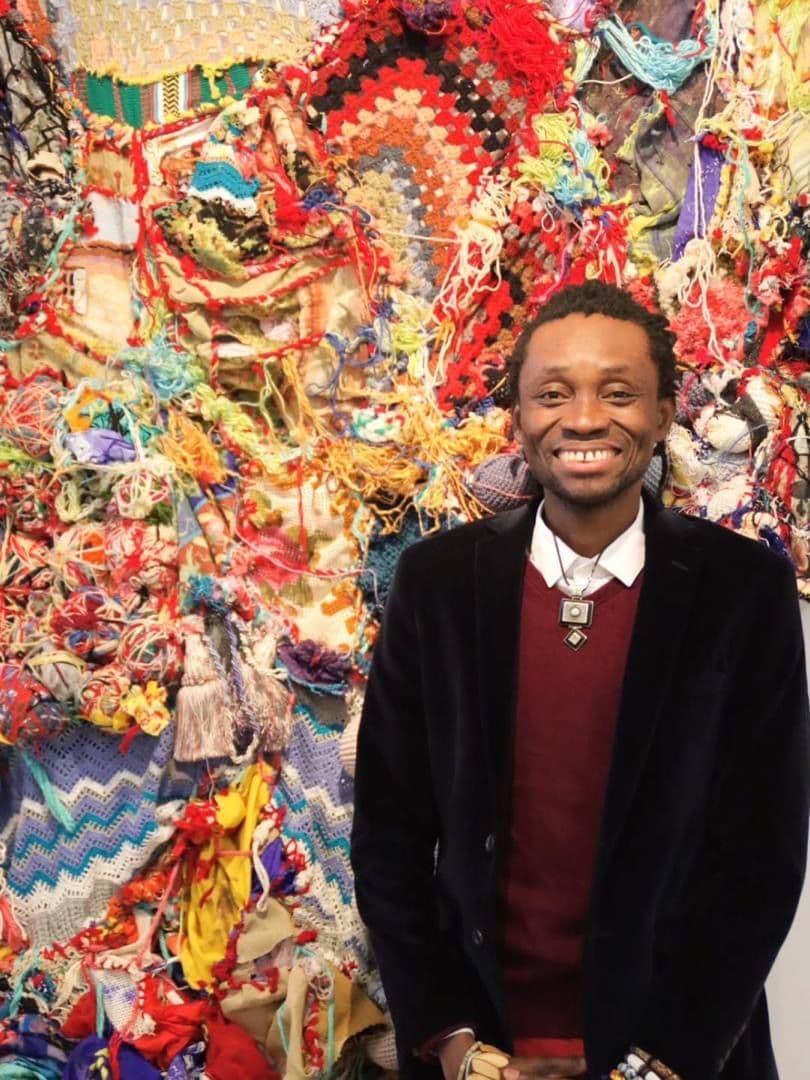
Multidisciplinary Visual Artist
Burkina Faso
Painting, Drawing, Sculpture, Installation, & Performance

Emmanuel Agyapong
Author
Published on:
August 5, 2026
Hyacinthe Ouattara is a Burkinabè multidisciplinary artist whose practice spans painting, drawing, sculpture, installation, and performance, exploring the relationships between people, bodies, memory, and inherited traditions. Across these mediums, he is interested in forms of connection that are felt before they are made visible: the memories carried by the body, the traces of cultural inheritance, and the relationships through which individual experience becomes part of something larger. His practice moves between presence and absence, appearance and disappearance, treating the visible not as a complete account of experience but as the surface of something deeper.
His paintings emerge through a spontaneous and gestural process in which the image develops through physical engagement with the material. Rather than beginning with a fixed composition and working toward its execution, Ouattara allows movement, gesture, and intuition to shape what appears on the surface. The resulting marks retain the evidence of that process, making the act of painting part of the work’s meaning. What is eventually represented is therefore inseparable from the physical process through which it comes into being.
His textile sculptures operate through a different material vocabulary while maintaining this concern with transformation. Found fabrics are twisted, knotted, layered, and patchworked into forms that appear organic rather than architecturally assembled. The textiles retain evidence of their previous lives while becoming something unfamiliar, allowing material memory and physical transformation to coexist. Their irregular forms can suggest bodies, organisms, or other living structures without settling into a single identifiable shape.

Photo Credit: Hyacinthe Ouattara
Together, these practices form what has been described as an intimate archaeology: a process of searching through material, gesture, and accumulated form for connections between individual memory, tradition, and the wider social world. Ouattara’s materials become repositories of traces. Paint records movement; fabric carries histories of use; knots and layers suggest relationships that are formed through accumulation rather than fixed in a single moment. The work consequently treats making itself as a form of investigation.
The idea of “human cartographies” provides a conceptual thread across this varied practice. Rather than mapping the body through its external anatomy, Ouattara considers the networks of memory, emotion, history, and relationship that exist beneath its visible surface. The body becomes a terrain through which experiences are carried and connected. This approach allows his work to move between the personal and the collective without reducing one to an illustration of the other.
The cultural and social context of Burkina Faso remains important to these questions. Memory and tradition appear not as static references but as living forces that continue to shape contemporary experience. Ouattara’s interest in what is seen and what remains hidden therefore operates on both an intimate and cultural level, considering how identities are formed through inherited knowledge, changing circumstances, and relationships that extend beyond the individual.
His commitment to collective artistic infrastructure reflects this understanding of connection beyond the studio. As co-founder of the artist collective Les Autres Yeux and a key figure in the development of the Hangar 11 workshop in Ouagadougou, Ouattara has contributed to spaces where artists can work, exchange ideas, and develop their practices. Since 2020, he has also been developing an open-air museum project in southwestern Burkina Faso, extending his engagement with art into a longer-term relationship with place, community, and public space.
His international exhibition history places this practice within a wider contemporary conversation, including participation in the Cairo Biennale in 2019, Dak’Art in 2022, and the Havana Biennale in 2024, alongside exhibitions in Paris, Accra, London, Berlin, New York, and Kinshasa. Yet the movement across these contexts does not dissolve the specificity of the questions from which the work emerges. Instead, it allows Ouattara’s investigation of the body, memory, tradition, and connection to encounter different audiences and cultural frameworks.
Across his paintings, drawings, sculptures, and installations, Ouattara repeatedly moves beneath the surface of things. A gesture becomes a trace, a textile becomes a repository of memory, and a body becomes a map of relationships rather than an isolated form. His practice suggests that what connects people may not always be visible, but it can still leave material evidence—and that art can begin by following those traces.