
Connect
© 2026 Kyekyekule Africa. All rights reserved.
kyekyekule.africa
© 2026 Kyekyekule Africa. All rights reserved.
kyekyekule.africa
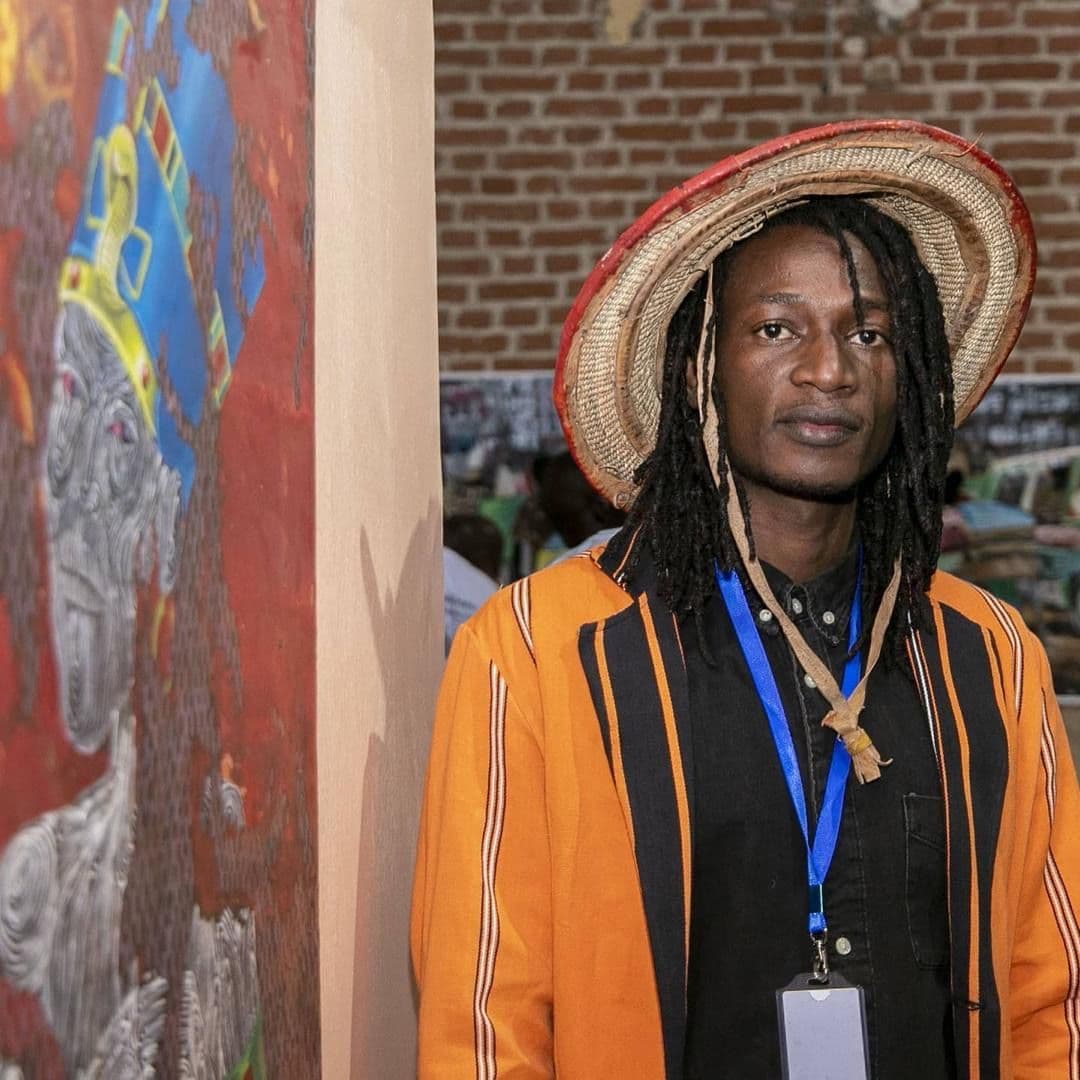
Multidisciplinary Artist
Mali
Textile installation, painting & sculpture

Emmanuel Agyapong
Author
Published on:
September 9, 2026
Ibrahim Bemba Kébé is a Malian multidisciplinary artist born in 1996 in Bamako whose practice moves across painting, sculpture, and textile installation, constructing a rich visual language through mixed media, acrylic, and large layered burlap surfaces. At the centre of his work is a sustained inquiry into identity, African cosmogony, and the continuing relationship between ancestral traditions and contemporary life. Rather than treating the sacred and the traditional as subjects belonging to the past, Kébé approaches them as living systems of knowledge, asking what might become possible when societies shaped by colonial histories begin to recover and value the cultural, spiritual, and philosophical resources they have been encouraged to leave behind.
The foundations of his practice are rooted in a remarkably varied relationship with making. His father, a carpenter-welder, introduced him to drawing through the practical logic of construction and craft, giving him an early understanding of form as something that can be built rather than simply represented. He later taught himself calligraphy and screen printing before developing his practice as a painter. Those experiences continue to shape the way he approaches the surface of his work. His paintings do not feel simply applied to a background; they are assembled, layered, and constructed, carrying within them an understanding of image-making that comes as much from craftsmanship and material process as from conventional painting.
One of the most important cultural and philosophical foundations of Kébé’s practice is the Korèdugaw, a Malian masquerade tradition associated with spiritual knowledge, social commentary, and forms of critique that can operate through performance and disguise. In his work, the tradition becomes more than an image or cultural reference. It provides a way of thinking. Kébé draws from its structures of hidden knowledge and masked critique to build the visual and conceptual language of his paintings and sculptures, allowing inherited traditions to shape the work from within rather than positioning them as objects to be observed from the outside.
This distinction is central to the seriousness of his practice. African cosmogonies appear in Kébé’s work not as distant histories but as living philosophical systems that continue to influence how individuals understand themselves, their communities, and their relationship to the world. His work considers what happens when these systems of knowledge survive within societies that have undergone colonial disruption and continue to navigate cultural frameworks imported from elsewhere. The question is not simply how to preserve tradition, but how to reactivate it.

Ibrahim Bemba Kébé, “The Shadow of the Inner Revolution,” 2024, Mixed technique. Courtesy of the Artist
That process of reactivation is also embedded in his choice of materials. Kébé frequently works on burlap, a coarse and utilitarian fabric whose physical presence gives his paintings a very different weight from the neutrality traditionally associated with canvas. The material brings its own associations with labour, trade, movement, and everyday life. Across its rough surface, layers of paint and mixed media accumulate into compositions that feel both constructed and excavated, as though the work is simultaneously building something new and uncovering something that was already there.
This relationship between material and meaning allows Kébé’s practice to move beyond illustration. Healing, cultural affirmation, spirituality, and identity are not simply themes represented in his work. They are embedded in its physical structure. The layering of surfaces mirrors the accumulation of cultural memory; the use of inherited symbols becomes a way of bringing ancestral knowledge into the present; and the physical construction of the work reflects a broader effort to rebuild connections between contemporary African life and the philosophical traditions that continue to exist beneath it.
Kébé’s commitment to artistic development also extends beyond his individual practice. After graduating at the top of his class from the Balla Fasséké Kouyaté Conservatory of Multimedia Arts and Crafts in Bamako, he founded the Sanou’Arts collective, bringing together young graduates of the Conservatory and creating space for collaboration and continued artistic development. That collective commitment reflects an understanding of art not only as an individual pursuit but as something strengthened through community, exchange, and the creation of opportunities for others.
His career has since begun to move into increasingly significant international contexts. His first solo exhibition, When The Sky Split Open, was presented in 2025, while his participation in ARCOlisboa the same year through WAAU Art marked an important moment in his growing international visibility. Representation by THIS IS NOT A WHITE CUBE gallery, alongside exhibitions in Lisbon, Paris, and other international contexts, points to a practice gaining recognition while remaining firmly grounded in the cultural and philosophical questions that shaped it from the beginning.
What makes Ibrahim Bemba Kébé’s work particularly compelling is its refusal to accept the idea that African spiritual and ritual traditions belong exclusively to history. His practice proposes something more urgent: that ancestral knowledge can remain a resource for understanding contemporary life. Across every layered burlap surface, every sculptural form, and every reference drawn from African cosmology and the Korèdugaw tradition, Kébé asks what might be recovered when inherited knowledge is taken seriously again.
His work ultimately suggests that tradition does not survive by remaining unchanged behind glass. It survives when it continues to be interpreted, questioned, transformed, and carried into new contexts. In Kébé’s hands, the sacred and the ancestral are not relics of a completed past but materials for imagining the present differently.