
Connect
© 2026 Kyekyekule Africa. All rights reserved.
kyekyekule.africa
© 2026 Kyekyekule Africa. All rights reserved.
kyekyekule.africa
Painter
Angola
Mixed Media

Emmanuel Agyapong
Author
Published on:
June 11, 2026
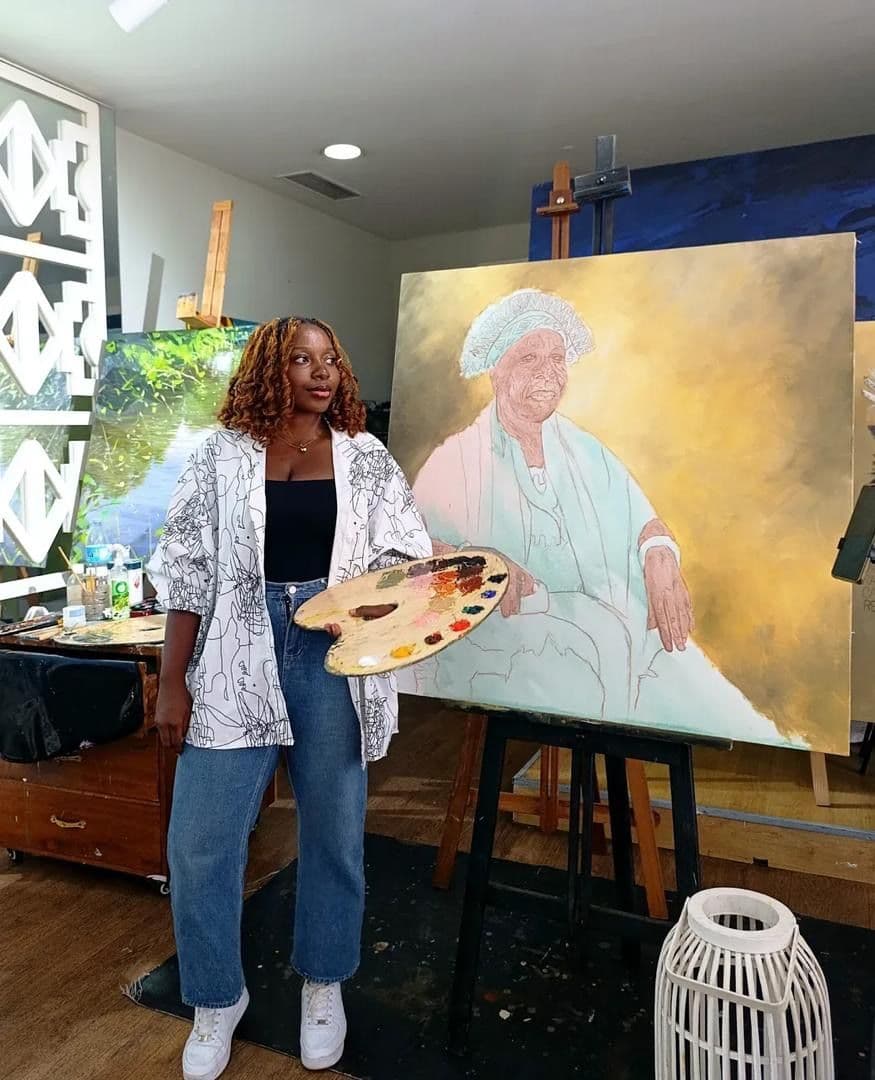
Ima Tchitanga is an Angolan visual artist based in Luanda whose practice spans painting, drawing, and installation, with a sustained interest in how Angolan art is represented, remembered, and carried forward by the generation making it now. Her position is significant because it begins from within the local creative community rather than from the distance of external interpretation. Working in Luanda and participating in a developing contemporary art scene, Tchitanga contributes to a form of visibility built through local practice itself, where Angolan artists are not simply subjects of an international art narrative but active producers of their own.
This question of proximity runs through the origins of her practice. Tchitanga began drawing comics with her siblings at the age of eight, developing an early relationship with image-making through play, collaboration, and storytelling. Before formal artistic structures entered the picture, drawing was already a shared activity through which stories could be constructed and exchanged. That beginning provides an important context for the relational quality of her practice, in which art functions not only as individual expression but as a means of creating connections between people, experiences, and generations.

Photo Credit: Ima Tchitanga
Her movement between painting, drawing, and installation extends this openness to different forms of visual communication. Rather than treating medium as a fixed boundary, she allows the requirements of an idea to determine the form it takes. The resulting practice reflects a wider shift within Angola’s younger art community, where artists are increasingly working across disciplines and using exhibition spaces to bring different modes of storytelling into conversation. Tchitanga’s work participates in this movement while remaining grounded in the specific social and cultural environment from which it emerges.
That environment became particularly visible through her participation in a group exhibition of seven young Angolan artists that developed from an online artistic residency during Angola’s COVID-19 state of emergency. The circumstances of the residency are important to the exhibition’s significance. At a moment when physical gathering and conventional exhibition-making were severely restricted, artists used digital space to maintain creative exchange and establish a platform for collective visibility. The resulting exhibition brought together painting, drawing, installation, photography, and video performance, reflecting a generation unwilling to allow institutional or medium-specific boundaries to define the possibilities of its practice.
The project also points to a broader condition within Angola’s contemporary art scene. Where established international frameworks have historically determined which African artists and practices become visible beyond the continent, local networks, digital platforms, artist-led initiatives, and collective exhibitions provide alternative structures through which artists can document and circulate their own work. Tchitanga’s participation in these spaces is therefore part of a larger process of cultural self-representation. Visibility becomes something constructed through participation and community rather than something that must first be conferred from outside.
Her practice can consequently be understood in relation to the question of who gets to document a particular moment in history. To work from Luanda, within a generation experiencing its own social and cultural transformations, is to produce a record that is shaped by proximity rather than retrospective interpretation. The comics drawn with siblings, the collaborative conditions of early artistic development, and the collective structures through which her generation exhibits all point toward an understanding of art as a form of connection and continuity.
Tchitanga remains at an early stage of her artistic development, but the questions surrounding her practice extend beyond the individual trajectory of an emerging artist. They concern how a generation represents itself while its experiences are still unfolding, and how those acts of representation become part of the cultural record. In this sense, her work participates in a larger process of building an Angolan contemporary art history from within—one in which the present is not simply observed, but documented by those living and making through it.