
Connect
© 2026 Kyekyekule Africa. All rights reserved.
kyekyekule.africa
© 2026 Kyekyekule Africa. All rights reserved.
kyekyekule.africa
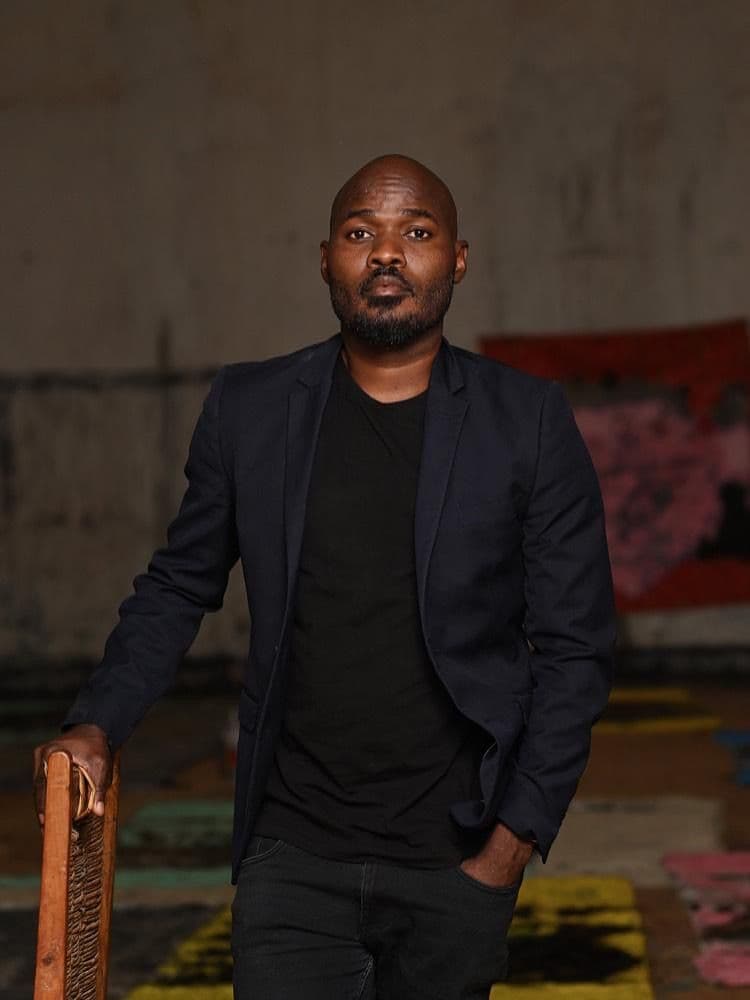
Multidisciplinary Artist
Kenya
Painting, Installation, & Sculpture

Emmanuel Agyapong
Author
Published on:
September 30, 2026
Kaloki Nyamai: Stitching Together Unfinished Histories
Kaloki Nyamai’s paintings refuse a simple distinction between image and object. Born in Kitui, Kenya, in 1985 and based in Nairobi, Nyamai works across painting, installation and sculpture, building dense surfaces from acrylic, sisal rope, stitched yarn, fabric, newspaper and photographic transfers. Drawing from Kamba histories, family memory, political violence and spirituality, he treats the painted surface as a place where fragments of the past can be gathered, layered and held together.
Stitching is central to this process. Across Nyamai’s work, thread and fabric do more than introduce another texture into the composition; they become a way of thinking about fracture and repair. Materials are joined, pulled across surfaces and held in tension, creating works that suggest histories that have not been resolved but continue to require acts of attention and reconstruction. His paintings consequently occupy a space between image, sculpture and installation, asking the viewer to consider not only what is represented but how a fragmented history might be materially assembled.

Image Credit: Courtesy of the Artist
This understanding of repair is connected to the stories Nyamai inherited during childhood. His mother introduced him to drawing and painting, while his grandmother, a Kamba storyteller and musician, passed down oral histories and cultural knowledge. These two forms of inheritance, visual making and storytelling continue to shape the way Nyamai constructs his work. His paintings often feel less like illustrations of inherited narratives than places where memory, oral history and contemporary experience can meet.
His early training also contributes to this material approach. Nyamai studied interior and industrial design at the Buruburu Institute of Fine Arts rather than entering contemporary painting through a conventional fine-art education. The attention to structure, material and spatial relationships associated with design remains visible in works that extend beyond the limits of the canvas. Rope, fabric, newspaper and photographic transfers are not applied simply as decorative additions; they alter the physical character of the work and make the surface behave more like a constructed environment.

Kaloki Nyamai, “Tusukane” 2023. Installation view at Gallery Barbara Thumm, 2023. Photo Credit: Jens Ziehe.
In Tusukane for example, the accumulation of materials creates a surface that carries the weight of both image and object. The title, like several of Nyamai’s works, draws from Kikamba, maintaining a linguistic connection to the cultural histories that inform the practice. The work demonstrates his interest in using material construction to hold together different temporalities: inherited histories, contemporary experience and the traces of political and social disruption that remain in collective memory.

Kaloki Nyamai, “TUKWATANE KIMWE”Installation view at Sharjah Biennale 16: to carry, 2025. Photo Credit: Ivan Erofeev. Artwork courtesy the artist, Galerie Barbara Thumm, Berlin, and James Cohan, New York.
This approach became particularly explicit in Tukwatane Kimwe, first presented at the Sharjah Biennial in 2025. Stitching functions here as a material language for communal repair, bringing separate elements into relation while retaining evidence of their separation. Nyamai has described the process as symbolically unifying a wounded or fractured community. The significance of the gesture lies in its incompleteness: stitching does not erase a tear. It records that something was broken and that an effort was made to hold it together.

Kaloki Nyamai, “Wenda kyao indi? (What is it that you want?), 2024, mixed media, acrylic, collage stitching on canvas, 78 3/4 × 78 3/4 in., 200 x 200 cm.” Photo by Dan Bradica. During Twe Vaa, exhibition ( Dining in Chaos, series) Courtesy of the Artist
That tension between fracture and repair also runs through Dining in Chaos, presented at Art Basel Unlimited in 2023. Nyamai’s works often resist the idea that historical violence belongs entirely to the past. Instead, memory appears as something that continues to shape bodies, communities and contemporary relationships. Newspaper fragments, photographic imagery and layers of paint introduce different kinds of historical evidence into the same surface, creating works in which personal and collective histories cannot be easily separated.
His engagement with history is therefore not simply archival. Nyamai works through materials that already carry associations with everyday life and public memory, transforming them through repetition, stitching, layering and accumulation. The resulting works do not offer a single narrative of Kenyan history. They create spaces in which multiple forms of memory, familial, cultural, political and spiritual can remain in conversation.
This has positioned Nyamai within a wider international conversation about contemporary African painting and its relationship to history. His work has been presented at the at the 2026 Venice Biennale, Art Basel Unlimited, Sharjah Biennial 16 and major institutional exhibitions, including presentations at the Norval Foundation and University of Michigan Museum of Art. His 2025–26 appointment as the William and Sally Searle Visiting Artist at the University of Michigan Institute for the Humanities further extended this engagement through exhibitions, talks and academic exchange.
But Nyamai’s practice has increasingly moved beyond the production of individual artworks. In Nairobi, he founded the Kamene Cultural & Research Center, named after his mother, extending his interest in cultural memory into a physical space for preservation, collaboration and art education. The centre adds another dimension to his understanding of repair: cultural histories do not survive only through artworks, but through places, conversations, research and the transmission of knowledge between generations.
This shift from artist to institution builder is consistent with the logic already present in his paintings. Both depend on gathering fragments and creating structures in which they can remain connected. The studio becomes one site of this work; the cultural centre becomes another. In each case, the question is not simply how to preserve what has been inherited, but how inherited knowledge can remain active in the present.
Nyamai’s practice ultimately treats memory as something that must be worked on. Stories are carried, images are transferred, materials are stitched and histories are assembled without pretending that their fractures can be completely concealed. His paintings make repair visible as a process rather than a finished condition. Between the stories of his grandmother, the visual language introduced by his mother, the material intelligence of his design training and the cultural space he is building in Nairobi, Nyamai’s practice proposes that remembering is itself a form of making.