
Connect
© 2026 Kyekyekule Africa. All rights reserved.
kyekyekule.africa
© 2026 Kyekyekule Africa. All rights reserved.
kyekyekule.africa
Figurative Painter
Cameroon
Acrylic on Canvas

Emmanuel Agyapong
Author
Published on:
August 24, 2026
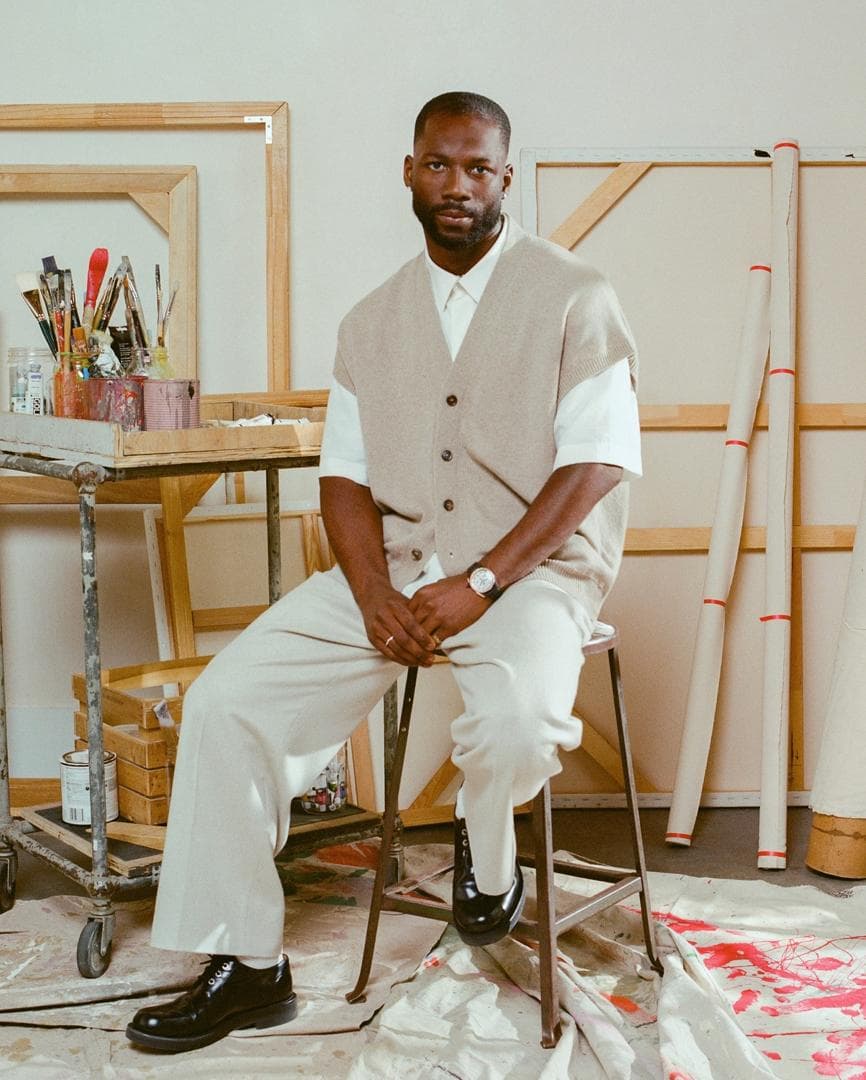
Ludovic Nkoth is a Cameroonian figurative painter born in Yaoundé in 1994 whose layered acrylic paintings examine identity, belonging, family history, colonialism, and the experience of Blackness across the diaspora. Having moved to the United States at thirteen, Nkoth works from the tension between two cultural inheritances: the Cameroonian world he left and the American racial structures within which he came of age. His thickly impastoed portraits hold these histories on the surface, constructing faces through accumulated colour, texture, and gesture rather than treating portraiture as a straightforward exercise in likeness.
Materiality is central to how this tension becomes visible. Nkoth builds his paintings through dense applications of acrylic, occasionally incorporating fabric and sand into the surface. The resulting faces appear almost physical enough to occupy space beyond the canvas, with each layer contributing to a sense of accumulated presence. The surface does not simply describe the subject; it carries the pressure of memory, displacement, and lived experience. In this sense, the density of the paintings becomes inseparable from the histories they address.
His approach to brushwork reinforces this relationship between material and feeling. Acrylic dries quickly, and Nkoth works within that constraint, responding to the paint with fast, instinctive marks rather than extensive deliberation. The resulting gestures retain the evidence of their making: strokes remain visible, colours meet without always settling into smooth transitions, and the image carries the momentum of decisions made in real time. This immediacy gives the paintings a sense of movement while resisting the polished distance that can separate an image from the experience it represents.
The wooden Cameroonian masks that appear in some of Nkoth’s large panel works extend this inquiry beyond the painted surface. Their presence is structural rather than decorative, bringing histories of cultural meaning and colonial dispossession into direct relation with the figures around them. The mask becomes another form of inheritance within the composition, connecting the cultural memory of Cameroon with the diasporic experience represented by the painted body. Rather than resolving these histories into a single identity, Nkoth allows them to remain in conversation, reflecting the condition of belonging to more than one place without being fully contained by either.

Photo Credit: Ludovic Nkoth
This becomes particularly significant in his engagement with the racial violence and social structures affecting Black men in America. Nkoth does not approach these subjects as distant social themes. They are connected to the experience of navigating a society in which race shapes visibility, belonging, and vulnerability. His paintings consequently move between the intimate and the historical: a face can carry family memory while also existing within much larger histories of migration, colonialism, racism, and cultural loss. Portraiture becomes a way of holding these scales together without reducing the individual to a symbol.
Nkoth has described his practice as an attempt to reclaim what was taken from his people, including power, culture, and pride. That idea is embedded in the physical construction of the paintings. The accumulation of impasto gives the figure weight, while the exposed gestures preserve the presence of the hand that made it. What might otherwise be flattened by historical or racial narratives is given density and specificity. Reclamation therefore operates not only as subject matter, but through the very process of making the painted body occupy the canvas.
Nkoth’s formal education includes a BFA from the University of South Carolina and an MFA from Hunter College in New York. His practice has since entered significant institutional and cultural contexts, including recognition in Forbes 30 Under 30 in Art and Style in 2024, the inaugural residency run by the Académie des Beaux-Arts and Cité internationale des arts in Paris, and a 2023 exhibition at Le Corbusier’s Maison La Roche, where he became only the second living artist to exhibit. His collaboration with Christian Dior, including the customisation of a Lady Dior bag, alongside representation by François Ghebaly Gallery and Massimo De Carlo, places the work across contemporary art, fashion, and institutional circuits without separating those contexts from the questions embedded in the paintings themselves.
Across Nkoth’s practice, the face becomes a place where histories meet: Cameroon and the United States, inheritance and displacement, intimacy and racial violence, memory and the present. His layered surfaces refuse to make these conditions visually simple. Instead, colour, material, gesture, and cultural reference accumulate until the painted figure becomes both individual and historical, carrying the complexity of a diasporic identity that cannot be contained by a single geography or narrative. The weight of the paintings lies precisely in that refusal: to flatten experience when the surface itself can hold its contradictions.