
Connect
© 2026 Kyekyekule Africa. All rights reserved.
kyekyekule.africa
© 2026 Kyekyekule Africa. All rights reserved.
kyekyekule.africa
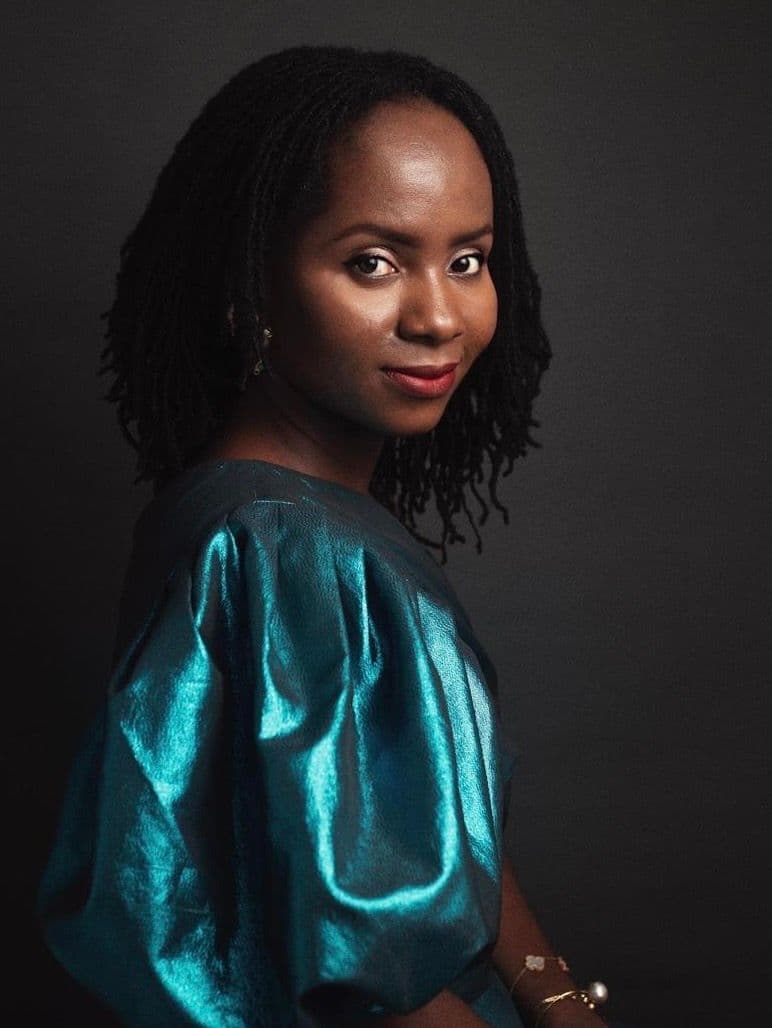
Multidisciplinary Artist
Nigeria
Painting, Collage & Textile-based Mixed media

Emmanuel Agyapong
Author
Published on:
October 9, 2026
Marcellina Akpojotor Turns Fabric Into an Archive of Everyday Life
When Fabric Remembers
Marcellina Akpojotor’s paintings begin with a material that already carries a history. Born in Lagos in 1989 and based in the city, Akpojotor works across painting, collage and textile-based mixed media, incorporating Ankara fabric, paper, acrylic, watercolour, charcoal and monoprints into layered compositions.
Much of the fabric she uses comes from discarded offcuts collected from neighbourhood tailors, fragments that may have once belonged to clothing worn at weddings, birthdays, funerals or other communal occasions. In her studio, these remnants become part of another kind of record: an archive of family, identity, womanhood and everyday life.
The Offcut as Evidence

Photo Credit: Courtesy of the Artist
Akpojotor’s statement that “The offcuts of fabric that I collect are filled with stories” points directly to the way her materials operate. The fabric is not simply chosen for its colour or pattern. It arrives with a previous life, having already participated in someone’s experience before being separated from the garment or object it once belonged to.
By incorporating these fragments into paintings, Akpojotor preserves something of that circulation. The offcut moves from tailor’s workspace to studio, from clothing to image, and from everyday use into an artwork. Its transformation does not erase its original function. Instead, the history of the material becomes part of what the painting can hold.
Ankara Beyond Decoration
Ankara is deeply embedded in the social life of many African communities, and Akpojotor draws on that familiarity without treating the textile simply as a decorative surface. The fabric becomes a way of entering questions of belonging, family and collective identity.
Its presence in ceremonies and domestic life gives the material a particular social charge. A pattern can evoke an occasion, a relationship or a period of life without explicitly representing any of them. Akpojotor uses this capacity for association to build paintings in which textile and image operate together, allowing memory to emerge through material as much as through representation.
Building an Image Through Layers
Layering is fundamental to Akpojotor’s process. Fabric, paint, paper and printed material are cut, arranged and built into compositions in which no single medium completely dominates.
Her more recent use of monoprinting extends this approach. Printed material can be cut into fragments and placed alongside textile and paint, creating surfaces that appear assembled rather than simply painted. The construction of the image therefore mirrors the way memory itself can work: through fragments, overlaps, repetitions and pieces that acquire new meaning when placed together.
Searching for a Great-Grandmother
The relationship between material and memory becomes particularly direct in Akpojotor’s Joy of More Worlds body of work. Her research into her great-grandmother was shaped in part by the difficulty of finding photographic records of her.
That absence becomes significant. When an image of an ancestor cannot be readily recovered, other forms of inheritance become more important: stories, objects, patterns, family knowledge and the traces that survive through generations. Akpojotor’s work considers how such fragments can become forms of remembrance without pretending that they provide a complete picture of the past.
Family as a Larger Story

Marcellina Akpojotor, Image: Weekend with Grandma, Fabric, charcoal on paper and acrylic on canvas, 96 x 76 Inches, 2022. Courtesy of the Artist
Akpojotor frequently begins with family and domestic scenes, but the paintings do not remain confined to autobiography. Motherhood, education, relationships and community become points through which broader experiences of Nigerian women can enter the work.
In Weekend with Grandma (2022), for example, a family scene involving Akpojotor’s mother and children becomes connected to questions of intergenerational memory. The significance of the work lies not only in who is represented, but in the relationship between generations that the image makes visible.
Her paintings consequently treat family as both intimate space and social structure. The domestic scene becomes a place where histories are passed on, adapted and sometimes recovered.
A Practice Shaped by Her Father
Akpojotor’s relationship with materials began before her formal art education. Her father, an artist and sign maker, introduced her to a broad range of materials and processes, including fabric, leather, cardboard and rubber stamps. She was apprenticed to him, observing the discipline of making alongside the practical demands of working with materials.
That early experience remains visible in the tactile character of her practice. Her later decision to make fabric central to the painting can be understood not simply as a formal choice, but as part of a longer relationship with making and material knowledge.
She subsequently studied Art and Industrial Design at Lagos State Polytechnic and Fine and Applied Arts at Obafemi Awolowo University, developing a practice in which inherited knowledge and contemporary experimentation continue to meet.
From Personal Memory to Shared Experience
Akpojotor describes herself as “a vessel, someone connecting others to a feeling.” The statement reflects an important quality of her work: she does not attempt to make private memory entirely self-contained.
Fabric provides a route outward. A piece of Ankara can belong to one family while also carrying associations shared across a wider community. A grandmother, a child, a gathering or a domestic interior can therefore become an entry point into experiences that extend beyond the individual depicted.
The paintings operate through this movement between particularity and recognition. They preserve something personal while allowing the material language of the work to remain open to collective memory.
Ten Years of Making Together
Akpojotor’s recent exhibition Woven and Built in Tandem at Rele Gallery, Lagos, held from May to June 2026, brought together ten years of shared artistic and personal practice with her husband, Patrick Akpojotor. The exhibition offered another context in which her interest in collaboration, domestic life and material relationships could be considered.
Works such as Where We Belong (2025–26) and Merry-go-Mimi (2026) continue her use of fabric, paper, watercolour and acrylic to construct images through accumulation. The materials remain recognisable, but their previous lives are reorganised into compositions concerned with belonging and connection.
What Remains in the Fabric
Akpojotor’s work begins with materials that might otherwise disappear: an offcut from a tailor, a discarded fragment, a pattern separated from the garment that gave it purpose. She gives these remnants another life without removing the histories they already contain.
This is what makes fabric an archive in her practice. It does not preserve memory as a fixed record. Instead, it carries traces of people, occasions, relationships and places into new forms. On Akpojotor’s canvases, what has been worn, handled, inherited and discarded becomes part of an image that continues to hold those histories, and allows them to be seen again.