
Connect
© 2026 Kyekyekule Africa. All rights reserved.
kyekyekule.africa
© 2026 Kyekyekule Africa. All rights reserved.
kyekyekule.africa
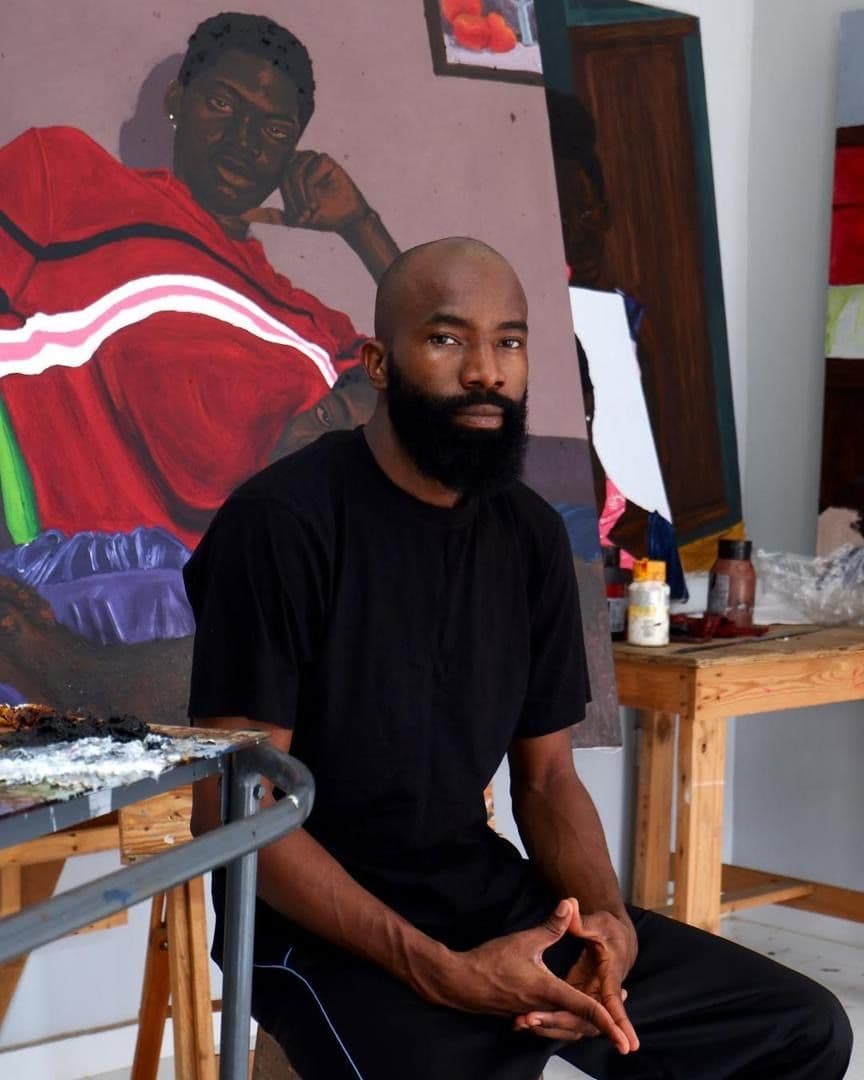
Painter
Nigeria
Combination of Oil paint, Acrylic paint, Charcoal, & Graphite pencil

Emmanuel Agyapong
Author
Published on:
July 13, 2026
Matthew Imuetiyan Eguavoen is a Nigerian painter born in Edo State in 1988 whose contemporary figurative practice uses oil, acrylic, charcoal, and graphite to examine the interior lives of his subjects through portraiture. His paintings depart from conventional likeness through bold colour, unconventional composition, and a heightened attention to emotional presence, treating the face not simply as a record of appearance but as a place where vulnerability, identity, memory, and lived experience become visible. The result is a form of portraiture in which looking closely at another person becomes an encounter with states that are often difficult to articulate.
The seriousness of that inquiry is connected to Eguavoen’s own unconventional route into painting. Trained as a civil engineer at the University of Port Harcourt, he turned toward art through sustained self-study rather than a predetermined institutional path. The decision placed painting in opposition to a more conventional professional trajectory, making the development of his practice an act of sustained commitment. His paintings retain something of that determination: they do not approach their subjects tentatively, but give emotional experience the scale, colour, and formal attention traditionally reserved for subjects considered worthy of public representation.
This is particularly evident in his treatment of the individual figure. Eguavoen’s subjects are not constructed primarily as representatives of abstract ideas about Africa, race, or gender. They remain specific people, and the paintings allow their complexity to remain attached to that specificity. Social questions emerge through the individual rather than being imposed upon them. A face can carry the pressure of history and social circumstance while still remaining irreducibly personal, preventing the subject from becoming merely an illustration of a larger political argument.
Mental health is one of the most consequential areas of this inquiry. In contexts where depression, emotional vulnerability, and psychological struggle have often been difficult to discuss openly, Eguavoen brings these experiences into the visual field through the language of serious portraiture. The decision to represent interior distress with the same formal attention given to beauty, status, or historical subjects challenges the idea that emotional vulnerability should remain private or invisible. His paintings give psychological experience a physical presence without reducing it to pathology, allowing states of uncertainty, isolation, resilience, and emotional exposure to occupy the canvas without apology.

Photo Credit: Matthew Imuetiyan Eguavoen
The broader conditions of Nigerian life remain present within this focus on interiority. Economic pressure, social expectation, political instability, questions of gender, and the inherited structures through which African identities are understood form part of the environment surrounding his figures. These forces do not always appear as explicit imagery. Instead, they operate as conditions that shape the people being represented. The portrait becomes a point at which individual experience and wider social realities meet, allowing the personal to register the pressures of the world without losing its particularity.
Eguavoen’s relationship to Edo and Benin cultural heritage adds another dimension to this understanding of identity. His 2024 solo exhibition Ukhurę at AFIKARIS Gallery in Paris draws on Benin and Edo spiritual traditions, bringing inherited systems of knowledge into a contemporary figurative language. The engagement is significant because it places questions of interior life within a cultural history that extends beyond the immediate present. Spiritual inheritance becomes another layer through which identity can be understood, connecting the individual subject to histories, beliefs, and forms of knowledge that precede them.
His growing international context reflects the development of a practice that remains grounded in these specific cultural and psychological concerns. Two solo exhibitions at AFIKARIS Gallery in Paris have established an ongoing relationship with the institution, while residencies at Black Rock Senegal in 2024 and 2025 have expanded the geographical and intellectual contexts in which his work is produced and encountered. His paintings are held in private and public collections across West Africa, the United States, Europe, and North America, placing a practice rooted in Nigeria within an increasingly international network of contemporary art.
Across Eguavoen’s portraits, colour and composition become tools for making interior experience visible without simplifying it. The face remains recognisable, but it is never only a face; it carries the tension between private feeling and public existence, individual vulnerability and collective circumstance. His practice insists that the psychological lives of African subjects deserve sustained attention—not as secondary narratives attached to larger histories, but as histories in themselves. In giving those inner states physical form, Eguavoen extends portraiture beyond the question of who someone is to consider what it means to be seen in the fullness of that experience.