
Connect
© 2026 Kyekyekule Africa. All rights reserved.
kyekyekule.africa
© 2026 Kyekyekule Africa. All rights reserved.
kyekyekule.africa
Painter / Sculptor
Togo
Acrylic on canvas

Emmanuel Agyapong
Author
Published on:
September 4, 2026
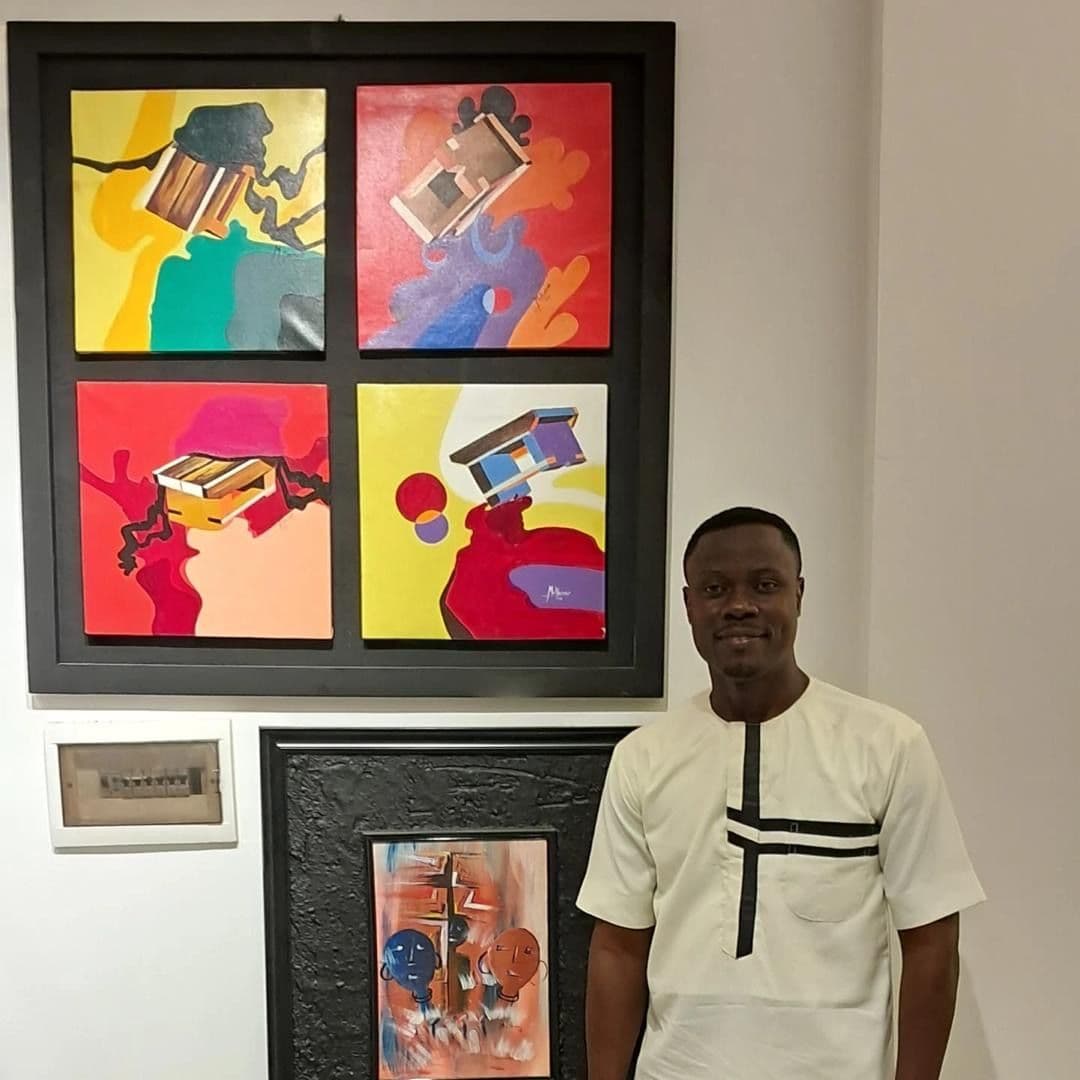
Mawuko Abosseh is a self-taught Togolese painter and sculptor based in Lomé whose practice has found an expansive philosophical world inside a single recurring object: the stool. Working across large-format acrylic paintings, typically measuring 140 by 140 centimetres, and three-dimensional sculptures made from wood, iron, and acrylic, Abosseh returns repeatedly to the Atiklè — the name for the stool in his language — as an ancestral totem carrying questions of power, authority, sovereignty, submission, ambition, and spiritual inheritance. It is a subject that might appear ordinary until the sustained attention of his practice reveals just how much history an object can hold.

Photo Credit: Mawuko Abosseh (Title: Atikle)
The stool occupies a particular position in Abosseh’s visual and philosophical world because it exists simultaneously within the everyday and the sacred. It is a familiar domestic object, part of the physical landscape through which ordinary life is organised, but it is also connected to spiritual belief and ancestral meaning. This duality gives the Atiklè its extraordinary range within his work. It can represent authority and hierarchy while remaining an object of daily use; it can suggest sovereignty and aspiration while also carrying ideas of submission and social order. None of these meanings settles permanently into another. The stool remains a site of tension.
Abosseh describes the Atiklè as an ancestral totem that continues to pursue him, and this sense of recurrence is central to understanding the seriousness of his practice. Repetition here is not limitation. By returning to the same subject across painting and sculpture, he creates the conditions for meaning to deepen over time. Each work becomes another encounter with an object that cannot be exhausted by its practical function. The stool changes according to material, scale, composition, and context, but the questions surrounding it remain: who has the right to occupy a position of power? What does authority look like? What histories are carried by the structures through which communities organise themselves?
To place this object at the centre of monumental canvases is itself a significant formal decision. Abosseh refuses the hierarchy that separates supposedly important subjects from ordinary things. The objects through which people organise domestic, social, and ritual life are not peripheral to history; they are among the places where history is physically stored. A stool can carry the memory of bodies, ceremonies, hierarchies, family structures, and spiritual systems. In Abosseh’s hands, it becomes large enough to demand the kind of attention normally reserved for the human figure or the grand historical event.
His sculptural practice extends this inquiry into physical space. Working with wood, iron, and acrylic, he allows the Atiklè to move beyond representation and become materially present. The distinction between looking at an image of an object and standing before an object-like form becomes important here. Sculpture gives weight, volume, and physical authority to the philosophical concerns already present in the paintings, allowing the stool’s relationship to power and presence to operate through the body of the viewer as well as through interpretation.

Photo Credit: Mawuko Abosseh (Title: Atiklê)
The development of his own technique, which he calls Pato, reflects the same commitment to building a visual language from within his particular cultural and spiritual inheritance. Rather than treating established artistic methods as neutral containers into which any subject can be placed, Abosseh has developed a formal vocabulary responsive to the world his work emerges from. The technique is therefore not separate from the subject matter. Both are connected to a larger insistence that a specific cultural experience should be allowed to generate its own forms.
This is one of the most compelling aspects of Abosseh’s practice: the relationship between language and image. The Atiklè is not simply a stool translated into an artistic symbol. Its meaning begins within a particular linguistic, cultural, and spiritual context before becoming available to viewers outside it. The work consequently creates a productive distance between those who immediately recognise the object’s significance and those encountering it for the first time. For one viewer, the stool may arrive with inherited associations already intact; for another, the work becomes an invitation to understand that an apparently familiar object can belong to an entirely different system of meaning.
Recognition of his practice has grown alongside the consistency of this inquiry. A portrait documentary feature on Africa24 TV in 2020 introduced his work to a wider audience, while the inclusion of his Atiklè series in Suboart Magazine’s international rising stars platform in 2023 reflected increasing attention to a practice whose focus has remained remarkably sustained. Across painting and sculpture, Abosseh has continued to develop the same central subject without allowing repetition to become predictability.
What Mawuko Abosseh’s work ultimately demonstrates is that an object becomes extraordinary not necessarily because of what it looks like, but because of everything a community has taught it to mean. The Atiklè carries power because people have placed power around it; it carries spiritual significance because generations have given it a place within systems of belief; it carries history because history has repeatedly passed through the spaces in which it exists.
Across every monumental canvas and every form constructed from wood and iron, Abosseh returns to the same essential question: what does an object carry when it has remained close enough to a people’s life to accumulate generations of meaning? And perhaps more importantly, can art make that accumulated weight visible to someone for whom the stool has always been nothing more than somewhere to sit?