
Connect
© 2026 Kyekyekule Africa. All rights reserved.
kyekyekule.africa
© 2026 Kyekyekule Africa. All rights reserved.
kyekyekule.africa
Visual Artist / Sculptor
Nigeria
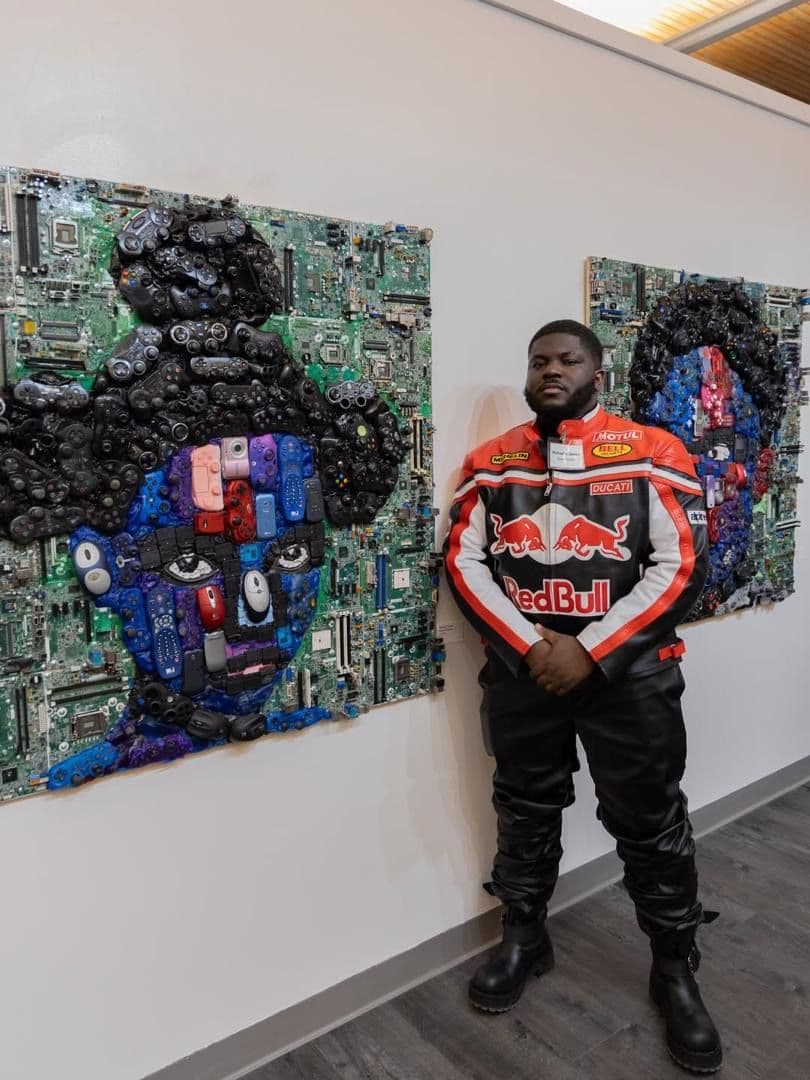
Portrait mosaic art made entirely from electronic waste — discarded circuit boards, keyboards, wires, and tech components arranged to form highly detailed human faces.

Emmanuel Agyapong
Author
Published on:
June 16, 2026
Michael Agwu is a Nigerian sculptor and mixed media artist based in Philadelphia whose practice transforms discarded electronic components into detailed portrait mosaics that place Black and African identity in direct relation to the material culture of contemporary technology. Working with circuit boards, keyboards, wires, and obsolete technological parts, he constructs faces from objects that have already passed through systems of production, consumption, and disposal. The resulting portraits occupy a space between sculpture and image, where the material history of the objects remains visible within the representation of the person.
That visibility is central to how the work operates. Agwu does not conceal the circuit boards or wires beneath an illusion of conventional portraiture; their original functions and physical characteristics remain legible. Components designed to process information, transmit signals, or facilitate digital communication become fragments of human faces. The transformation therefore does not erase the identity of the material. Instead, the portrait depends on the viewer recognising both things at once: the technological object and the person constructed from it.
This produces a productive tension around value and obsolescence. The electronic components have been discarded because they are no longer considered useful within a rapidly changing technological system. Agwu redirects them toward another form of usefulness, but the process is more than recycling. By placing these materials within portraits of Black and African subjects, he shifts the question from what objects are worth to what—and who—society chooses to preserve. The face becomes the point at which disposability and permanence meet.
The relationship between technology and African identity is equally important. Contemporary technological culture is often narrated through the centres of global production and innovation, leaving Africa positioned either outside the story or within a simplified narrative of technological catch-up. Agwu’s work disrupts that framing. African heritage and Black identity appear directly within the circuitry of contemporary life, suggesting that African experience is not external to technological modernity but already embedded within it. The materials of the digital age become part of a visual language through which African presence is asserted within that age.

Photo Credit: Michael Agwu
The portraits also carry a particular relationship to memory. Electronic waste is the physical residue of rapid technological change: yesterday’s tools become today’s obsolete components, leaving behind material evidence of how quickly systems replace themselves. Agwu slows that process down. Through painstaking assembly, fragments designed for short technological lifespans are reorganised into images of individual people. The work consequently turns materials associated with impermanence into structures of remembrance.
This process also gives the portraits a particular kind of resilience. Their subjects are not simply depicted against a technological background; they are materially constituted through it. Circuitry becomes skin, wires become lines within the composition, and fragmented components accumulate into recognisable expressions. The transformation creates a relationship between the vulnerability of discarded objects and the persistence of the human figure without reducing either to a simple metaphor.
Agwu’s growing visibility, including viral attention to his work, reflects the immediate legibility of this material language. The portraits can be encountered first through their visual precision, but closer attention reveals the histories embedded within their construction: technological change, consumption, disposal, identity, and representation. His practice has developed from Philadelphia into an expanding international exhibition context while remaining grounded in the physical encounter between discarded technology and the human face.
Across Agwu’s work, the portrait becomes a site where questions of technological progress and human value intersect. The circuit board, keyboard, and wire have already been classified as obsolete, while the face demands attention precisely because it represents an individual presence. By assembling one from the other, Agwu unsettles the distinction between what is disposable and what is worth preserving. His work leaves the viewer with a question that extends beyond electronic waste: what determines what we keep, what we discard, and whose presence we decide should remain?