
Connect
© 2026 Kyekyekule Africa. All rights reserved.
kyekyekule.africa
© 2026 Kyekyekule Africa. All rights reserved.
kyekyekule.africa
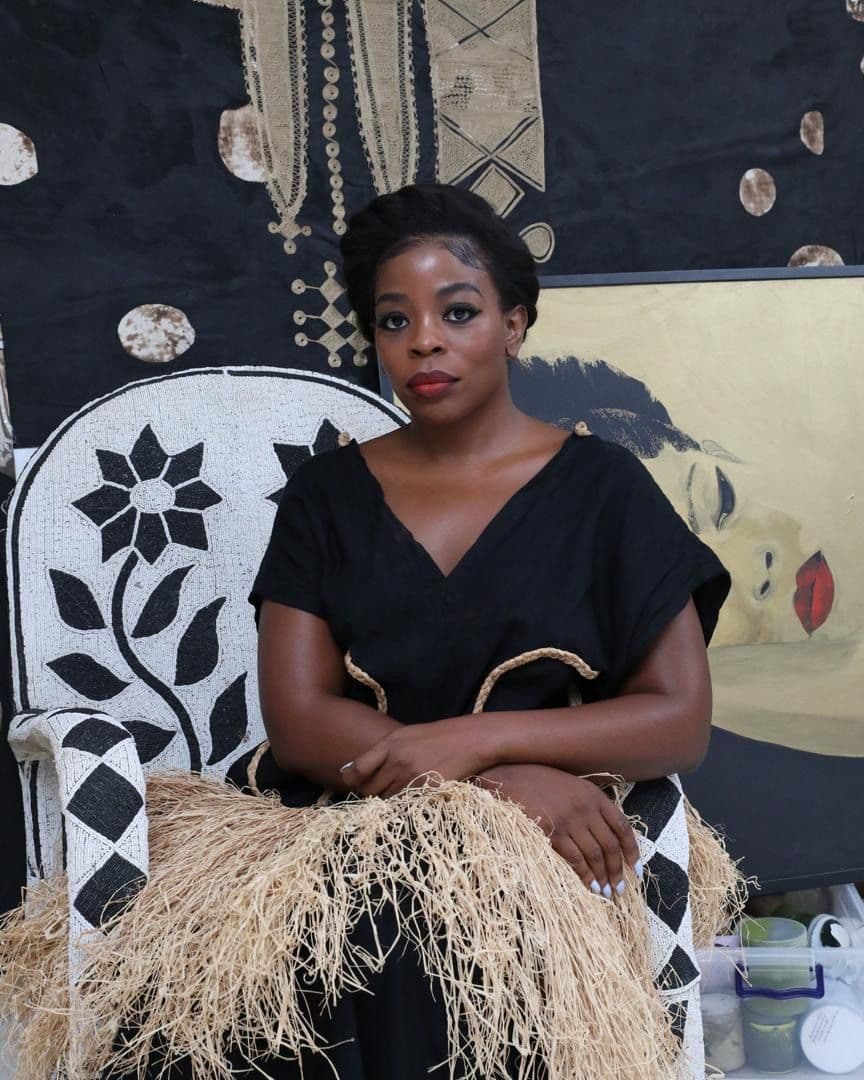
Multimedia Artist
Nigeria
Painting, drawing, socially engaged installation

Emmanuel Agyapong
Author
Published on:
September 14, 2026
Modupeola Fadugba is a Nigerian artist, born in Lomé, Togo in 1985 and currently based in Ibadan, whose practice moves across painting, drawing, socially engaged installation, and multimedia to investigate the systems that organise human life and the ways individuals attempt to move within, against, and beyond them. Her work is formally diverse, incorporating acrylic, graphite, ink, gold and metallic leaf, burned canvas, beads, photography, and video, but beneath that diversity runs a remarkably consistent intellectual concern: how do systems shape the possibilities available to people, and what happens when art makes those systems visible enough to be questioned?
Her path into contemporary art is essential to understanding the particular logic of her practice. Before becoming a full-time artist, Fadugba studied Chemical Engineering and Economics at the University of Delaware and later completed a Master’s degree in Technology in Education at the Harvard Graduate School of Education. These disciplines might initially appear distant from painting, but her work has never treated the boundary between scientific, social, and artistic knowledge as fixed. Statistics, game theory, research, systems thinking, and education continue to operate beneath the surface of her practice, not as academic references applied to the work for intellectual effect but as methods through which she approaches the conditions people are required to navigate.
Her early interest in Chemical Engineering was connected to a desire to address pharmaceutical problems affecting Nigeria, a motivation that reveals something important about the direction her practice would eventually take. The medium changed, but the underlying question remained consistent: how can complex systems be understood, challenged, and potentially transformed? Art became the space in which that question could expand beyond the technical limits of engineering or economics and become social, emotional, participatory, and visual all at once.
That interdisciplinary intelligence found one of its clearest early expressions in The People’s Algorithm, an interactive installation developed around Nigeria’s education system. Structured through the logic of a game, the work invited participants into the very systems it was attempting to examine, using play and participation to expose the inequalities and structural failures that shape educational opportunity. The project was significant not simply because of its subject matter but because of its method. Fadugba understood that explaining a system is not always enough to make its consequences felt; sometimes people must be placed inside its logic before they can understand what that logic does.
The recognition the project received confirmed the force of that approach. The People’s Algorithm was awarded El Anatsui’s Outstanding Production Prize and subsequently received the 2016 Dakar Biennale Grand Prize from Senegal’s Minister of Communication. These achievements established an important early foundation for a practice that had already demonstrated an unusual ability to move between research, social engagement, participation, and visual art without allowing any one discipline to dominate the others.
Yet it was through painting — and particularly through the bodies of swimmers — that Fadugba would develop one of the most recognisable and sustained bodies of work of her career. Her interest in water began from personal experience. Having grown up near the ocean in Lomé, she initially carried a fear of the sea before developing a relationship with swimming that would eventually become the starting point for a much broader artistic investigation. Swimming pools, unlike the ocean, offered controlled environments: spaces where water could be contained, regulated, entered, and navigated according to rules. That distinction opened a conceptual space that her paintings would continue to explore for years.
The swimmers who began appearing across her canvases were therefore never simply studies of movement or technical depictions of bodies in water. They became a way of thinking about risk, vulnerability, access, survival, community, and belonging. A body swimming must remain in motion. It must negotiate an environment that can sustain it but can also overwhelm it. The pool, meanwhile, is a social space shaped by questions about who has access, who feels welcome, and whose presence has historically been excluded.
Her research into synchronized swimming expanded those concerns further. During a residency at the International Studio & Curatorial Program in New York, Fadugba worked with the Harlem Honeys and Bears, an older adult synchronized swimming group whose collective practice introduced another dimension into her understanding of movement in water. The swimmer was no longer only an individual body negotiating risk. The synchronized group demonstrated what could happen when movement became collective — when timing, trust, coordination, and mutual awareness transformed separate bodies into a shared formation.
Her investigation also led into the complex racial history of swimming pools in the United States, including research into the relationship between segregation, access, and public space. The swimming pool became, in her work, an unexpectedly powerful social structure: a place that could reveal how race, class, mobility, and belonging are organised in physical space. Water itself might appear universal, but access to the spaces in which people encounter it has never been equally distributed.
This is what gives Fadugba’s Synchronized Swimmers works their deeper significance. They operate through the visual beauty of bodies moving across water while carrying questions that extend far beyond the pool. Community and individuality exist together. Risk is balanced against discipline. The possibility of drowning exists beside the possibility of collective support. What appears at first to be a serene image of movement becomes an inquiry into the conditions required for people to survive, participate, and belong.
For approximately a decade, water remained one of the central territories of her practice. Then, in 2025, something significant changed.
Her solo exhibition Of Movement, Materials and Methods marked a decisive transition from water toward land, from the swimming body toward new forms of collective movement, and from the contained architecture of the pool toward the cultural and ceremonial spaces of Yoruba tradition. Drawing inspiration from Ojude Oba, the celebrated Yoruba festival associated with Ijebu-Ode, Fadugba began working with horses, riders, clothing, procession, and the collective choreography of cultural gathering.
The shift is important because it is not simply a matter of replacing one visual subject with another. It represents a deeper movement in the questions her practice is asking. The swimmer is often understood through individual effort, through the body negotiating an unstable environment and maintaining itself against the possibility of submersion. The rider and the ceremonial procession introduce another kind of relationship: one structured around heritage, collective identity, tradition, performance, and continuity.
Water gives way to land. Solitude gives way to community. Survival gives way, not to the absence of struggle, but to the inheritance of culture. Individual movement becomes collective choreography.
Her works from this direction, including The Lone Rider and The King’s Seat, demonstrate how her material practice has evolved alongside this conceptual transition. Burned canvas, graphite, acrylic, ink, and beads create surfaces in which the image carries both physical and symbolic weight. The burned material is particularly significant within a practice that has always understood surface as something capable of recording process. A canvas can hold evidence of transformation. It can show what has been altered, marked, removed, or rebuilt.
The movement toward Yoruba cultural references also signals an increasingly direct engagement with the specific histories and traditions surrounding her. Fadugba’s earlier work was already deeply attentive to questions of race, community, and social systems, but the 2025 transition brings those concerns into a different relationship with place and inheritance. The work is no longer looking primarily at the structures that determine access to a shared space; it is increasingly interested in the cultural structures through which communities sustain themselves across time.
Her practice has also consistently returned to questions about representation. In her Heads or Tails series, Fadugba placed Black women into the visual language of currency, responding to the historical absence of women from Nigerian banknotes and asking what it means when systems of representation assign value unevenly. Currency is itself a form of collective agreement — a material object whose value depends on what societies decide it represents. By placing Black women within that visual structure, Fadugba exposes the relationship between visibility and value, asking whether the people a society chooses to commemorate influence the way that society understands whose lives matter.
This concern with value — economic, social, cultural, and personal — connects her apparently different bodies of work more closely than they might initially appear. The People’s Algorithm examines the systems through which opportunity is distributed. The swimmer paintings investigate access, survival, and belonging. Heads or Tails questions representation and social value. The more recent works rooted in Ojude Oba explore collective identity and cultural continuity. Across each of these directions, the underlying concern remains the same: how are people positioned within the systems that give structure to their lives, and what possibilities emerge when those positions are questioned?
Her recognition through the 2025 Norval Sovereign African Art Prize marks another significant moment in the development of this practice. Winning the Grand Prize for Portrait Of An Artist At Ease brought one of the continent’s most important contemporary art honours to an artist whose career has been defined by a willingness to evolve rather than remain inside a recognisable formula. The prize, accompanied by a substantial award, a solo exhibition at the Norval Foundation, and a residency in London, confirms the growing institutional recognition of a practice that has consistently moved between disciplines while maintaining an unusually coherent intellectual foundation.
What makes Modupeola Fadugba particularly compelling at this moment is precisely this capacity for transformation. Many artists find a visual language and spend their careers refining it. Fadugba has instead allowed her questions to determine the form the work must take. When a system required participation, she created an interactive game. When questions about race and access required a social space, she turned to the swimming pool. When representation required a challenge to established symbols of value, she entered the visual language of currency. And when her practice needed to move toward heritage, collective memory, and cultural continuity, she left the water and found new ground.
That movement may be the clearest way to understand her work.
Fadugba did not abandon the concerns that shaped the swimmer paintings when she moved away from water. She carried them with her. The questions of movement, community, trust, and collective organisation remain, but they now operate through different bodies and different histories. The transition is not a break in the practice. It is evidence of its ability to grow.
What Modupeola Fadugba continues to demonstrate, across algorithms, swimmers, currency, horses, and the increasingly complex material surfaces through which these ideas take form, is that contemporary art does not have to choose between intellectual rigour and emotional experience, between research and beauty, or between social engagement and formal ambition. Her practice holds those possibilities together, asking how systems shape human life while refusing to forget the bodies, memories, communities, and traditions that exist inside them. And perhaps the most compelling development in her work today is the one that has taken her from the uncertainty of water toward the shared ground of cultural memory — proving that sometimes an artist has to leave one landscape behind, not because its questions have been answered, but because those questions have finally led somewhere new.