
Connect
© 2026 Kyekyekule Africa. All rights reserved.
kyekyekule.africa
© 2026 Kyekyekule Africa. All rights reserved.
kyekyekule.africa
Multidisciplinary Artist
Zimbabwe
Sculptor & Installation

Emmanuel Agyapong
Author
Published on:
September 25, 2026
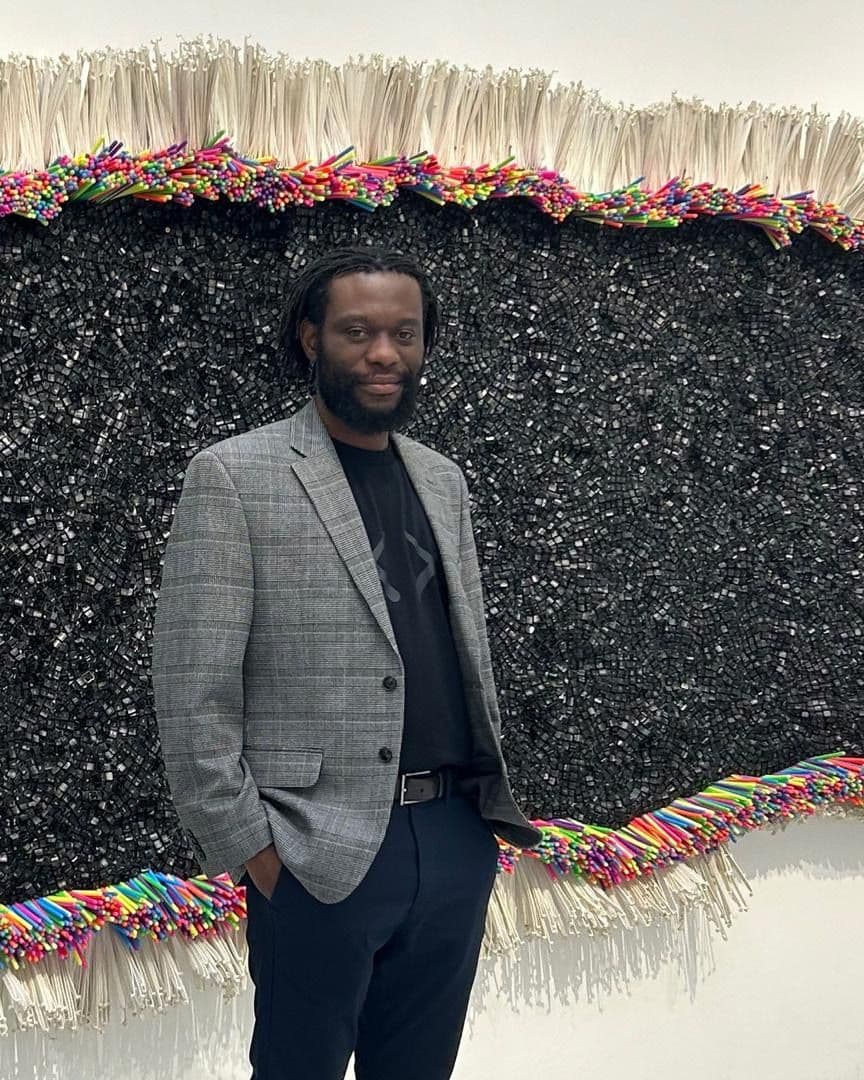
Moffat Takadiwa is a Zimbabwean sculptor and installation artist whose practice turns the discarded objects of everyday consumption into records of how people, economies, and histories are connected. Working in Harare with keyboard keys, bottle caps, toothbrushes, toothpaste tubes, calculator components, plastics, and other post-consumer materials, Takadiwa sorts and assembles waste into large-scale wall works that can initially resemble textiles or tapestries. The closer they are examined, however, the more clearly their former lives emerge. What appears decorative from a distance becomes an accumulation of objects shaped by consumption, trade, technology, and disposal.
The materials are therefore not simply a medium through which Takadiwa communicates an idea. They are part of the subject itself. Collected from dumps and informal recycling environments around Harare, the objects already carry evidence of the systems that produced and discarded them. Keyboard keys point toward technological consumption; bottle caps and plastic packaging toward everyday commerce; calculator components toward systems of measurement and exchange. By removing these objects from the waste stream and reorganising them into carefully structured compositions, Takadiwa changes their function without erasing their histories.

Photo Credit: Courtsey of the Artist
This process gives waste an archival quality. Each object is a small record of a larger economic and social system, and the accumulation of thousands of such fragments makes that system visible at another scale. Takadiwa’s practice consequently moves beyond an environmental critique. The work asks what discarded objects can reveal about the societies that produce them, who has access to particular goods, where those goods come from, and what remains after their usefulness has ended.
His relationship to waste is also grounded in place. Takadiwa works in Mbare, a Harare township closely associated with informal commerce and recycling, where the materials surrounding his studio are connected to the economic life of the community. The proximity between material source and working environment matters. These are not abstract symbols of global consumption collected from a distance; they are objects encountered within the social and economic landscape of the city.
The works also carry Zimbabwean and postcolonial dimension. Takadiwa’s practice draws partly on his Korekore heritage, bringing ancestral and contemporary forms of knowledge into contact with the material remains of global consumer culture. The resulting compositions place Zimbabwean cultural identity alongside imported goods and systems, complicating any simple division between local and foreign. Postcolonialism, consumerism, inequality, and environmental damage are therefore not separate themes but interconnected conditions within the same material landscape.
This tension is visible in the way the works balance attraction and discomfort. Takadiwa’s careful sorting of objects according to colour, shape, and type produces surfaces with rhythm and visual order. From a distance, the works can possess the formal qualities of woven textiles. Up close, that order is interrupted by the recognition of toothpaste tubes, plastic fragments, computer keys, bottle caps, and other discarded objects. Beauty and waste occupy the same surface without one cancelling the other.
Pregnant Picasso Bull (2024) demonstrates how this strategy can operate at the level of both material and cultural reference. The work incorporates Zimbabwean banknotes, bottle caps, calculator components, and computer keys, bringing together currency, commerce, technology, and discarded consumer goods. Its title introduces another layer of cultural reference, while the materials keep the work anchored in the economic realities from which they are drawn. The sculpture does not simply represent a postcolonial condition; it is physically constructed from some of its residues.

Photo Credit: Courtsey of the Artist
His 2023–24 body of work Vestiges of Colonialism, presented at Galeria Nicodim in Bucharest and the National Gallery of Zimbabwe, similarly approaches history through what remains. The title shifts attention away from colonialism as a completed historical period and toward its traces in contemporary life. In Takadiwa’s work, those traces can be found not only in institutions or monuments, but in the objects that circulate through homes, markets, streets, and waste sites.
The scale of his recent institutional presence has brought these questions into international contexts. Takadiwa participated in the 60th Venice Biennale in 2024 and was included in exhibitions at mumok in Vienna and the Orange County Museum of Art that same year. His work appeared at the Latvian National Museum of Art in Riga and CAPC Bordeaux in 2025–26, while the 36th São Paulo Bienal placed his practice within a major international exhibition of contemporary art. These presentations have expanded the contexts in which his material investigations can be read without separating them from their Harare origins.
The 2025–26 museum exhibition Recoded Memories at Washington and Lee University Art Museum offered a particularly focused presentation of this approach. Running from October 2025 to May 2026, the exhibition examined transformation, waste, memory, and the environmental consequences of global power structures. The title itself points toward one of the central operations in Takadiwa’s practice: materials that once belonged to one system are reorganized and given another function, allowing their histories to be read differently.
That process of transformation also extends beyond his individual studio. Takadiwa founded Mbare Art Space, an artist-led initiative housed in a repurposed colonial-era beer hall in Harare’s Mbare township. The space supports and mentors the local artistic community, connecting his concern with material environments to the development of cultural infrastructure. His practice therefore operates on two levels: he reassembles discarded objects into new forms, while also helping to create spaces in which artists can build new forms of cultural life.
Takadiwa’s work ultimately complicates the idea of waste as something that has reached the end of its story. A discarded keyboard key, bottle cap, or calculator component may appear insignificant on its own, but accumulated and reorganised, such objects begin to describe the systems that produced them. His sculptures ask us to look at what societies throw away as evidence of what they value, consume, import, use, and leave behind. In that sense, waste becomes an archive, not because it preserves the past untouched, but because it records the forces that continue to shape the present.