
Connect
© 2026 Kyekyekule Africa. All rights reserved.
kyekyekule.africa
© 2026 Kyekyekule Africa. All rights reserved.
kyekyekule.africa
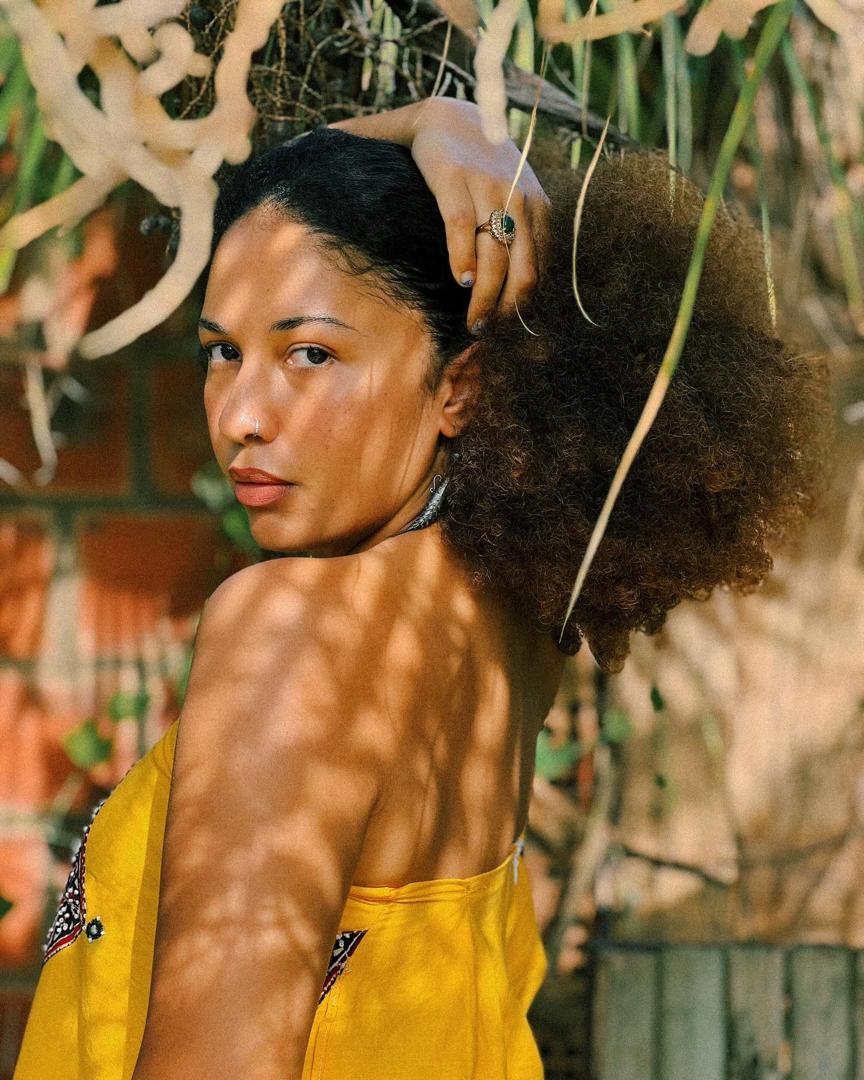
Visual Artist
Zambia
Acrylic on canvas, Cowrie shells, Oil pastel,

Emmanuel Agyapong
Author
Published on:
November 18, 2026
Mwaba Marie Chandia is a Zambian-Canadian visual artist based in Lusaka, Zambia. Drawing primarily on her Zambian heritage and multicultural experience, her practice examines the relationship between people, nature, identity and cultural memory. Through painting, printmaking, mixed media and installation, she explores how knowledge is embodied in physical forms and transmitted across generations.
Chandia’s work frequently places the female body within an imagined natural world, bringing together human, plant and insect forms to consider the connections between women and their environments. Traditional Zambian hairstyles, ceremonial dress, masquerade traditions and natural materials inform her visual language, while vivid colors and intricate patterns connect personal identity to broader histories of cultural expression.
Her practice is particularly interested in the relationship between the natural world and indigenous knowledge. Rather than treating nature as a separate landscape surrounding the human figure, she considers how people are part of these environments and how cultural knowledge is carried through the materials, objects and practices that communities inherit.
Cabinet of Curiosities: Questioning the Display of Black Bodies

Mwaba Marie Chandia, "Cabinet of Curiosities" 2 70cm x 70cm, acrylic on canvas, 2019. Image Credit; Courtesy of the Artist
An important starting point in Chandia’s practice is Cabinet of Curiosities, a series that examines the historical and contemporary display of Black bodies and cultural objects. The work considers how people and cultural artefacts have been presented, categorized and viewed, particularly within museums and other spaces of display.
Combining portraiture with botanical imagery, Chandia disrupts conventional representations of the human figure. Her interest extends to the ways Black bodies continue to be displayed and consumed through fashion, social media and other contemporary platforms. By bringing human figures into compositions that recall the arrangement of botanical specimens and museum collections, she questions the relationship between representation, ownership and the ways cultural objects acquire meaning.

Mwaba Marie Chandia; " Cabinet of Curiosities"5 140cm x 100cm, acrylic on canvas, 2022. Image Credit; Courtesy of the Artist
This concern with display and repatriation provides an important foundation for her later work. It also establishes her interest in the physical forms through which identity and cultural knowledge are preserved, interpreted and sometimes disconnected from their original contexts.
Where the Weird Things Are: Imagining New Relationships Between Women and Nature

Mwaba Marie Chandia; "Daughter of The Earth" 100cm x 80cm, acrylic, cowrie shells on canvas, 2025. Image Credit; Courtesy of the Artist
Developed from Cabinet of Curiosities, Where the Weird Things Are expands Chandia’s investigation into an imagined, Afro-futuristic world. The series brings together women, insects and plants to create hybrid beings that challenge conventional distinctions between human and natural life.
The female figure remains central, but her body is no longer presented as an entirely separate form. Plant structures, insect features, clothing and other natural elements become part of the figure’s construction. Through these combinations, Chandia imagines a future situated within an African context, one in which the relationship between indigenous communities and the natural world is expressed through new forms of existence.
Her visual references come from several sources, including contemporary fashion, Zambian ceremonial dress, traditional hairstyles and the environment around her. These references are not simply decorative additions. They connect the imagined figures to cultural practices and forms of knowledge that have been passed down through generations.

Mwaba Marie Chandia; "Pathfinder" 90cm x 80cm, acrylic, twine, cowrie shells on canvas, 2026. Image Credit; Courtesy of the Artist
Traditional Zambian masquerades, including Gule Wamkulu and Makishi, are particularly important to this exploration. Chandia is interested in the transformative role of masks and masquerade performances within ceremonial storytelling. In these traditions, the mask and costume help create a figure through which ancestral knowledge, collective memory and cultural narratives can be expressed.
Her work draws on this transformative potential. The hybrid beings in Where the Weird Things Are occupy a space between the familiar and the imagined, suggesting that identity can be formed through relationships with other living things, inherited traditions and the natural environment.
Patterns: Womanhood, Cultural Heritage and Visual Continuity

Mwaba Marie Chandia; "Good Fortune" 100cm x 80cm, acrylic, oil pastel, cowrie shells on canvas, 2026. Image Credit; Courtesy of the Artist
In Patterns, Chandia approaches related concerns through acrylic paintings on canvas, incorporating lino-printed backgrounds. The series celebrates womanhood and cultural heritage through vivid colors and repeated patterns influenced by Chitenge fabric, natural forms and Zambian symbolism.
Traditional hairstyles and the female form are central to the compositions. These elements connect the figures to cultural practices in which hair, clothing and adornment carry meanings beyond appearance. They become ways of expressing identity, belonging and continuity.

Mwaba Marie Chandia; "Crown" 100cm x 60cm, Acrylic, oil pastel on canvas, 2022. Image Credit; Courtesy of the Artist
The use of pattern is equally significant. Rather than functioning only as a background, the lino-printed surfaces establish a visual relationship between the figures and the cultural references surrounding them. The repeated motifs create a sense of movement and connection, allowing the paintings to bring together personal representation and shared cultural memory.
Across Patterns and Where the Weird Things Are, Chandia uses imagined worlds to consider how stories and knowledge are preserved. Her work suggests that cultural memory is not held only in written records or historical accounts. It also exists in hairstyles, textiles, ceremonial objects, patterns and the materials used in everyday and ritual practices.
From Painting to the Physical Properties of Natural Materials
A more recent development in Chandia’s practice is her movement towards material-based works. In 2026, she began experimenting with natural materials gathered from her immediate surroundings, including River Tamarind seedpods, dried lemongrass stalks, palm fibers, palm sheaths, wooden beads and cowrie shells.

Mwaba Marie Chandia; "The Shaker" River Tamarind pods, lemon grass, palm fiber & plaster, 2026. Image Credit; Courtesy of the Artist
This development introduces a different relationship between the artist and the process of making. In her paintings, she constructs figures through the deliberate arrangement of images, colours and patterns. In her newer works, the physical qualities of the materials increasingly influence the forms that emerge.
In a June 2026 conversation with Collective Cares, Chandia discussed collecting natural materials and allowing their shapes, textures and movement to guide her experiments. Rather than imposing a predetermined form on each material, she described trying to become less controlling and allowing the materials to inform the outcome.
Two works offer insight into this direction. The Shaker (2026) combines River Tamarind seedpods, lemongrass stalks, palm fibre and plaster. She Carries The Earth (2026) brings together palm sheath, hessian fibers, wooden beads and cowrie shells, suspended from a Bougainvillea branch.

Mwaba Marie Chandia; "She Carries The Earth", Palm sheath, hessian fibers, wooden beads & cowrie shells hanging from a bougainvillea branch. Image Credit; Courtesy of the Artist
These works move away from the canvas towards objects whose forms are shaped by the properties of the materials themselves. Their use of untreated natural elements also introduces the possibility of change and deterioration over time. Rather than treating permanence as the only measure of an artwork’s existence, Chandia allows the materials to retain something of their natural condition.
The presence of cowrie shells and plant fibres also connects this recent work to her wider interest in Zambian ceremonial traditions, where similar materials appear in masquerade attire. Their significance therefore extends beyond their visual qualities. They carry associations with cultural practices, inherited knowledge and the environments from which they come.
An Artistic Language Shaped by Family and Environment
Chandia’s relationship with natural materials is also connected to the artistic environment in which she grew up. She graduated from Emily Carr University of Art + Design with a Bachelor of Fine Arts and an honourable mention for the university’s Anti-Racism Award. Her multicultural experience, including studying in Canada and returning to Zambia, informs a practice that draws from different contexts while remaining grounded in her Zambian heritage.
In her conversation with Collective Cares, she discussed the influence of her mother, Laurey Nevers, a mixed-media artist who collected natural materials from the neighbourhood and incorporated them into her work. Chandia recognized a similar habit in herself, describing how she began collecting seedpods, dried palm leaves and lemongrass stalks from her surroundings.
She also recalled growing up around artists who worked with seedpods, including her sculptor father, Flinto Chandia, and artist Agness Buya Yombwe. These experiences point to a relationship between artistic practice, family influence and the transmission of knowledge through making. Her interest in natural materials is not simply a recent formal experiment; it is connected to an environment in which collecting, observing and transforming materials were already familiar activities.
This connection gives her recent work another dimension. The materials are drawn from the immediate environment, but they also recall the knowledge and practices of people who came before her. Their forms become a way of connecting personal memory to wider cultural histories.
An Expanding Practice
Chandia began exhibiting professionally in 2018 and has since participated in exhibitions in Zambia and internationally. Her exhibition history includes Echoes of the Ancestors at 37D Gallery in Zambia (2025), Open Horizons at Buat Fine Art Gallery in Spain (2025), and African Women in Art at the Real Círculo Artístico de Barcelona (2025). In 2026, she participated in Mosi-Oa-Tunya Perennial: Smuggling as Resistance, organized by the Livingstone Office for Contemporary Arts (LoCA) in Zambia.
She was a recipient of the Cynthia Zukas Young Artists Award in 2021 and the African Women in Art Award in 2024, under the emerging painting category. In 2026, she also participated in the Siyabonana Artist Residency at Zeitz Museum of Contemporary Art Africa in Cape Town, South Africa.
Across these developments, Chandia’s practice continues to examine how identity and knowledge are shaped through relationships between people, culture and the natural world. From the questions of display raised in Cabinet of Curiosities to the hybrid figures of Where the Weird Things Are, the cultural patterns of Patterns and her recent material-based experiments, she has developed a visual language that brings inherited references into new forms.
Her work does not treat cultural heritage as something fixed in the past. Instead, it considers how traditions, materials and stories can be reinterpreted, carried forward and transformed. By placing women within imagined natural worlds and allowing natural materials to shape physical forms, Chandia explores the possibilities of a practice in which memory, identity and the environment remain closely connected.