
Connect
© 2026 Kyekyekule Africa. All rights reserved.
kyekyekule.africa
© 2026 Kyekyekule Africa. All rights reserved.
kyekyekule.africa
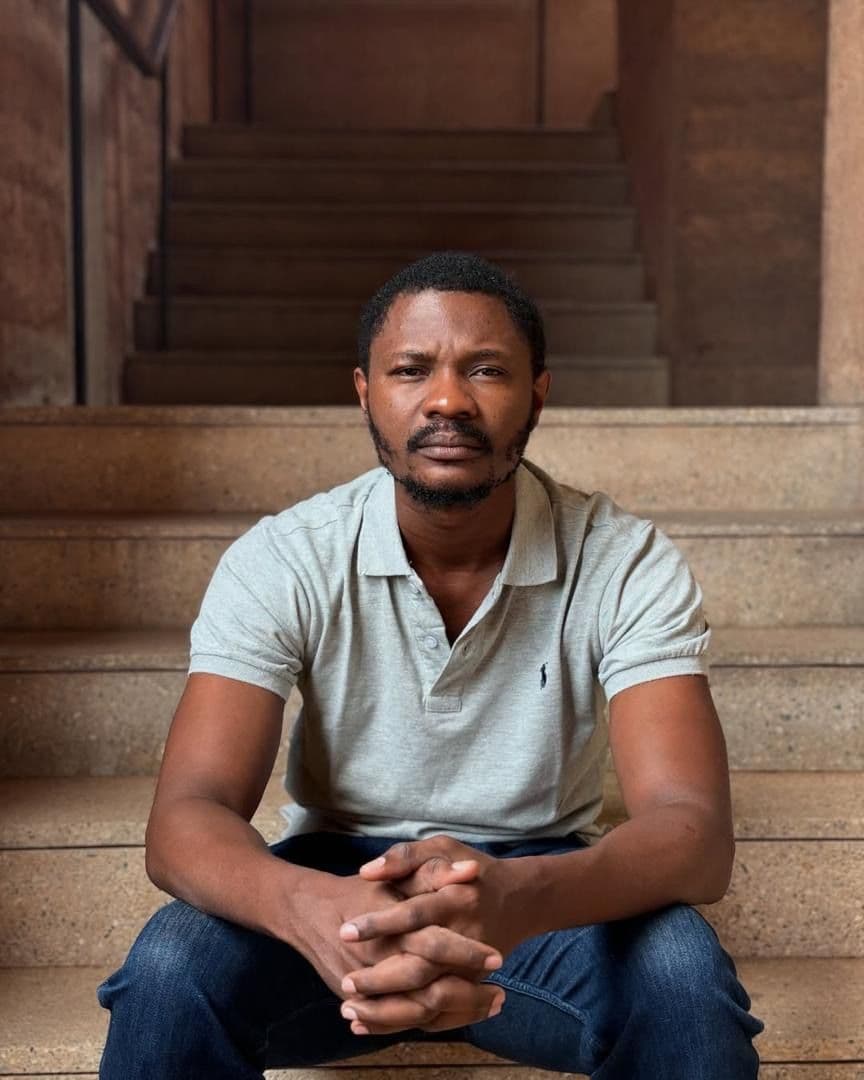
Painter
Benin
Acrylic on canvas

Emmanuel Agyapong
Author
Published on:
July 17, 2026
Nobel Koty is a self-taught Beninese painter born in Cotonou in 1988 whose practice returns repeatedly to the self-portrait, using his own face and body as the primary site through which to examine fragility, vulnerability, doubt, and the conditions of human existence. The repetition is significant. Koty does not treat the self-portrait as a record of appearance or autobiography alone, but as a sustained method of inquiry, returning to the same subject in order to examine what can emerge when the body is observed through changing emotional and psychological states. His paintings therefore move from the specific experience of one person toward questions that remain open to the viewer: what does the body reveal about what we carry internally, and what might become visible when there is nowhere else for attention to settle?
This inquiry is reinforced by the deliberate restriction of his visual language. Koty works primarily with browns, reds, and violets, while often removing contextual detail from the background. The resulting figures exist within spaces stripped of narrative distraction, leaving gesture, expression, proportion, and surface to carry the weight of the image. Without objects, environments, or elaborate settings to explain the subject, the body becomes both the image and its context. The absence of external markers turns the portrait inward, making physical presence the principal means through which uncertainty and vulnerability are communicated.
Paint itself becomes part of this argument. Koty builds his surfaces through layers that accumulate into volume, texture, and variations of light, giving the body a palpable physical density. This material density parallels the emotional conditions explored in the work. Feeling is not presented as something fleeting or immaterial; it appears to accumulate within the body, leaving traces and weight. The thickness of the paint consequently becomes inseparable from the psychological presence of the figure, making the surface a record of both physical construction and internal pressure.
The self-portrait also allows Koty to approach vulnerability from within rather than from the position of an observer. His subjects are placed in states of uncertainty and introspection without being transformed into symbols of weakness. Because the artist uses his own body as the recurring subject, vulnerability becomes an active condition of looking and making. The paintings do not claim to resolve doubt or explain emotional experience. Instead, they hold those states in view, allowing uncertainty to remain part of the subject rather than something the image must overcome.

Photo Credit: Nobel Koty
Animist thought provides another layer to this understanding of the body. The belief that body, soul, and spirit exist as interconnected dimensions informs Koty’s approach to self-representation, moving the work beyond psychological self-examination toward a more spiritual conception of embodiment. The painted body is not simply a physical container for emotion; it becomes a site where material, emotional, and spiritual experience meet. In this context, the repeated act of painting oneself takes on something of a ritual quality: a return to the body as a means of examining what it carries, what it remembers, and what remains difficult to articulate.
This inwardness does not isolate the work from the viewer. Instead, it creates the conditions for identification. By placing his own uncertainty directly before the viewer, Koty removes some of the distance that exists when vulnerability is represented through an anonymous or fictional subject. The face belongs to the artist, but the conditions it carries are not exclusively his. Doubt, fear, fragility, and introspection become points through which the viewer can encounter their own interior life, allowing the self-portrait to move from autobiography toward shared human experience.
Koty’s growing recognition reflects the significance of this sustained inquiry. In 2024, he received the Ellipse Prize for contemporary art, a major prize dedicated to Beninese artists, and presented his solo exhibition Incertitudes in France. His participation in Révélation: Art du Bénin at the Conciergerie in Paris, alongside a residency at dot.ateliers in Accra, further situates his practice within an expanding West African and international contemporary art context. These developments have increased the visibility of the work without altering the fundamental simplicity of its proposition: the artist returns to himself because the self remains the subject he has not finished examining.
Across Koty’s paintings, the removal of context is therefore not an absence but a method. By reducing the image to body, gesture, colour, and accumulated paint, he creates a space in which uncertainty cannot be displaced onto the surrounding world. The figure remains exposed, materially present, and unresolved. His self-portraits ultimately suggest that what remains when external markers fall away is not an empty remainder, but a complex interior world—and that sustained attention to the body can become a way of asking what, beneath everything we inherit and construct, it means simply to be alive.