
Connect
© 2026 Kyekyekule Africa. All rights reserved.
kyekyekule.africa
© 2026 Kyekyekule Africa. All rights reserved.
kyekyekule.africa
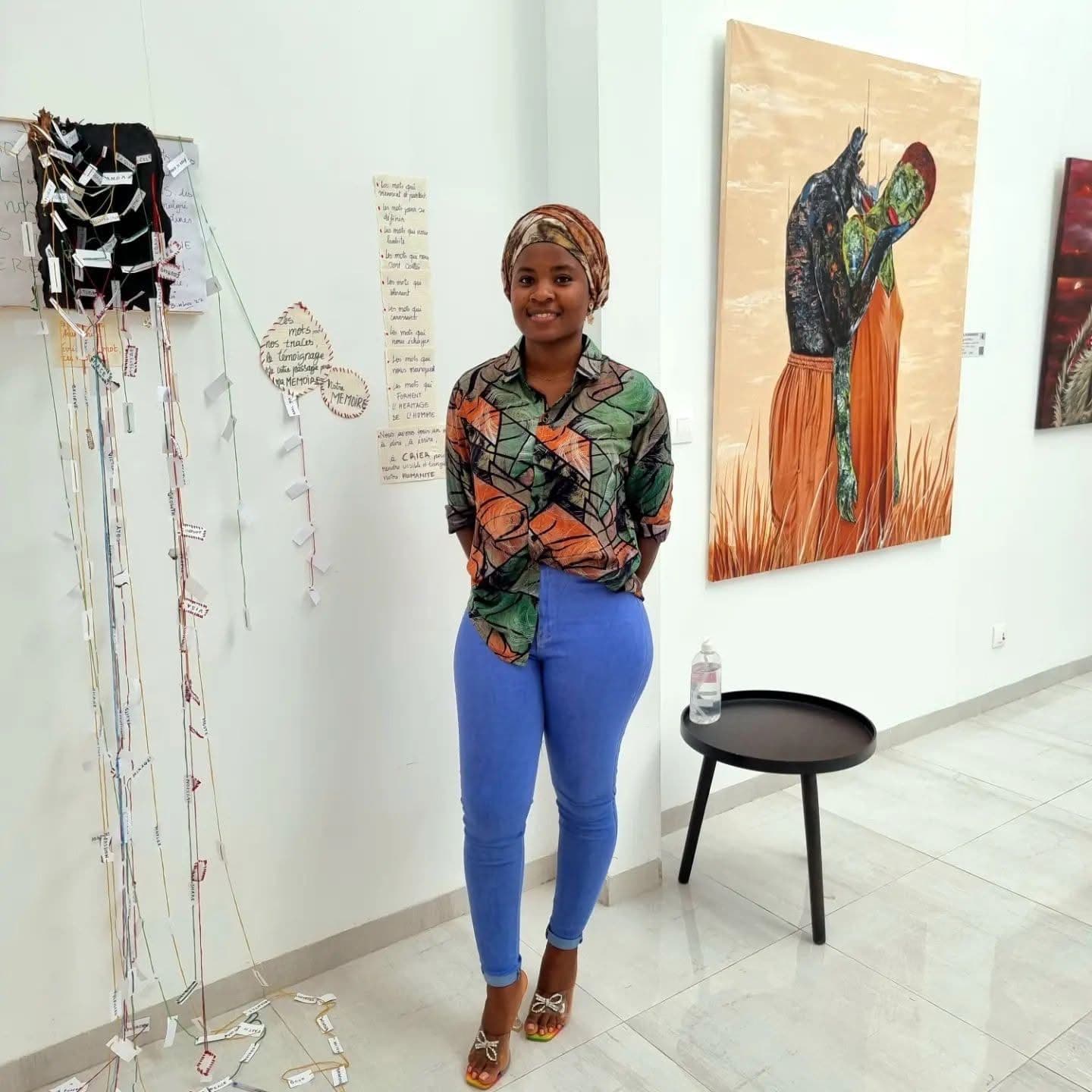
Painter / Collage
Cameroon
Acrylic on Canvas

Emmanuel Agyapong
Author
Published on:
September 2, 2026
Noumbimboo Leuna Njiele, known as Bimboo, is a Cameroonian painter and collage artist born in Garoua in 1996 whose practice combines acrylic and collage to construct figures whose bodies carry the textures and fragments of the natural world. Across her canvases, flora and fauna appear within the skin of her subjects, making landscape part of the body rather than something that exists around it. The result is a visual language concerned with identity, transformation, urbanisation, and the conditions of a generation coming of age within an increasingly unstable environment.
Bimboo’s use of collage is central to this proposition. Each fragment of paper becomes part of the figure, layered onto another fragment until the body appears assembled from multiple surfaces and histories. The process gives her paintings a sense of construction and incompleteness at once. Her figures are not presented as fixed identities but as bodies still being formed, carrying traces of the environments, experiences, and pressures that surround them.

Photo Credit: Noumbimboo Leuna Njiele
This relationship between the human and the natural world is more than a metaphor within the work. Bimboo transforms landscapes into human entities, allowing leaves, organic forms, textures, and fragments of the environment to become constituent parts of her figures. The distinction between person and landscape consequently begins to collapse. What happens to the environment is also happening to the body, and what happens to the body becomes a way of understanding the environment. Climate change and urbanisation therefore enter the paintings not simply as subjects but as conditions that shape how identity is experienced.
There is an intentional instability in these surfaces. Bimboo allows accident and ambiguity to remain visible, creating compositions that can feel suspended between softness and aggression, warmth and cold. These opposing qualities prevent the figures from settling into a single emotional register. The tension reflects the process her work describes: identity formed through change rarely moves in a straight line, and experiences of crisis can contain vulnerability and resistance at the same time. Rather than resolving these contradictions, Bimboo keeps them active within the image.
Her interest in transformation also complicates the conventional idea of portraiture. The figures are recognisable as human, but their surfaces continually disrupt the expectation that a body should remain stable or clearly defined. Skin becomes landscape; landscape becomes skin. The portrait consequently becomes a site of negotiation between the individual and the world that individual inhabits, suggesting that identity is never produced in isolation from physical surroundings, social conditions, or collective experience.
Bimboo’s formal education began at the Institut des Beaux-Arts de Nkongsamba in 2014, where she earned a professional degree in drawing and painting as well as a higher degree in visual arts. Her development has since been accompanied by growing recognition within Cameroon’s contemporary art landscape. In 2018, artist Barthélémy Toguo selected her for the Woman Power exhibition at Bandjoun Station. She later received the first prize Jeune Espoir in the Pascale Marthine Tayou competition in 2021, followed by residencies with Hervé Youmbi. Exhibitions at Doual’art in Douala and participation in the Douala Art Fair, alongside representation by 193 Gallery, have further situated her practice within conversations extending beyond Cameroon.
What gives Bimboo’s work its particular tension is the refusal to separate personal transformation from environmental change. Her figures are not simply placed within landscapes; they are materially composed from them. Every fragment layered onto the canvas becomes part of a body in transition, carrying evidence of the world that shaped it. In that sense, her paintings offer identity not as something discovered once and preserved, but as an ongoing process of accumulation, rupture, adaptation, and renewal.