
Connect
© 2026 Kyekyekule Africa. All rights reserved.
kyekyekule.africa
© 2026 Kyekyekule Africa. All rights reserved.
kyekyekule.africa
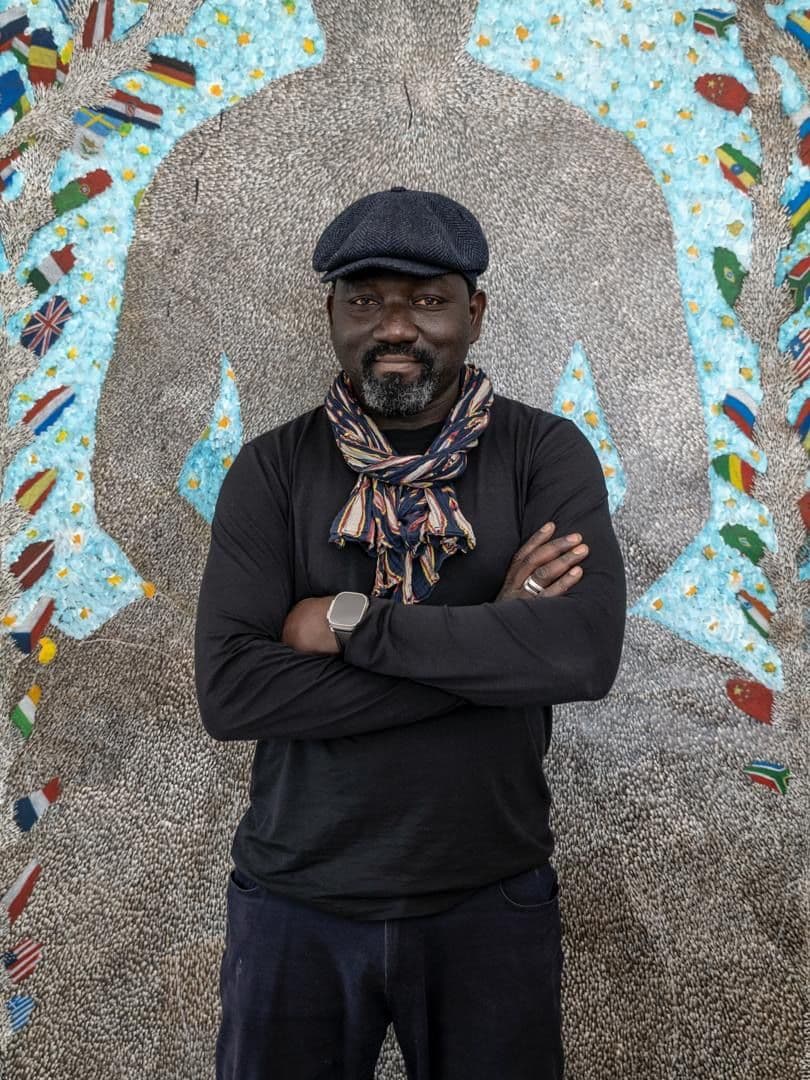
Multidisciplinary Artist
Senegal
Painting, Drawing & Mixed Media

Emmanuel Agyapong
Author
Published on:
October 7, 2026
Omar Ba Builds Imagined Worlds to Examine Power and History
A Political World Without a Single Political Event
Omar Ba’s paintings do not illustrate political events so much as construct a visual world in which questions of power, violence, history and control can be examined through invented forms.
Born in Senegal in 1977 and working between Dakar and Geneva, Ba brings together painting, drawing and mixed media to create compositions populated by hybrid figures, animals, plants, machines and recurring symbols. The result is a body of work that moves between African history, contemporary political realities and imagined futures without settling entirely into any one of them.
Figures That Refuse a Fixed Identity

Omar Ba, “Masters of war”, 2026 Mixed media on canvas 94 × 71 cm. Courtesy of the Artist
The characters that populate Ba’s paintings often resist immediate identification. A figure might suggest a political leader, soldier, animal or mythological being without becoming any of these things literally. Their ambiguity allows Ba to move away from direct representation and toward a symbolic language in which authority, conflict and social structures can take unfamiliar forms.
This is central to how the paintings operate. Rather than asking the viewer to recognise a particular person or event, Ba creates relationships between bodies, symbols and environments. Figures can appear exaggerated or hybrid, while animals and mechanical elements enter the same visual space as human forms. These combinations create a fictional universe, but the tensions within it remain recognizable.
Cardboard as Part of the Visual Language
Ba’s choice of cardboard is not simply a practical alternative to canvas. He has described it as more manageable than canvas and more absorbent than paper, qualities that affect how ink, pencil, oil, gouache and other materials settle onto the surface. The support therefore becomes part of the character of the work.
The roughness and absorbency of cardboard also complicate the relationship between the fantastical imagery and the physical object. Against an unconventional ground, Ba builds dense fields of colour, lines and symbols. The surface carries traces of the process while holding together the different materials that make up his visual vocabulary.
Between History and Invention
Ba’s imagery draws from African histories and cultural references while refusing to reproduce them literally. His paintings instead operate somewhere between historical memory and invented mythology. Figures can carry the presence of folktale heroes while simultaneously suggesting contemporary structures of political authority.
This movement between the known and the imagined allows history to remain active without becoming illustration. Colonialism, migration, violence, ecology and political power enter the paintings as underlying conditions. Ba’s fictional world becomes a space where these forces can be rearranged and examined from different perspectives.
Kidal and the Politics of Landscape
In Tempêtes de poussières à Kidal (2013), held in the Fondation Louis Vuitton collection, the reference to Kidal in Mali brings a specific geographical and political context into Ba’s symbolic language. The title connects the imagined world of the painting to a real place associated with political conflict and environmental conditions.
The work demonstrates how Ba can begin with a recognisable location without producing a straightforward account of it. Landscape, politics and atmosphere become intertwined, allowing the painting to hold several meanings at once. The reference to Kidal remains important, but it becomes part of a broader visual system in which human figures, environmental forces and political tensions coexist.
From Dakar to Geneva
Ba’s education at the École Nationale des Beaux-Arts in Dakar established an important foundation for his practice. His later studies at the École Nationale Supérieure des Beaux-Arts in Dakar and the Hochschule der Künste in Geneva extended that formation, while his relocation to Geneva in 2003 introduced another geographical and cultural position from which to consider Africa and its representation.
Working between Dakar and Geneva has become part of the context through which Ba’s practice can be understood. His paintings do not present Africa as a fixed subject viewed from a single location. Instead, they move between histories, geographies and systems of representation, bringing African references into conversation with wider global structures.
Myth as a Way of Speaking About Power

Omar Ba, “Alliés encombrants”, 2024 Oil, ink, acrylic, pencil, pigment on canvas 250 x 150 cm Courtesy of the Artist
The mythical quality of Ba’s figures does not remove the paintings from political reality. It gives him another way to approach it. A soldier can become a hybrid creature; a political figure can take on the qualities of an animal; a landscape can become a field of symbolic forces. These transformations make it possible to examine power without reducing the work to a single political message.
This is where the strangeness of Ba’s paintings becomes significant. Their bright colours and unusual characters can initially suggest play, but the visual world they construct is structured by questions of hierarchy, violence, control and survival. The paintings ask the viewer to look beyond the recognisable surface and consider what kinds of systems might produce the worlds being depicted.
Imagining Other Futures
Across Ba’s practice, invention is not an escape from reality. It is a method for reorganising it. By combining human and non-human figures, historical references, mechanical forms and invented symbols, he creates worlds in which existing relationships can be made unfamiliar.
That approach gives his paintings their particular tension. They belong to neither pure fantasy nor direct political commentary. Instead, they occupy the space between the two, using imagination to examine the structures that shape lived experience. In Ba’s work, the invented world is not separate from history; it becomes another way of seeing it.