
Connect
© 2026 Kyekyekule Africa. All rights reserved.
kyekyekule.africa
© 2026 Kyekyekule Africa. All rights reserved.
kyekyekule.africa
Painter
Ghana
Mixed Media

Emmanuel Agyapong
Author
Published on:
August 14, 2026
Raphael Adjetey Adjei Mayne, known as Afutumix, is a Ghanaian painter, mixed media artist, and fashion designer based in Cologne whose practice uses textile, painting, and assemblage to examine African sociocultural experience, gender politics, social marginalisation, and the philosophical dimensions of everyday Ghanaian life. His visual language has developed through more than a decade of self-taught textile practice, bringing a material vocabulary rooted in fabric, pattern, memory, and craft into conversation with contemporary figurative painting. The result is a practice in which cultural knowledge is not simply represented through imagery but embedded within the physical construction of the work.
Afutumix works with a sewing machine to attach uniquely sourced African fabrics and intricately woven patterns directly onto canvas before building acrylic elements across the surface. Textile and paint therefore operate as a single system rather than separate layers, with stitching becoming as important to the composition as brushwork. The seams, patterns, overlaps, and painted forms create surfaces that register both the labour of making and the histories carried by the materials themselves. His technique makes the canvas a constructed object, one in which meaning develops through accumulation rather than a single image.

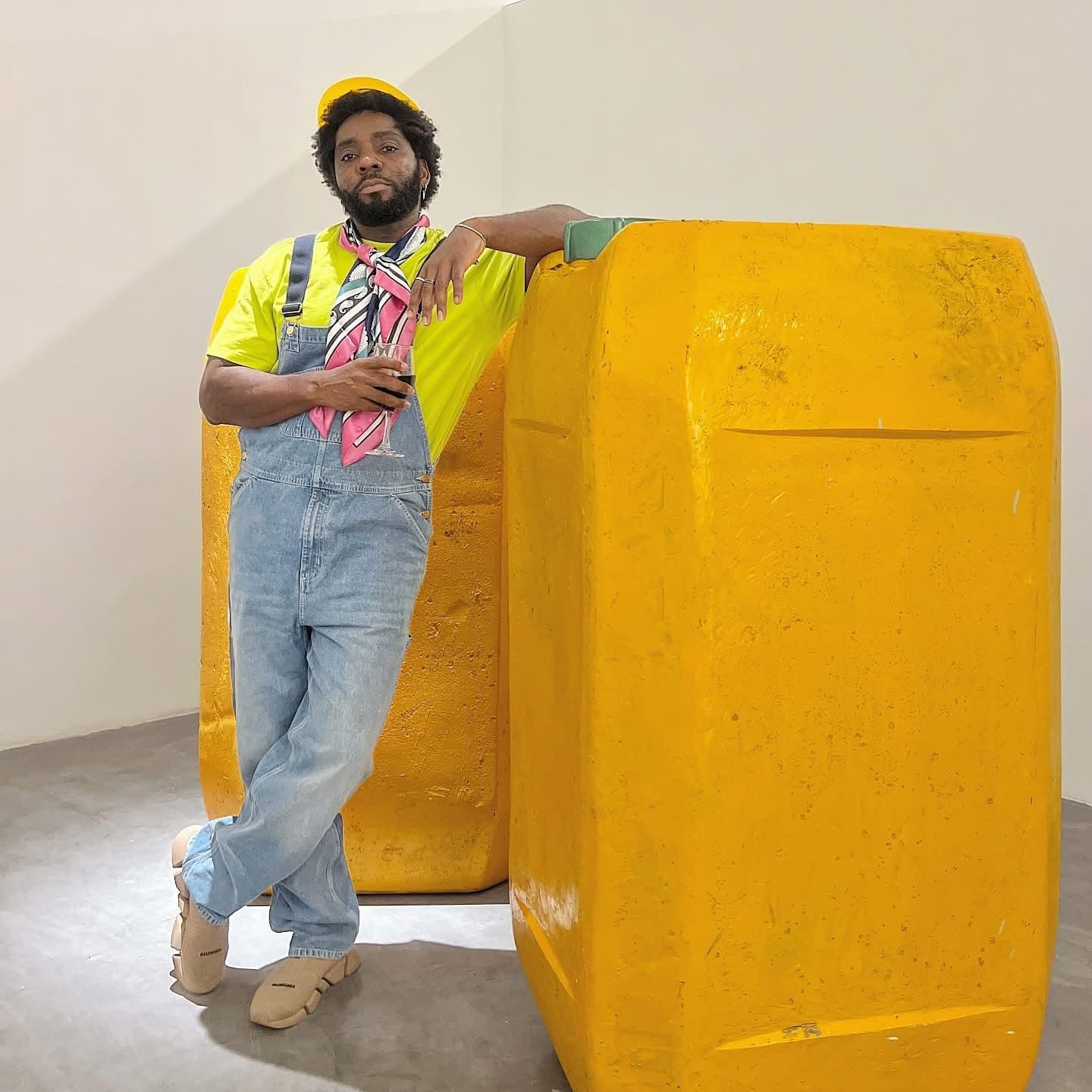
Photo Credit: Raphael Adjetey Adjei Mayne
This patchwork structure also provides a way of bringing different forms of time into the same work. Childhood memories, Adinkra philosophical symbols, personal experience, and contemporary social commentary can occupy the same surface without being reduced to a single narrative. The fabric carries cultural and personal associations before the painted figure enters the composition, allowing memory to exist materially rather than only through depiction. Stitching becomes a form of connection: between past and present, inherited knowledge and contemporary life, private recollection and collective experience.
The figures that emerge from these textile grounds are consequently shaped by the material surrounding them. Afutumix’s subjects come from across Ghanaian social life, including rural and urban communities and people situated at different positions within social structures. Their presence is not detached from the environments and histories represented by the fabrics beneath them. Instead, the figures appear held within a surface that carries its own cultural information, making the relationship between person, place, and material part of the portrait itself.
This approach gives the political dimensions of the practice a physical form. Questions of gender, marginalisation, and social hierarchy are not presented only through explicit imagery or narrative. They are embedded within decisions about whose lives enter the picture, how bodies occupy space, and what cultural materials are given prominence. The poetic and political therefore operate simultaneously: a familiar fabric pattern can carry philosophical knowledge, while a painted figure can bring that inherited language into relation with contemporary social realities.
Afutumix’s formation reflects this combination of formal education and independent material exploration. He trained at Ghanatta College of Art and Design alongside artists including Amoako Boafo and Otis Kwame Kye Quaicoe, while developing his textile practice independently over more than a decade. This parallel development is important to the character of the work. His painting is informed by an established artistic education, but the sewing, stitching, sourcing, and construction of his textile surfaces developed through a separate process of sustained experimentation.
The institutional reach of the practice has continued to expand. His portrait of Amanda Gorman entered the permanent collection of Harvard University’s Hutchins Center for African and African American Research, while his solo and group exhibitions across North America and Europe have placed his work within wider international contexts. Through the Afutumix Foundation, his engagement with community also extends beyond representation, supporting children within his Ghanaian community and connecting the social consciousness of his artistic practice with direct forms of investment.
Across Afutumix’s work, fabric becomes more than a material applied to canvas. It functions as archive, structure, and carrier of knowledge, allowing cultural memory and contemporary experience to remain visible within the same surface. The stitched composition holds different histories together without asking them to resolve into one story, reflecting a practice that understands African identity not as a fixed category but as something continuously assembled through memory, place, philosophy, social experience, and change.