
Connect
© 2026 Kyekyekule Africa. All rights reserved.
kyekyekule.africa
© 2026 Kyekyekule Africa. All rights reserved.
kyekyekule.africa
Mixed media
Ghana
Collage

Emmanuel Agyapong
Author
Published on:
May 12, 2026
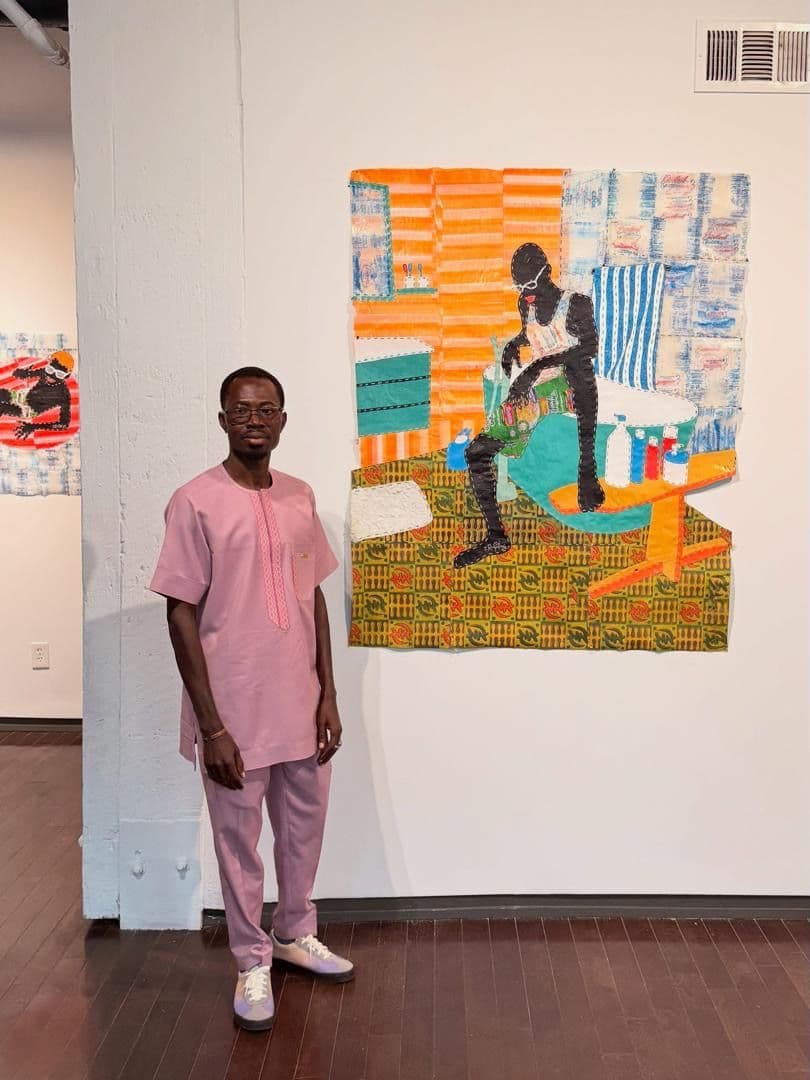
Rufai Zakari Jabre is a Ghanaian mixed media artist working between Accra and Bawku whose practice transforms discarded plastic bags, food packaging, and street-gathered waste into figurative portraits. His subjects emerge from materials associated with consumption and disposal, creating a tension between the dignity of the human figure and the social conditions embedded in the objects from which it is made.
The materials enter the work with histories of their own. A discarded plastic bag has already passed through a chain of production, purchase, use, and abandonment before it reaches Zakari Jabre’s studio. Through cutting, stitching, layering, and careful arrangement, he redirects that material history into images of people whose presence is given sustained attention. The resulting portraits hold two realities at once: the formal beauty of the image and the uncomfortable persistence of the waste beneath it. Neither is secondary to the other.
Many of Zakari Jabre’s subjects are women drawn from the rhythms of Ghanaian everyday life. They do not function as symbols of an environmental crisis, nor do they disappear into the material from which they are constructed. Instead, the figures assert themselves through it. Their posture, expression, clothing, and scale establish a sense of presence that challenges the disposability associated with the materials surrounding them. The contradiction is deliberate: objects treated as worthless become the means through which individual lives are rendered with care.
This is what gives the environmental dimension of the work its particular force. Zakari Jabre does not need to illustrate pollution or explain the consequences of waste. The evidence is already embedded in the surface. The plastic retains its associations with streets, markets, packaging, consumption, and accumulation, while the act of transforming it into portraiture asks the viewer to reconsider the value assigned to both material and subject. Waste is therefore not a visual shorthand for environmental concern. It is the physical condition through which the work makes its argument.

Photo Credit: Rufai Zakari Jabre
His practice is also grounded in a distinctly Ghanaian artistic and social context. Trained at Ghanatta College of Art and Design and further developed through an apprenticeship under Mozzay in Nima, Accra, Zakari Jabre’s approach emerges from a local visual culture in which resourcefulness, material reuse, and everyday observation are inseparable from artistic practice. The establishment of the Rujab Eco-Art Foundation in Bawku extends this thinking beyond the studio, connecting his environmental concerns to community engagement in northern Ghana and to questions of waste, land, and resources that have consequences beyond the gallery.
The reach of his practice has expanded considerably, with solo exhibitions in London, Berlin, Rome, and Mexico City and exhibitions across Africa, Europe, the United States, and the Middle East. His work is also held in the permanent collections of the Nubuke Foundation, the LAM Museum, and the Columbus Museum of Art. Yet the international context does not displace the specificity of the work’s origins. The streets, materials, people, and environmental conditions that inform the practice remain present in the portraits, even as the work enters wider conversations around contemporary African art and ecological practice.
Zakari Jabre’s portraits ultimately shift the question from what society throws away to what society decides is disposable. A plastic wrapper can be discarded without thought; a face demands attention. By bringing the two together, his work makes that distinction difficult to maintain. What appears first as a portrait gradually becomes a consideration of consumption, value, visibility, and the people and places that bear the consequences of what others choose to discard.