
Connect
© 2026 Kyekyekule Africa. All rights reserved.
kyekyekule.africa
© 2026 Kyekyekule Africa. All rights reserved.
kyekyekule.africa
Painter/ Sculptor
Togo
Pastel, Chalk, Pigments, Wood Sculpture & Ceramics

Emmanuel Agyapong
Author
Published on:
July 20, 2026
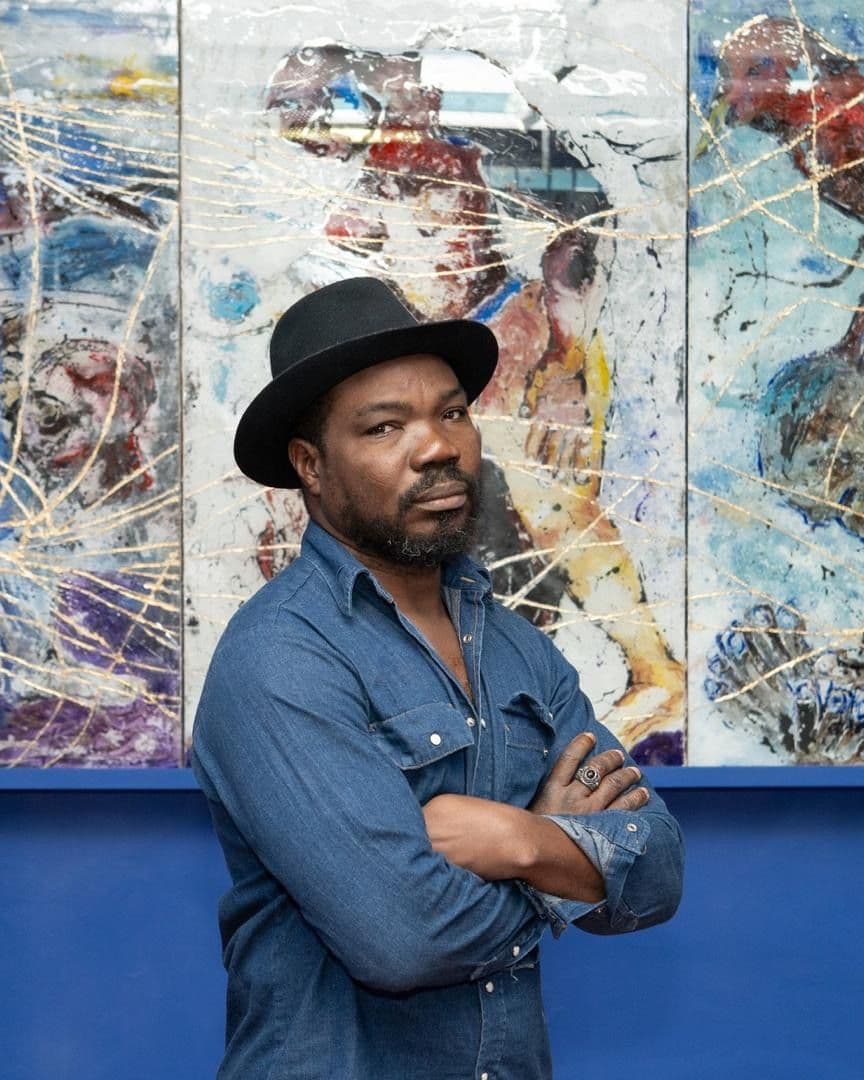
Sadikou Yaya Oukpedjo is a Togolese painter, sculptor, and draughtsman born in Kétao in 1975 whose practice moves across painting, wood sculpture, drawing, pastel, chalk, pigments, and ceramics to examine the unstable boundary between human and animal. His surfaces often carry a mineral quality, rough and layered as though the image has been excavated rather than simply painted, connecting his contemporary practice to much older forms of image-making while addressing questions of violence, inequality, power, and belief. Across these mediums, the figure becomes a site where human identity is unsettled rather than confirmed.
Oukpedjo’s therianthropic figures—bodies that combine human and animal characteristics—are central to this inquiry. They do not function simply as mythical creatures or symbols of transformation. By refusing to keep the human and animal separate, Oukpedjo questions the hierarchy that places humanity above the rest of the living world and asks what that separation has produced. The hybrid body becomes a way of examining the instincts, violence, vulnerability, and forms of domination that modern ideas of civilisation can obscure. What appears mythical is therefore closely connected to the realities of human behaviour.

Photo Credit: Sadikou Yaya Oukpedjo
The material character of his surfaces reinforces this relationship between contemporary practice and older forms of knowledge. Pigment, chalk, pastel, and other earthy materials produce bodies that seem to emerge from stone or earth, while the physical irregularity of the surface recalls the directness of prehistoric image-making. The connection to cave painting is not simply historical quotation. It places the act of representing the human and animal figure within a much longer history of image-making, before the divisions between art, ritual, spirituality, and knowledge became as firmly established as they are in contemporary Western institutions.
West African cosmology and oral traditions provide an important philosophical foundation for this approach. Oukpedjo draws on systems of thought in which relationships between human beings, animals, spiritual forces, and the natural world are not necessarily organised according to the strict divisions common to modern Western thought. His engagement with witchcraft similarly operates as a framework for considering where human actions come from and what forces shape behaviour. These references are not decorative markers of cultural difference. They provide conceptual structures through which questions of morality, power, conflict, and human nature can be examined on their own terms.
This becomes particularly consequential in his treatment of political and social violence. The hybrid figure allows Oukpedjo to consider the impulses that underlie domination without reducing conflict to a simple opposition between good and evil. Violence can be understood as part of a wider failure in the relationship between human beings and the systems they create: political authority becomes abuse, inequality becomes structure, and social divisions harden until they appear inevitable. By returning repeatedly to the unstable boundary between human and animal, Oukpedjo asks what forms of behaviour are concealed when societies define themselves through claims of human superiority and rational control.
His biography gives this inquiry a particular proximity to the conditions represented in the work. Oukpedjo trained under the Togolese master artist Paul Ahyi in Lomé in 1998, establishing a formal foundation within an important lineage of West African modern art. He subsequently worked in Mali before settling permanently in Côte d’Ivoire following the armed conflict in Mali in 2013. Movement across these countries and the experience of conflict provide a lived context for his attention to political power, inequality, and instability. These concerns are not imposed retrospectively upon the work; they form part of the environments through which the practice has developed.
The international contexts in which Oukpedjo’s work has been encountered have expanded considerably. His presentation of 7 Billion People, a major painting, sculpture, and installation project, at the 36th São Paulo Bienal places his practice within one of the most significant platforms for contemporary art globally. His work has also appeared at the Dakar Biennale, 1-54 Contemporary African Art Fair in London and New York, Art Paris Art Fair, Galerie Cécile Fakhoury, and Kristin Hjellegjerde Gallery. Auction results reaching $33,135 indicate growing market recognition, but the significance of the practice lies more fundamentally in the continuity between its material language and its philosophical concerns.
Across Oukpedjo’s work, the human figure remains deliberately unresolved. It can become animal, spirit, ancestor, or something that exists between these categories, refusing the idea that identity must settle into a single form. The mineral surfaces and hybrid bodies return the viewer to a world in which the boundaries between human, animal, earth, and spirit are less secure than modern categories suggest. His practice ultimately uses that instability to examine a question with political as well as philosophical consequences: if the distinction between human and animal is constructed rather than absolute, what forms of violence, hierarchy, and domination have been justified by insisting that it is?