
Connect
© 2026 Kyekyekule Africa. All rights reserved.
kyekyekule.africa
© 2026 Kyekyekule Africa. All rights reserved.
kyekyekule.africa
Visual Artists
Senegal
Painting, Drawing, Collage, & Mixed media

Emmanuel Agyapong
Author
Published on:
October 21, 2026
Serigne Ibrahima Dieye Turns Social Contradictions Into Visual Fables
In Serigne Ibrahima Dieye’s paintings, the familiar world takes on the logic of a fable. Hybrid animals, enigmatic figures and improbable encounters populate scenes that draw on contemporary life without adhering to its literal appearance. Working across painting, drawing, collage and screen printing, the Senegalese artist constructs images that examine the tensions beneath public appearances, social behaviour and political authority.
His selection for the 2026 Dakar Biennale brings this practice into focus at a moment when his work continues to circulate across Senegal and the international exhibition circuit.
A Theatre of Human Behavior

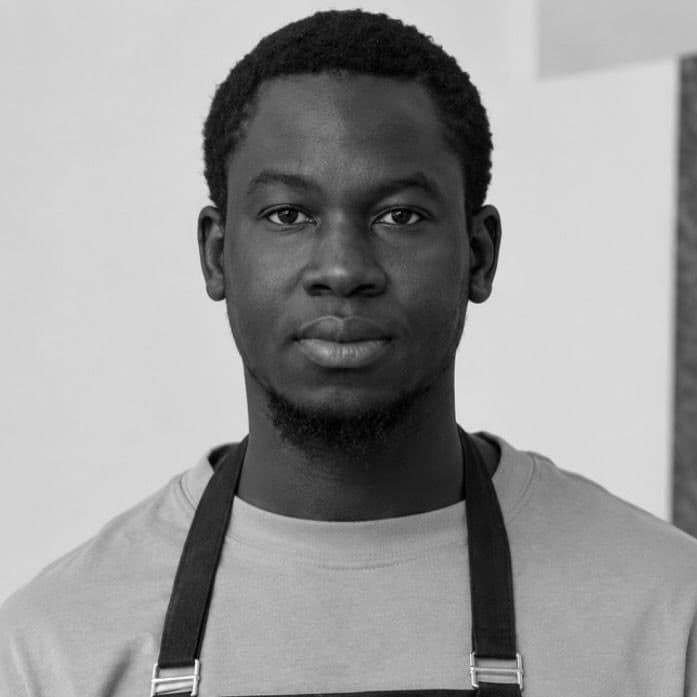
Serigne Ibrahima Dieye. Image credit: Courtesy of the Artist
Dieye’s compositions often resemble stages on which something has happened, or is about to happen, but the terms of the encounter remain uncertain. Figures occupy ambiguous positions; human and animal forms coexist; and relationships between subjects resist immediate explanation. The viewer enters a scene without being given a complete narrative.
This ambiguity is central to how the paintings operate. Rather than illustrating a specific event, Dieye draws on the language of allegory to approach the contradictions of contemporary society. His imagery makes room for absurdity, unease and the unexpected, allowing familiar structures of behavior and authority to appear strange enough to be examined.
The theatrical quality of the work is not simply a matter of dramatic composition. It also shapes the relationship between the image and its audience. A conventional narrative might identify its protagonists and explain their actions. Dieye leaves these connections less settled, requiring viewers to consider the positions his figures occupy and the conditions that might have produced their encounter.
His paintings consequently resist a single, predetermined reading. Their subjects may suggest recognisable social realities, but the images do not resolve into straightforward illustrations of them. Instead, Dieye creates a space between observation and invention in which the absurd can expose the inconsistencies of the world it resembles.
Painting Beyond the Literal

Serigne Ibrahima Dieye. Wavy metamorphosis gallery Cecile Fakhoury Dakar. Courtesy of the Artist
Political pretence and global power relations form part of the contemporary concerns associated with Dieye’s practice. Yet the significance of his work lies in how these subjects are approached. He does not depend exclusively on direct representation to make social conditions visible. He transforms them through imagined situations, combining recognizable references with forms that disrupt the viewer’s expectations.
The hybrid creature is one element of this visual language, but its meaning cannot be separated from the composition in which it appears. An animal figure does not automatically represent a particular political actor or human characteristic. Its role emerges through its relationship to other subjects, the surrounding space and the larger logic of the image.
This approach gives Dieye room to address power without reducing a painting to a statement about a single issue. The invented scene can hold conflicting implications at once. What appears comic may also be unsettling; what seems fantastical may recall the performance of authority in everyday life. The work derives its critical force from this instability rather than from an explicit explanation.
For Dieye, imagination becomes a way of reorganising reality. His paintings do not abandon the world outside the studio; they alter its terms, making visible the tensions that familiar representations can leave undisturbed.
Constructing the Image
Dieye works across painting, drawing, collage and screen printing, with large-format collage also forming part of his practice. These media offer different possibilities for building an image through line, surface, layering and the arrangement of forms.
Their importance is best understood in relation to the work each produces. Collage can bring disparate elements into proximity, creating visual relationships that do not depend on a unified source. Drawing establishes contours and gestures, while painting develops the interaction of figures, colour and space. Screen printing introduces another method of constructing and transferring imagery.
Rather than treating this range as a list of techniques, it is more useful to consider how each contributes to Dieye’s interest in scenes that remain open to interpretation. His images depend on the organization of multiple elements, and the relationships between those elements determine how a composition unfolds.
A closer comparison of works from different periods would establish how his handling of these media has changed over time. The available exhibition record provides a starting point, but the development of his technique is a question to be answered through the works themselves.
From Dakar to Paris and Abidjan
Born in Senegal in 1988, Dieye trained at the École Nationale des Arts de Dakar, graduating in 2013. His early exhibition history includes participation in the OFF program of the Dakar Biennale in 2014, placing him within Senegal’s contemporary art scene at the beginning of his professional trajectory.
His subsequent presentations brought his work into a wider range of contexts. In 2019, his exhibition record included the Cairo Biennale and 1-54 Contemporary African Art Fair in London. The following year, he participated in Feet Book, créer en partage at the Musée des Civilisations Noires in Dakar and Sumegne Ngaparou 2 at Fondation Blachère in France.
In 2021, Galerie Cécile Fakhoury presented Métamorphoses ondulatoires in Dakar. Two years later, Jungle noire was presented through the gallery in Paris and Abidjan. These exhibitions offer points of reference for examining how his work has been presented across different art scenes, from institutional programs to commercial galleries.
The record establishes a sustained exhibition practice, though it does not by itself demonstrate a linear evolution in the work. That requires closer attention to the paintings: the subjects Dieye returns to, the compositional choices he makes and the ways his visual language shifts between bodies of work.
Returning to the Dakar Biennale in 2026
Dieye’s selection for the 2026 Dakar Biennale’s international exhibition reconnects his practice with an event that has formed part of his exhibition history since 2014. His participation places him among artists presenting work within Senegal’s major international contemporary art gathering, offering audiences an opportunity to encounter his practice in its home context.
The Biennale arrives after a series of gallery and institutional presentations that have taken his work beyond Senegal. Seen against this history, the 2026 edition is less a sudden breakthrough than a new point of encounter with an artist whose practice has developed through sustained exhibition activity.
It also provides a timely setting in which to consider the place of imaginative painting within contemporary art. Dieye’s work does not rely on documentary realism to engage with the present. Instead, it builds visual situations through which social and political contradictions can be approached indirectly, without being reduced to a single narrative or message.
His participation therefore brings renewed attention to the particular terms of his practice: the construction of an invented world, the arrangement of figures within it and the questions that remain unresolved when the image refuses to explain itself.
The Limits of a Fixed Reading

Serigne Ibrahima Dieye. Wavy metamorphosis gallery Cecile Fakhoury Dakar. Courtesy of the Artist
Dieye’s paintings leave their narratives deliberately unsettled. The viewer may recognise the social conditions that inform them, but recognition does not necessarily produce certainty. Figures remain difficult to classify, encounters resist resolution, and the relationship between the imagined scene and the world beyond it stays in motion.
This openness should not be mistaken for an absence of direction. The paintings are carefully constructed, and their ambiguity depends on the relationships between the elements within them. Their meaning emerges through looking rather than through a fixed code in which each figure corresponds to a single idea.
A more complete understanding of Dieye’s practice will come from sustained engagement with individual works, including the changes in form and subject that distinguish one period from another. His exhibition history establishes the contexts through which this work can be encountered; close visual analysis reveals what holds it together.
In Dieye’s paintings, the strange is not separate from the real. It is a means of looking at the real from an unfamiliar position, and of questioning what familiar appearances have allowed us to accept without scrutiny.