
Connect
© 2026 Kyekyekule Africa. All rights reserved.
kyekyekule.africa
© 2026 Kyekyekule Africa. All rights reserved.
kyekyekule.africa
Painter
Cameroon
Acrylic on canvas, drawing from Pop Art and Surrealism

Emmanuel Agyapong
Author
Published on:
August 19, 2026
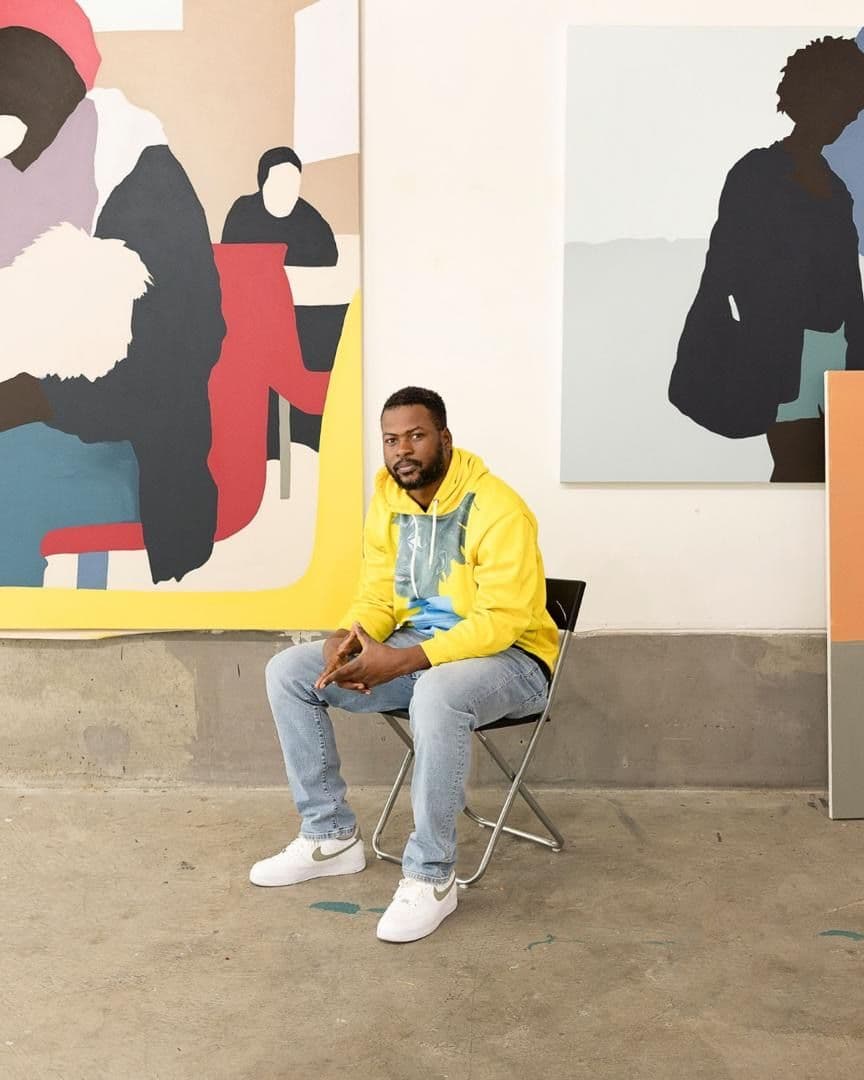
Sesse Elangwe is a self-taught Cameroonian painter born in 1994 and based in San Antonio, Texas, whose acrylic paintings draw on Pop Art and Surrealism to examine the social realities, psychological conditions, and lived experiences of Black communities across Africa and the United States. Although his practice is rooted in painting, his background in Political Science at the University of Buea provides an important context for the questions that run through the work: how people understand themselves, how communities are seen, and how systems shape the conditions in which they live. His portraits approach these questions through a visual language that is direct without being straightforward.
At the centre of that language is the asymmetric, oversized eye that recurs throughout his portraits. The enlarged eye does more than distinguish his figures; it makes the act of looking itself part of the composition. By disrupting the proportions of the face, Elangwe interrupts the familiarity of portraiture and draws attention to the relationship between the subject and the person viewing it. The eye becomes both an organ of perception and a device for examining perception, turning the viewer’s attention back toward the conditions under which they are looking.
This reciprocity is important to how Elangwe’s paintings operate. His figures do not simply present themselves for observation. They appear to observe, register, and sometimes confront the viewer, creating a visual exchange that complicates the conventional relationship between portrait and audience. The exaggerated eye therefore functions as a structural element through which critical awareness enters the work. Seeing becomes something that requires consideration rather than something that happens automatically.
The social and political dimensions of the paintings develop from this same concern with perception. Elangwe addresses identity, resilience, and the lived realities of Black communities across two geographic contexts, drawing from experiences shaped by both Africa and the United States. These subjects are not treated as distant social categories. They emerge through portraiture, where broader questions about race, identity, belonging, and community become attached to individual faces and bodies. The paintings consequently move between the personal and the collective, allowing a single figure to carry both intimate experience and wider social conditions.

Photo Credit: Sesse Elangwe
His use of Pop Art and Surrealism provides a visual framework for holding these tensions together. Pop Art contributes a language of immediacy and recognisable imagery, while Surrealism allows familiar forms to be disrupted and psychologically reconfigured. Elangwe brings these influences into a figurative practice where distortion is purposeful: the altered proportions of the face create a space in which ordinary ways of seeing can be questioned. The paintings remain accessible at the level of image while resisting passive consumption.
Elangwe’s development has unfolded largely outside conventional academic art training. He began exhibiting in 2013, holding his first exhibition in Buea at nineteen, and has since participated in more than twenty exhibitions internationally. Works from his practice are held in the Green Family Art Foundation in Dallas, the W Art Foundation in Shanghai, and the Lester Marks Collection in Houston. These contexts place his paintings within an expanding network of institutional and private collections while retaining the continuity of a practice that began in Cameroon and has developed across different cultural environments.
Across Elangwe’s portraits, the oversized eye remains the point at which form and inquiry converge. It changes the structure of the face, but more importantly, it changes the terms of looking: the viewer enters the work expecting to observe and encounters a figure that appears to observe back. In that exchange, Elangwe’s paintings locate critical awareness not as an abstract idea but as a condition of looking itself, leaving open the question of what becomes visible when attention is no longer assumed to be neutral.