
Connect
© 2026 Kyekyekule Africa. All rights reserved.
kyekyekule.africa
© 2026 Kyekyekule Africa. All rights reserved.
kyekyekule.africa
Painter
Tanzania
Acrylic on canvas

Emmanuel Agyapong
Author
Published on:
October 28, 2026
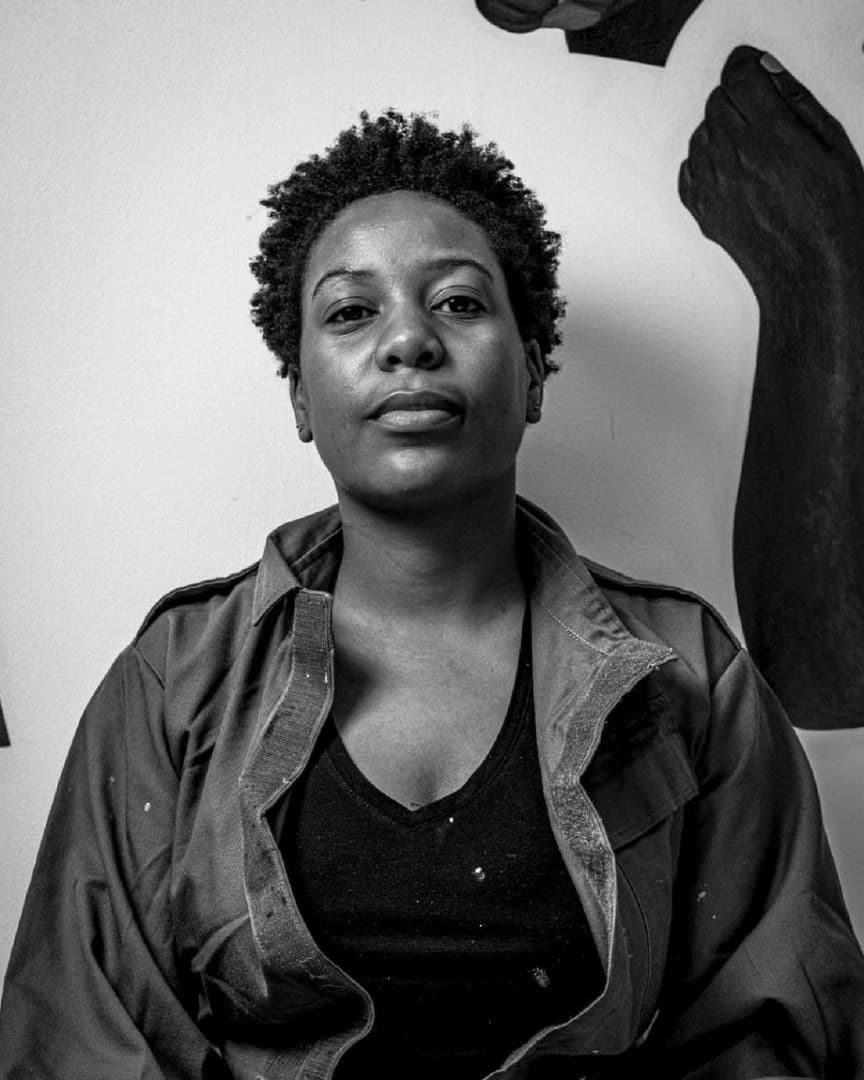
Sungi Mlengeya, the self-taught Tanzanian painter who builds her compositions around the relationship between the human figure and the space surrounding it. Working primarily in acrylic on canvas, she paints Black women in deep shades of black and brown against expanses of white, allowing posture, gesture and proximity to carry the composition.
What distinguishes this approach is not minimalism alone, but the way an apparently empty background becomes an active part of how the figures occupy the image.
The Space Around the Figure

Sungi Mlengeya, UNCLENCH, 2020 Acrylic on Canvas 140x200cm Courtesy of the Artist
Mlengeya’s use of negative space emerged through experimentation. In an interview with MADE IN BED Magazine, she described struggling to find a suitable background for a portrait before deciding to concentrate on the figure and leave the surrounding canvas untouched. The result established a visual approach she continued to develop.
That decision has consequences beyond appearance. Without a detailed setting to anchor them, the figures are not confined to a particular room, landscape or social environment. The white ground gives their bodies visual room while directing attention towards their relationships, expressions and physical presence. Space becomes something the figures inhabit rather than a background that explains them.
The restraint of the palette also places greater emphasis on the body as a means of communication. A change in posture or the distance between two figures can establish a relationship without requiring a detailed narrative. Mlengeya’s paintings therefore depend on what the figures do within the composition as much as on who they represent.
Her subjects often come from her own life: friends, family members and acquaintances whose presence has shaped her experience. These relationships provide the paintings with a personal foundation, even when a figure represents a broader feeling or moment rather than a specific individual. The women are not simply illustrations of an abstract idea of empowerment. They emerge from the artist’s attention to the people around her.
From Portraits to Movement

Sungi Mlengeya, MIKONO, 2026 Acrylics on Canvas 200 x 150 cm. Courtesy of the Artist
Mlengeya’s practice has developed from portraits towards compositions that include full bodies, varied poses and more sustained attention to movement. In a 2023 interview, she discussed how growing technical confidence allowed her to move beyond faces, introducing hands and legs before working with the body as a whole. Dance, part of her own life, has also informed her interest in how the body expresses what language cannot.
This shift changes the role of the figure. A portrait concentrates attention on the face and the act of looking; a full-body composition introduces gesture, balance and the relationship between one body and another. The figure can lean, stretch, turn or appear suspended, making movement part of the painting’s structure.
The white space remains essential to this development. It gives gestures room to unfold and allows bodies to be read in relation to one another without the distractions of a detailed setting. Stillness and movement are not opposites in these works. A figure may appear suspended in a moment of action, while the surrounding space holds that moment open.
Mlengeya’s compositions can also bring several women into the same visual field. Their arrangement creates possibilities for reading companionship, distance and shared presence. The relationships are not always explained, and the paintings do not need to supply a complete story. Instead, the viewer encounters a set of bodies whose gestures and proximity establish the terms of the image.
When Water Enters the Composition

Sungi Mlengeya, “Installation view of Tides of Being.” Courtesy of the Artist
In Tides of Being, presented from 10 April to 3 May 2025, Mlengeya introduced water as a more prominent element in her exploration of the human body. The exhibition extended her interest in women and negative space into a setting where bodies could appear to float, drift or merge with their surroundings.
Water alters the relationship between figure and ground. Where the white canvas gives the body room through absence, water introduces a material environment that reflects, distorts and reshapes the forms within it. Bodies become less fixed, their outlines subject to currents and changing states. The shift allows Mlengeya to explore movement without abandoning the visual economy that characterizes her work.
The women in these paintings continue to draw from her personal relationships, including friends, family and muses. Their presence links the exhibition to her earlier practice, while the water introduces a different way of thinking about the body’s relationship to its environment. The figures are simultaneously present and in transition, grounded by their physical form yet altered by the element around them.
Tides of Being also coincided with the publication of Mlengeya’s first monograph, extending the context through which her practice could be encountered. The exhibition marked a development in her visual language, not a complete departure from it: the body remains central, but the space around it has acquired a new physical character.
Earth and Sky: What Remains

Sungi Mlengeya, “Installation view of Earth and Sky.” Courtesy of the Artist
In 2026, Mlengeya’s exhibition Earth and Sky at Les filles du calvaire in Paris brought questions of memory and inheritance into sharper focus. Presented from 5 September to 24 October, the exhibition was described by the gallery as her first monographic exhibition in France.
The works emerged in the context of the death of her mother. Rather than treating loss as an endpoint, the exhibition considers what continues through the lives of others: gestures, ways of thinking, creative impulses and forms of knowledge that pass between generations. The title establishes a relationship between grounding and expansion, between what is inherited and what continues to develop.
Within this context, negative space takes on another dimension. The white surrounding the figures can be read as an open field in which presence persists without needing to be represented literally. The space does not illustrate an absent person; it allows the relationship between absence and continuity to remain unresolved. The figures occupy the canvas in the present while the exhibition considers the lives, memories and influences that make that presence possible.
This reading builds on the formal questions that have shaped Mlengeya’s practice from the beginning. Her paintings have consistently made the space around the body matter. In Earth and Sky, that space also becomes a way to approach what cannot be fully pictured: the influence of someone who is no longer physically present, or the ways a life continues through those who remain.
A Practice Built Through Experimentation
Mlengeya’s route into art was not a conventional one. She studied finance and worked in banking before leaving her job in June 2018 to pursue painting full-time. She developed her practice independently, learning techniques through sustained experimentation and online resources, then building professional connections through encounters with artists and the wider East African art community.
Her subsequent exhibition history includes Just Disruptions at Afriart Gallery in Kampala in 2021 and Unsettled Minds, a solo booth at Art Basel Miami Beach that same year. In 2022, * (Un)Choreographed* marked the reopening of The Africa Centre’s London home in Southwark, while Don’t Try, Don’t Not Try was presented by B.LA Art Foundation in Vienna. She was also included in When We See Us: A Century of Black Figuration in Painting, first presented at Zeitz MOCAA in Cape Town in 2022 and subsequently shown at Kunstmuseum Basel.
These exhibitions place her paintings within a wider conversation about Black figuration, but the specificity of her practice lies in how she constructs an image. Her figures do not depend on elaborate surroundings or descriptive detail. Instead, the relationship between body, gesture and space gives each composition its structure.
Recognition has accompanied this development, including her selection for Apollo 40 Under 40 Africa in 2020 and the Johnnie Walker and Trace Africa Top 30 list in 2022. Such distinctions establish the reach of her work, but the paintings themselves offer a more precise account of its direction: an ongoing investigation into how women occupy space, how bodies communicate and how personal relationships become visible without being reduced to narrative.
Mlengeya’s white backgrounds are never simply blank. They hold open the space in which her figures can stand, move and remain in relation to one another. Across portraits, full-body compositions and paintings shaped by water, that space has become a means of thinking about presence and continuity. The question is no longer only what a figure represents, but what the space around her allows her to become.