
Connect
© 2026 Kyekyekule Africa. All rights reserved.
kyekyekule.africa
© 2026 Kyekyekule Africa. All rights reserved.
kyekyekule.africa
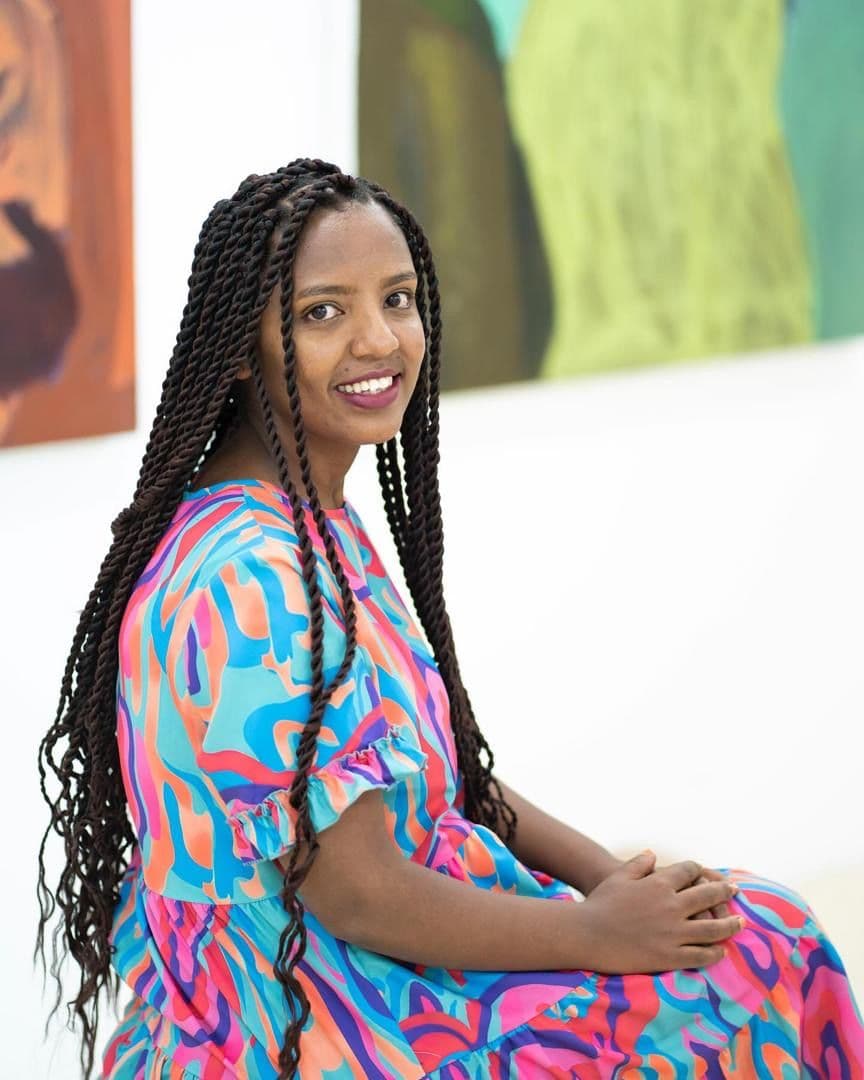
Figurative Painter
Ethiopia
Oil, Acrylic

Emmanuel Agyapong
Author
Published on:
October 2, 2026
Tizta Berhanu: When Love Becomes a Visual Language
Tizta Berhanu paints love as a condition of relation rather than a single romantic emotion. Born in Addis Ababa in 1991 and based in the city, the Ethiopian painter works in figurative oil painting, constructing bodies and faces through thin washes of colour that accumulate into dense fields of intimacy. Her figures lean into one another, overlap and sometimes appear to merge, creating paintings in which the boundaries between individuals become difficult to locate.
This refusal of clear separation is central to Berhanu’s understanding of connection. Her figures are not portraits of identifiable people but composites drawn from multiple references, allowing them to function as representations of emotional states rather than individual identities. Faces, hands and bodies become interchangeable points of contact, making the relationships between them more important than the question of who they depict.
Berhanu’s practice has developed around love, but the subject has expanded considerably over time. Romantic relationships remain part of the work, yet her paintings increasingly consider friendship, family, motherhood, care and the quieter forms of attachment through which people sustain one another. This expansion shifts love away from the language of romance and toward something practiced through presence, vulnerability and mutual dependence.
Her technique reinforces this movement from the individual toward relation. Rather than building figures through sharply defined contours, Berhanu layers thin oil washes and intense colour to create bodies that remain porous. Colour moves across skin, clothing and neighbouring figures, while overlapping forms complicate the distinction between one body and another. The paintings therefore do not simply depict closeness; their construction makes closeness part of the way the image exists.

Tizta Berhanu, Pile of Care, 2024. Oil on canvas, 170 x 150cm. Courtesy of the artist and Addis Fine Art.
This approach can be seen in works such as Pile of Care (2024), where the accumulation of bodies suggests that care can itself become a collective physical condition. The title directs attention away from individual identity and toward the relationships contained within the composition. What initially appears as a group of figures becomes a study of support: bodies gather, lean, overlap and occupy space together.
The same logic informs Berhanu’s recurring interest in overlapping figures. When one body enters another’s visual space, the painting resists the idea of intimacy as something easily contained within separate individuals. Her figures are connected without necessarily becoming indistinguishable. The tension between separation and merger gives the work its central visual problem: how can two people remain distinct while being profoundly shaped by one another?
This question has roots in Berhanu’s own development as an artist. She began drawing as a child and later pursued formal art education at the Alle School of Fine Arts and Design at Addis Ababa University, where she received her BFA in 2013. She also studied under the Ethiopian painter Tadesse Mesfin. Although she did not initially plan to pursue an artistic career, the need to make remained persistent enough to become a professional commitment. As she has put it, “I feel complete when I paint.”
Painting, then, operates in her practice as more than a medium for representing relationships. It is itself a form of sustained attention. The slow accumulation of oil washes mirrors the subject she returns to: connection is built through repetition, proximity and continued acts of care. The paintings do not present intimacy as an instantaneous encounter but as something that develops through time.
Berhanu’s position within contemporary Ethiopian painting has also expanded through a growing international exhibition history. Her work was included in When We See Us: A Century of Black Figuration in Painting at Zeitz MOCAA in 2022, following presentations including Art Dubai and The Armory Show, where her work was presented with Addis Fine Art. Subsequent exhibitions such as Synthesis of Souls and Agape continued her investigation of human connection through increasingly complex figurative compositions.
In 2026, this inquiry reached a new stage with Love Is A Practice, her solo exhibition with Tiwani Contemporary in London. The title is itself a proposition: love is not treated as a feeling that simply exists, but as something enacted through everyday forms of support, empathy and attention. The exhibition extends Berhanu’s earlier interest in romantic intimacy toward a broader understanding of the relationships through which people experience belonging.
That development is important because it prevents her paintings from being reduced to images of couples or romantic closeness. Berhanu’s figures can represent lovers, friends, family members or people whose precise relationship remains deliberately undefined. Their ambiguity allows the work to remain focused on the experience of connection itself rather than on a predetermined narrative.
Her recognition in 2026 through the Toyota Tsusho CFAO African Art Award further situates this evolving practice within the current international conversation around African figurative painting. Yet the central proposition of Berhanu’s work remains intimate rather than monumental. She is interested in what happens between people: the spaces they occupy together, the ways their bodies register attachment and the forms of care that rarely become visible until they are represented.
In Berhanu’s paintings, intimacy is therefore not simply something to look at. It becomes a structure within the image. Bodies overlap, colours bleed across boundaries and individual identities give way to relationships. The paintings ask us to consider connection not as an abstract ideal but as something constructed through repeated acts of attention, proximity and care. Love, in this sense, is less a subject than a method of being with others, and painting becomes the place where that method can be made visible.