
Connect
© 2026 Kyekyekule Africa. All rights reserved.
kyekyekule.africa
© 2026 Kyekyekule Africa. All rights reserved.
kyekyekule.africa
Painter
Tanzania
Acrylic on Canvas

Emmanuel Agyapong
Author
Published on:
August 10, 2026
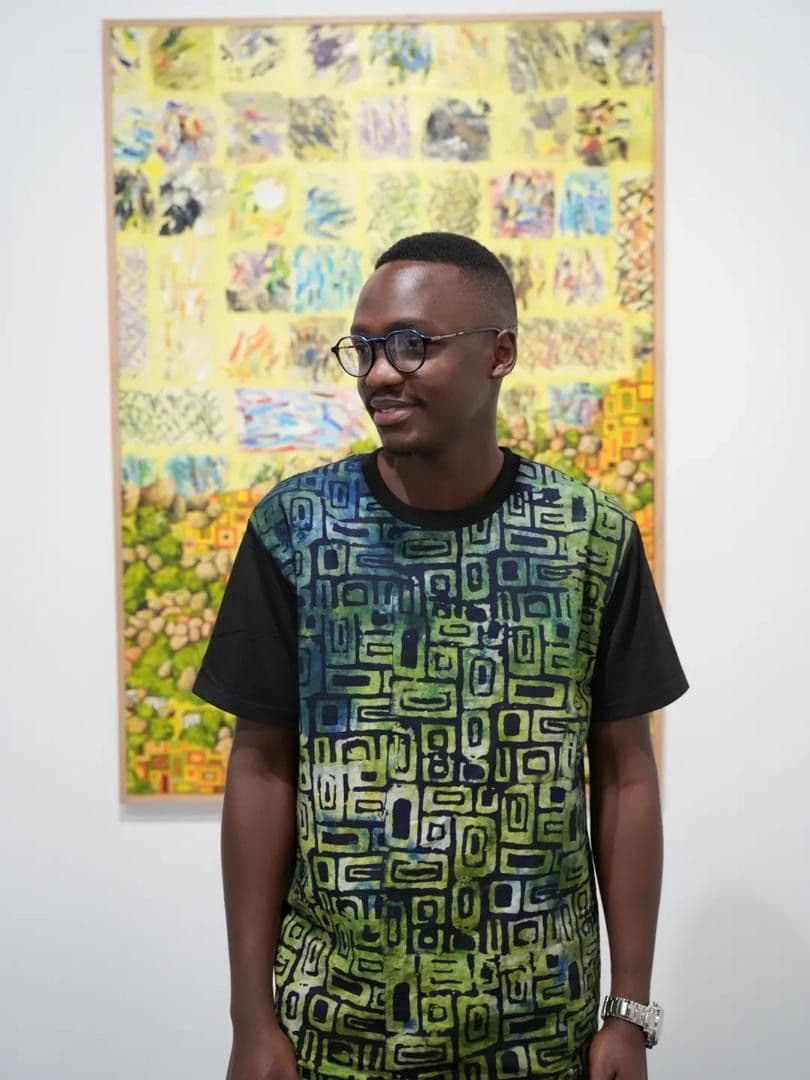
Undare Mtaki is a self-taught Tanzanian painter born in Mwanza in 1993 whose layered canvases incorporate beach soil from the shores of Lake Victoria, crushed stone, recycled tissue paper, found textiles, and acrylic paint to construct surfaces in which place, memory, ancestry, and time become materially present. Rather than using these elements as additions to an otherwise conventional painting surface, Mtaki allows the materials themselves to carry part of the meaning. Soil carries a relationship to land, stone carries physical weight, and found textiles bring traces of human use into the composition, making the canvas a site where different forms of memory accumulate.
This approach is informed by a background that initially seems distant from painting. Mtaki studied Architectural Engineering at Ardhi University in Dar es Salaam, graduating in 2019, and the structural thinking associated with that training remains visible in the organisation of his compositions. Materials are positioned with an awareness of weight, tension, balance, and surface, while the canvas is treated less as a neutral support than as something constructed. His decision to leave architecture and commit fully to art therefore represents less a rejection of his earlier discipline than a transfer of its structural sensibility into a practice where materials can hold emotional, cultural, and ancestral meanings.
The choice of materials is particularly significant because they connect the work to specific places and histories. Beach soil gathered from the shores of Lake Victoria does not simply reproduce the appearance of the landscape; it brings a physical fragment of that environment into the studio. Crushed stone and discarded textiles similarly introduce substances with histories that precede the painted image. By embedding them within the canvas, Mtaki allows the physical world around him to become part of the record, making material itself a form of testimony.
His subjects and themes develop from this relationship between physical matter and inherited knowledge. Identity, memory, manhood, and womanhood within Tanzanian life are explored through references to oral history, ritual, ancestry, and lived experience. Mtaki describes his practice as a form of self-portraiture across timelines, bringing the physical, emotional, and ancestral into the same field. The figure in this context is not confined to an individual present; it becomes connected to histories that extend beyond a single lifetime.

Photo Credit: Undare Mtaki
This understanding of identity also explains the density of the surfaces. Layers accumulate rather than resolve into a single, immediately readable image, allowing different histories to remain present at once. Tissue paper, fabric, soil, stone, and paint produce variations in texture and depth that make the act of looking partly physical. The viewer encounters a surface that has been built up through processes of addition and transformation, mirroring the way personal and collective identities are themselves shaped through accumulated experience.
Mtaki’s engagement with art extends beyond his own studio practice. Through the Undarey Art Gallery in Dar es Salaam, he has created a space for his work while contributing to the visibility and development of contemporary art within Tanzania. His exhibitions at venues including Alliance Française and The Drum Gallery place his practice within a wider cultural context, while the gallery provides another form of continuity between making, exhibiting, and creating conditions for other artistic practices to be encountered.
The sale of one of his paintings for $8,500 to a prominent Tanzanian businessman further situates the work within an emerging local collector context. More significant than the figure itself is what it indicates about the relationship between contemporary practice and its immediate cultural environment: Mtaki’s work is being collected and engaged with within Tanzania as well as beyond it. His trajectory therefore remains connected to the place from which the materials, histories, and questions of the paintings originate.
Across Mtaki’s practice, the canvas becomes a meeting point between landscape and memory. The soil, stone, fabric, and paper do not merely describe a world outside the studio; they bring parts of that world into the work, allowing the material history of a place to remain physically present. His paintings consequently ask us to consider memory not only as something carried by people, stories, and images, but also as something that can reside in the substances through which a place is known.