
Connect
© 2026 Kyekyekule Africa. All rights reserved.
kyekyekule.africa
© 2026 Kyekyekule Africa. All rights reserved.
kyekyekule.africa
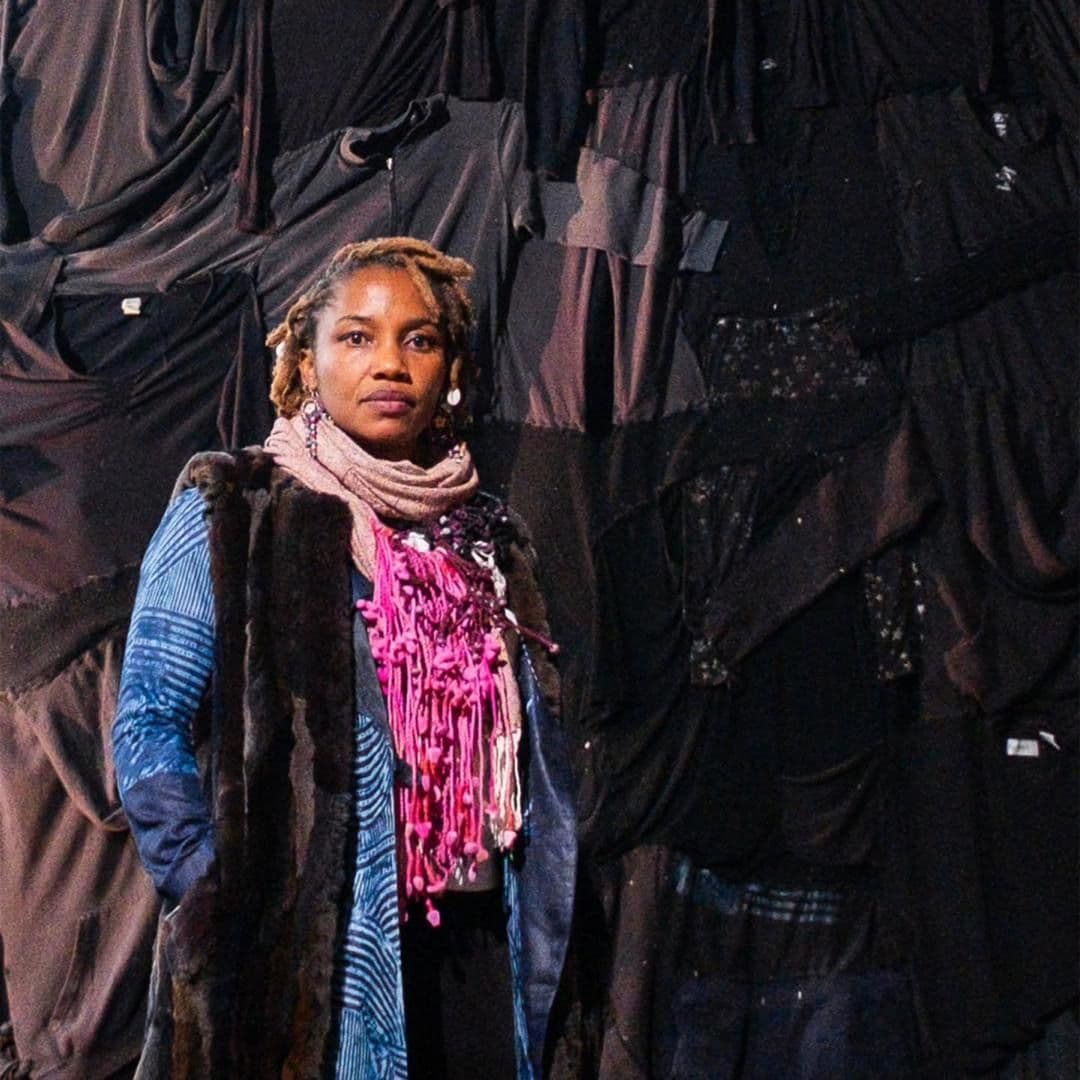
Interdisciplinary Artist
Nigeria
Textile, Sculpture, Installation & Performance

Emmanuel Agyapong
Author
Published on:
September 28, 2026
Victoria-Idongesit Udondian and the Hidden Labour Behind Second-Hand Clothing
Victoria-Idongesit Udondian’s practice begins with clothing, but it does not end with fashion. Born in Uyo, Nigeria, in 1982 and now based between Lagos and New York, Udondian works across textiles, sculpture, installation, performance, photography, video and ceramics to examine how garments carry histories of identity, migration, labour and trade. Her interest in clothing is also rooted in her own material education: before becoming a visual artist, she trained as a tailor and fashion designer.
For more than a decade, Udondian has examined what happens to clothing as it moves through the global economy—from production and consumption to reuse, export and eventual disposal. In her work, second-hand garments are not neutral materials. They record the systems through which they have travelled and the people whose labour sustains those systems. A discarded shirt, piece of fabric or length of rope can become evidence of a much larger relationship between consumption in the Global North and the infrastructures that receive, sort, sell and process unwanted clothing elsewhere.
This concern is central to Ofong Ufok (2019–2022), a body of large-scale hand-woven textiles made with second-hand clothing, repurposed textiles, rope and dye. The work considers clothing as a carrier of migration and labour, drawing attention to the people who remain largely invisible within the global second-hand clothing economy. Udondian’s textiles therefore operate simultaneously as objects and records: their materials retain traces of circulation while their construction transforms those traces into another form of visual and material language.
Her relationship with clothing is inseparable from questions of labour. Tailoring provided her with an early understanding of fabric as something that can be cut, assembled, repaired and transformed. That knowledge continues to shape her contemporary practice, where sewing, weaving, dyeing and reuse become ways of investigating economic and social systems rather than simply techniques for producing an image. Her work moves between fashion and contemporary art without treating either field as fixed, using the material language of clothing to examine who produces, who consumes and who is left to manage what consumption leaves behind.

Victoria-Idongesit Udondian "Okrika Reclaimed” - a powerful art installation at Accra's Kantamanto market. Courtesy of the Artist
This question became particularly concrete in Okrika Reclaimed, developed at Kantamanto Market in Accra. Working with discarded clothing collected from the market, local communities and Revival Earth, Udondian approached textile waste through a combination of installation, reuse, workshops, cleanup activities and performance. The project locates the global clothing economy within a specific social and material environment, where garments arriving from elsewhere become part of the daily labour of traders, sorters, makers and waste workers. Rather than treating waste as an abstract environmental problem, Okrika Reclaimed traces the human systems through which it is encountered and negotiated.
Kantamanto is significant to Udondian’s practice because the market makes visible a circulation that is often obscured elsewhere. Clothing discarded by consumers does not simply disappear. It moves through networks of trade and resale, acquiring new economic and social lives while also generating material consequences. Udondian’s engagement with the market turns these movements into a site of artistic research, asking what clothing reveals about the unequal geography of global consumption.

Victoria-Idongesit Udondian "How Can I Be Nobody" site-specific solo exhibition at smack Mellon. Courtesy of the Artist
Her work also considers the relationship between clothing and identity. In How Can I Be Nobody (2022), presented at Smack Mellon in New York, Udondian examined Black identity, migration and the lives shaped or lost through migratory movement. Here, clothing becomes connected to the body that wears it and to the histories that can remain after that body has moved, changed or disappeared. The garment is both personal and economic: it can signify belonging while simultaneously participating in systems of labour and exchange that extend far beyond the individual.
That movement between the intimate and the systemic has become increasingly visible in Udondian’s international practice. Her work has been recognised through a 2019 MacDowell Fellowship, a 2020 Guggenheim Fellowship and the 2024 Anonymous Was A Woman Environmental Art Grant for Okrika Reclaimed. In 2026, Ofong Ufok and Okrika Reclaimed are presented together in the main exhibition of the Venice Biennale, In Minor Keys, under the title Obroni Wawu. The presentation places her sustained investigation of clothing, waste and global exchange within one of the most visible contexts in contemporary art.

Victoria-Idongesit Udondian "Obroni Wawu (2019-2026) Dead white man's clothes at the 61st la biennale di Venezia. Courtesy of the Artist
Yet the significance of Udondian’s practice is not simply that discarded clothing becomes art. Her work changes the terms through which clothing can be understood. A second-hand garment can be a commodity, a marker of identity, evidence of migration, a record of labour and a piece of environmental waste at the same time. By moving these materials into textiles, installations and performances, Udondian makes their overlapping histories difficult to separate.
Her trajectory from tailoring and fashion design to international contemporary art, makes this material continuity particularly important. Even before clothing became the subject of her artistic research, she understood it through the practical knowledge of making. That experience gives her work an unusually direct relationship with the material systems it examines. The fabric is not merely representing labour; it has already passed through it.
Udondian’s practice ultimately asks us to look beyond the moment when a garment is purchased or discarded. What happens after clothing leaves the person who bought it? Who handles it, sorts it, repairs it, resells it or absorbs its waste? And what histories remain embedded in the material as it crosses borders and changes hands? For Udondian, clothing provides a way into these questions because every garment already carries a record of movement. Her work makes that record visible.