
Connect
© 2026 Kyekyekule Africa. All rights reserved.
kyekyekule.africa
© 2026 Kyekyekule Africa. All rights reserved.
kyekyekule.africa
Multidisciplinary Artist
Ethiopia
Mixed Media

Emmanuel Agyapong
Author
Published on:
June 25, 2026
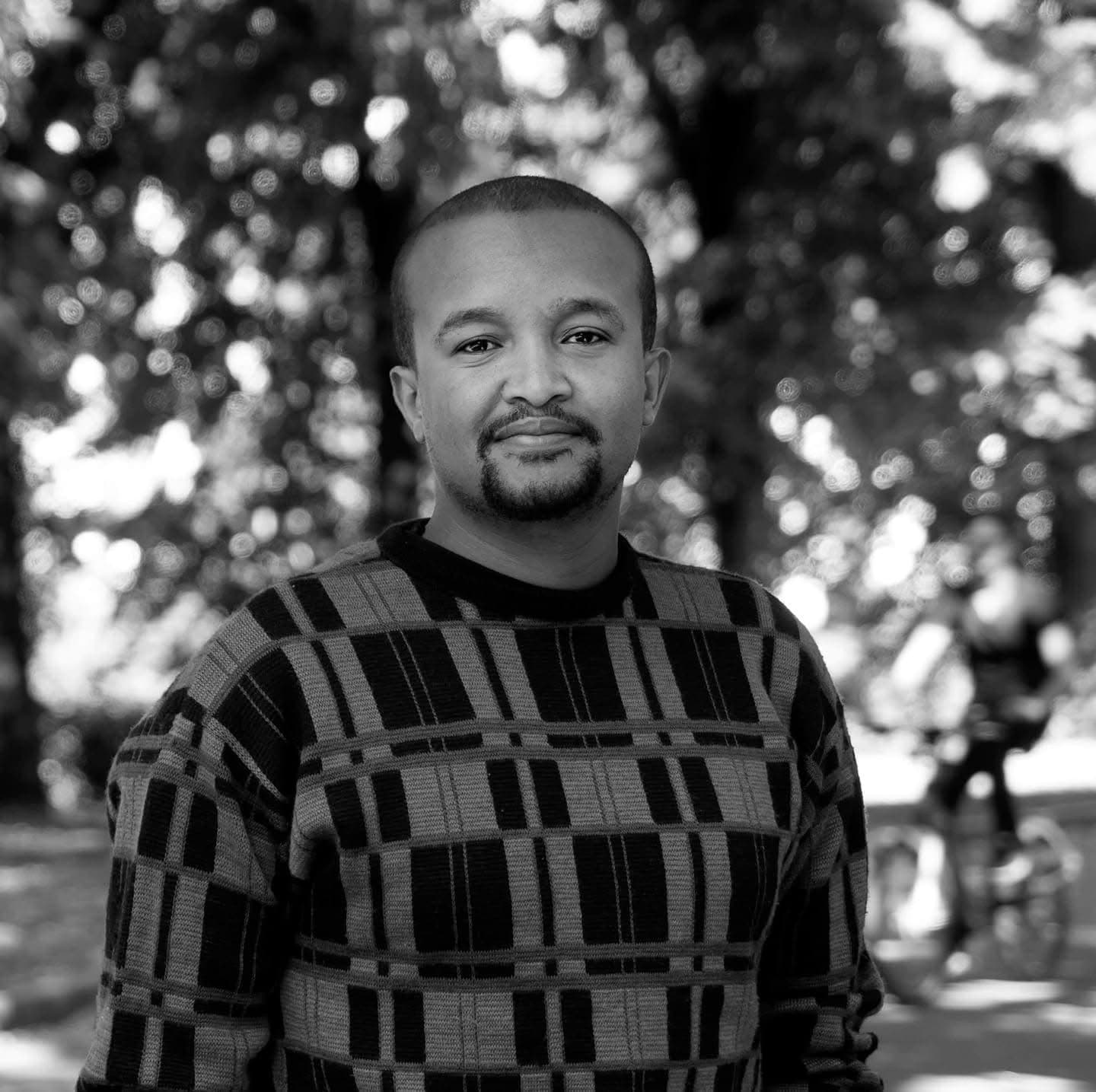
Wendimagegn Belete, known as Wende, is an Ethiopian multidisciplinary artist living between Oslo and Addis Ababa whose large-scale mixed-media practice examines how history, identity, and memory move across generations and remain present long after the original experience has passed from living memory. Working with archival photographs, letters, maps, and recorded conversations alongside spray paint, hand-stitched textiles, digitally manipulated photographs, oil sticks, acrylic, and charcoal, Belete constructs what he describes as a visual memory map. His works bring fragments of personal and collective history into the same physical field, creating surfaces in which memory appears not as a complete record but as something layered, interrupted, and continually reconstructed.
The concept of epigenetic inheritance provides an important framework for understanding this process. Belete approaches ancestral memory as something that can persist within the body and emerge through creative practice. This idea is not simply a theme applied to finished works; it informs their construction. Archival photographs overlap with painted gestures, textiles are stitched into existing surfaces, and digital images are altered and reintroduced into compositions, creating material relationships in which no single layer can fully account for the image. The work becomes an enactment of inherited memory: accumulated, partially obscured, and carried forward without ever becoming completely separable into its individual parts.
The archive is therefore central but never treated as neutral evidence. Photographs, letters, maps, and recorded voices carry the perspectives and limitations of the systems through which they were originally produced and preserved. Belete’s interventions disrupt the authority of those records by altering, layering, stitching, and recontextualising them. The archival image remains visible, but it is no longer allowed to function as the final account of what happened. Through this process, history becomes something that can be revisited and reinterpreted from within the communities whose lives those archives attempted to document.
This is particularly significant in his engagement with Ethiopian history and the politics of colonial representation. Belete’s work challenges the ways African histories have been filtered through external systems of documentation, where complex societies and individual lives could be reduced to images and narratives produced for purposes that did not belong to the people being represented. His use of archival material does not simply recover what has been forgotten. It questions the conditions under which certain memories were preserved, others were excluded, and particular images came to stand in for much larger histories. Reworking the archive becomes a form of reclaiming narrative authority.

Photo Credit: Wendimagegn Belete
The breadth of his practice follows from this understanding of memory as something that exceeds a single medium. Painting, installation, tapestry, sculpture, video, and archival photography allow different kinds of evidence to occupy the same inquiry. A photograph can carry historical distance; a stitched textile can introduce touch, labour, and continuity; paint can obscure or reactivate what lies beneath it. These materials do not function as separate stylistic experiments. They provide different ways of approaching a subject that is itself fragmented across time, bodies, documents, and recollection.
Belete’s own formation moves between two artistic contexts. He completed a BFA at Addis Ababa University in 2012, graduating among a cohort of twenty-five students from Ethiopia’s only formal art academy at the time, before completing an MFA at the Tromsø Academy of Contemporary Art in Norway in 2017. His movement between Addis Ababa and Norway places his practice within different institutional and cultural frameworks, but also reinforces one of its central conditions: the negotiation between places, histories, and systems of knowledge. The distance between these contexts becomes productive rather than merely biographical, allowing questions of belonging and inheritance to remain active within the work.
His international recognition has developed alongside this sustained engagement with history and memory. Belete was shortlisted for the Future Generation Art Prize in 2021 and participated in a Venice Biennale group exhibition that same year, followed by participation in the 2024 Gwangju Biennale. His work has also received critical attention from publications including ARTnews, Art South Africa, and The Art Newspaper. These contexts have expanded the reach of his practice while maintaining its grounding in the specific histories and cultural inheritances from which the work begins.
Across Belete’s visual memory maps, the past is never presented as something finished and safely contained within an archive. It remains active within images, materials, bodies, and the stories that move between generations. A photograph can be stitched into a painted surface; a recorded voice can become part of a layered composition; a historical document can be interrupted and made to speak differently. His practice ultimately makes visible a form of inheritance that is difficult to locate in any single record: the weight of histories carried by people who did not experience them directly, but continue to live with their consequences. In Belete’s work, memory becomes both archive and embodiment—a collective history that survives by being continually reconstructed.