
Connect
© 2026 Kyekyekule Africa. All rights reserved.
kyekyekule.africa
© 2026 Kyekyekule Africa. All rights reserved.
kyekyekule.africa
Painter
Nigeria
Oil on Canvas

Emmanuel Agyapong
Author
Published on:
August 12, 2026
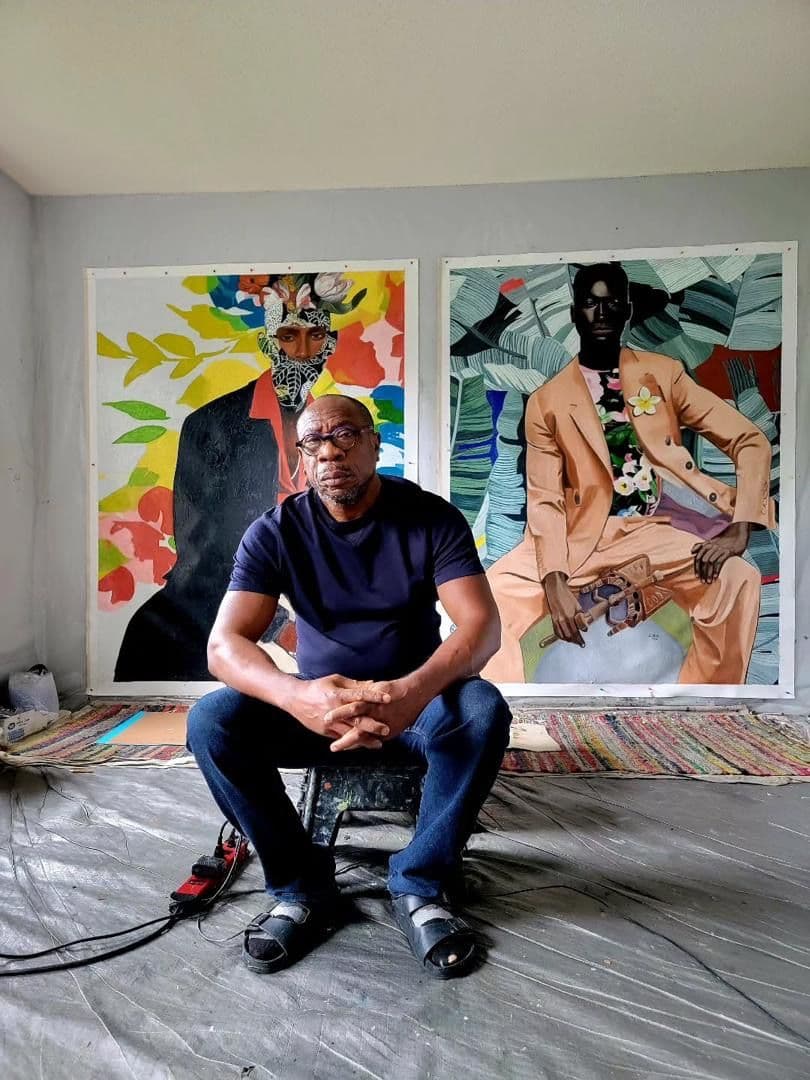
Wole Lagunju is a Nigerian painter and installation artist based in Winston-Salem, North Carolina, whose colour-rich figurative paintings bring Yoruba cultural motifs into sustained dialogue with Western art history, colonial imagery, and representations of femininity and power. His compositions draw together Gelede masks, Adire textile patterns, Dutch Golden Age portraiture, Elizabethan visual conventions, and mid-20th-century Euro-American imagery, creating encounters between visual traditions that were shaped by very different histories of power. Rather than presenting these references as evidence of cultural exchange alone, Lagunju examines the hierarchies and assumptions embedded within the images through which cultures have historically represented one another.
The Gelede mask is central to this inquiry. Rooted in Yoruba tradition and associated with the spiritual and social power of women, it enters Lagunju’s compositions alongside Western representations of femininity, creating a tension between distinct systems of meaning. The mask is not a decorative quotation from Yoruba culture; its presence changes how the surrounding imagery can be read. Placed against established Western conventions of portraiture and female representation, it introduces another conception of authority, beauty, gender, and social power into the frame.
This collision becomes particularly significant because Lagunju works directly with the visual language of Western art history. The poses, costumes, compositional structures, and pictorial conventions associated with European portraiture are recognisable, but they are interrupted by Yoruba forms and patterns that refuse to remain secondary within the image. Adire motifs can move across clothing and backgrounds, while the Gelede mask alters the identity and presence of the figure. Familiar art-historical forms are therefore retained while their cultural assumptions are unsettled.
His engagement with Onaism provides a broader philosophical context for this approach. The movement reimagines Yoruba tradition as a living visual language capable of continued development rather than as a fixed archive of inherited forms. Lagunju’s paintings operate within this understanding of tradition. Yoruba motifs do not appear as remnants of a completed past; they are activated within contemporary compositions and placed into conversation with histories, images, and cultural systems that have shaped the present. Cultural reclamation in this context becomes an act of reinvention rather than a return to an untouched origin.

Photo Credit: Wole Lagunju
Questions of femininity and power consequently run through the work alongside questions of colonial history. By placing Yoruba conceptions of female spiritual and social authority against Western images of womanhood, Lagunju exposes the fact that representations of gender are never culturally neutral. Portraiture can reproduce particular ideas about status, beauty, sexuality, and authority, but it can also become a site for challenging them. His figures occupy this contested space, carrying multiple visual histories within the same composition.
Lagunju’s background in graphic design, from which he graduated at Obafemi Awolowo University in 1986, provides an important foundation for the formal control evident in his work. The precision of his compositions allows densely layered references to remain legible without collapsing into visual excess. Colour, pattern, costume, and historical quotation are carefully organised, giving the paintings the visual clarity necessary for their more complex historical conversations.
His practice has received significant institutional recognition, including a Philip Ravenhill Fellowship from UCLA in 2006 and a Pollock-Krasner Award in 2009. His exhibitions across Nigeria, the United States, Trinidad, and Germany include Womanscape: Race, Gender and Sexuality in African Art at the University of Texas at Austin in 2011 and a 2018 solo exhibition at Ebonycurated Gallery in Cape Town. These contexts reflect the geographical reach of a practice concerned with histories that themselves move across borders.
Across Lagunju’s paintings, art history becomes something to be entered, rearranged, and questioned rather than simply inherited. Yoruba masks and patterns do not sit outside Western visual traditions; they occupy the same pictorial space, forcing the histories attached to each to encounter one another. The resulting images suggest that colonialism persists not only in political and economic structures but also in the ways cultures have been pictured, classified, and understood. By bringing those visual systems into the same frame, Lagunju makes the history of looking itself available for reconsideration.