
Connect
© 2026 Kyekyekule Africa. All rights reserved.
kyekyekule.africa
© 2026 Kyekyekule Africa. All rights reserved.
kyekyekule.africa
Sculpture & Installation
Ghana
Ghanaian pesewa coins, copper, copper-plated steel, zinc coins, stainless steel, wood, canvas, US pennies, industrial steel sheets, & found objects.

Emmanuel Agyapong
Author
Published on:
November 25, 2026

Yaw Owusu, 'The Glories of Our Past' 2023, 168cm x 158cm x 9cm, 1 Ghana pesewa, steel, linen, wood. Image courtesy of the artist and Gallery 1957
From Ghanaian pesewa coins to the currencies of the United States and the UAE, the Ghanaian artist uses found materials to examine how economic systems assign value, shape political relationships and determine what societies choose to preserve or discard.
A coin is designed to represent value. It carries an assigned denomination, circulates through an economy and gives people a recognised means of exchange. But what happens when that value diminishes? What remains when a coin can no longer buy what it once could, or when the material it is made from becomes more significant than the amount printed on it?
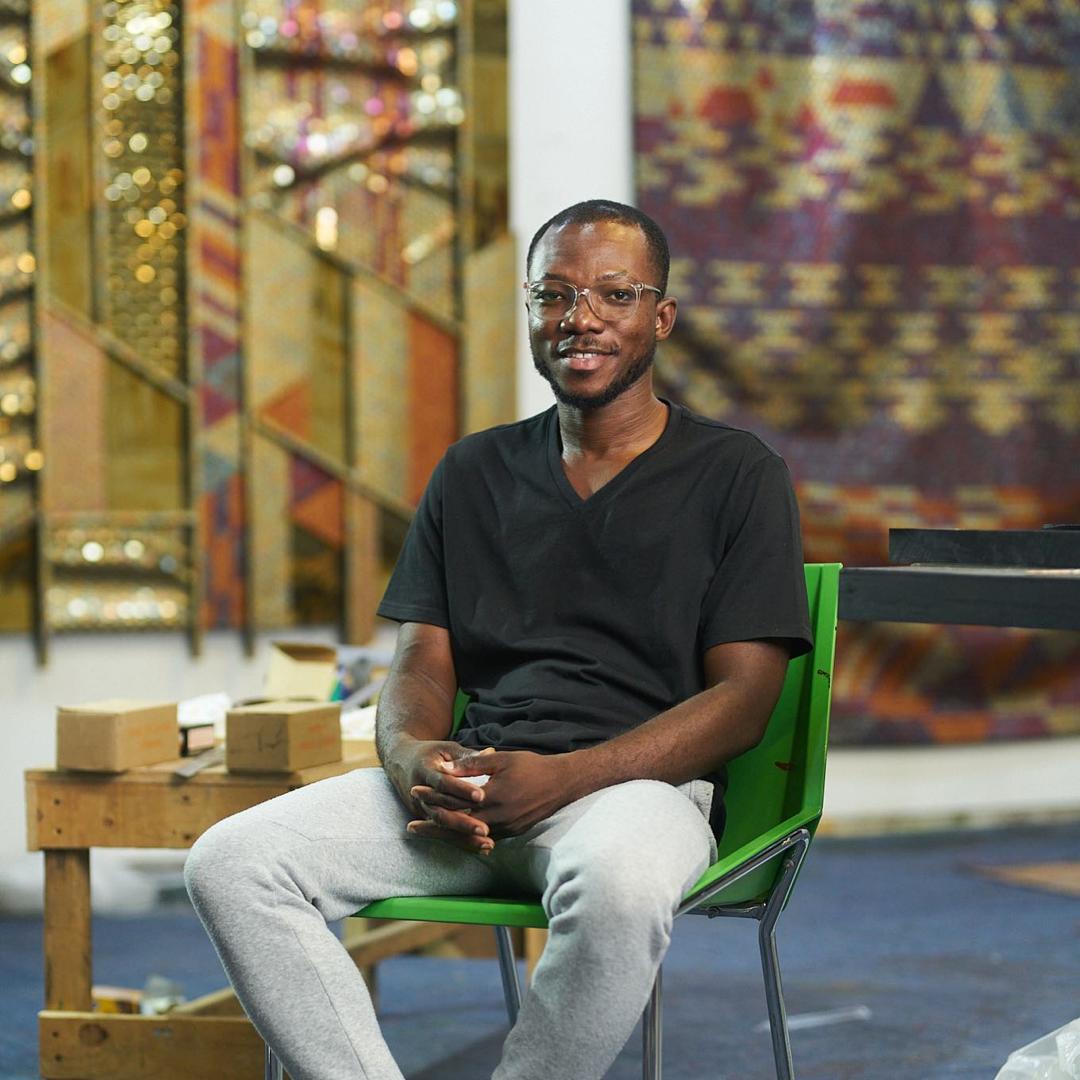
These questions sit at the centre of Yaw Owusu’s artistic practice. Born in Kumasi and currently based between Ghana and New York, the artist works primarily through sculpture and installation. He uses found objects, currencies and industrial materials to examine the relationship between money, labour, history and political power.
His works often begin with materials that have little monetary worth. Ghanaian pesewa coins, US pennies, metal sheets and other discarded objects are arranged, treated and accumulated into compositions with a striking physical presence. Their transformation does not erase their previous identities. Instead, it makes their histories more visible.
For Owusu, the coin is not simply a convenient material. It is an object shaped by the systems that produce, circulate and regulate money. By bringing these objects into the gallery, he asks how value is established, who controls it and whose labour sustains it.
From Painting to Material Experimentation
Owusu studied painting and sculpture at Kwame Nkrumah University of Science and Technology (KNUST) in Kumasi before moving to the United States, where he completed a Master of Fine Arts at Pratt Institute in New York.
His early practice included more conventional forms of painting, including portraits of political figures, royalty and popular culture. Over time, however, his interest shifted towards the possibilities of materials and the processes through which they could change. His education at KNUST, with its engagement with different approaches to art and material, contributed to his willingness to move beyond the boundaries of a single medium.
A formative encounter took place along Ghana’s southern coast. Owusu came across pesewa coins whose surfaces had changed colour after exposure to salt water and the coastal environment. Their green, blue and reddish tones suggested possibilities beyond their original function as currency.
The coins had been introduced as part of Ghana’s monetary system, but their purchasing power had diminished over time. What had once been intended for everyday transactions was becoming increasingly marginal in circulation. Owusu became interested in this change: a material could retain its physical form while losing much of the economic value assigned to it.
He began experimenting with the coins, using chemical treatments to alter their surfaces and arranging them into sculptural compositions. Obtaining large quantities also required negotiations with Ghanaian banking institutions. This process became part of the work’s wider concerns. Before the coins could be transformed into art, the artist had to engage with the institutions responsible for regulating their circulation.
The relationship between the material and the systems surrounding it therefore begins before the artwork is assembled.
The Pesewa as a Record of Economic Change

Yaw Owusu, All That Glitters, installation view at Gallery 1957, 2017. Image credit: Courtesy of the artist and Gallery 1957. Photograph by Nii Odzenma
Owusu’s 2017 solo exhibition, All That Glitters, at Gallery 1957 in Accra established the Ghanaian pesewa as a central material in his practice.
Rather than treating the coins as ordinary found objects, he uses their original monetary function as the starting point for an investigation into economic independence and the instability of value. Each coin carries a history of national currency, monetary policy and everyday exchange. Once assembled into a larger work, these individual objects begin to speak about the wider structures that give money its meaning.
The artist’s treatment of the coins is central to this process. Through oxidation and other chemical interventions, including the use of salt and vinegar, he changes their colours and textures. Their surfaces develop variations that can resemble precious metals, aged stone or intricate patterns.
The resulting compositions often take the form of dense, geometric arrangements. Individual coins become part of a larger surface, with repeated circular forms producing patterns that recall mosaics, textiles and maps.

Yaw Owusu, Untitled II, 2016, Treated copper coins on wood, 48 x 48 in . Image courtesy of the artist and Gallery 1957
In Untitled 2 (2016), this approach connects to the history of mapping in Ghana. Owusu drew on archival maps that traced the country’s railway networks through regions rich in timber, gold and other natural resources. The arrangement of coins becomes a way of considering how infrastructure and mapmaking have been used to organize the movement and extraction of wealth.
The work moves between abstraction and historical reference. Its surface can first appear decorative, but its composition points towards the relationship between territory, resources and economic control.
This tension is important to Owusu’s practice. The visual appeal of a work does not remove the political history of its materials. Instead, the two exist together.
Beyond Ghana: Currency, Race and the History of Wealth

Yaw Owusu, Left: Unsolicited Barter, 2021 Right: Heads And Tales, 2021. Image courtesy of the artist and Gallery 1957
As Owusu’s practice developed, his use of currency expanded beyond the Ghanaian pesewa. Working with US pennies and UAE fils, alongside copper, stainless steel, wood and industrial materials, he began to bring different monetary systems into conversation.
The use of the US penny introduces another set of historical questions. The coin carries the image of Abraham Lincoln, whose political legacy is closely associated with the abolition of slavery in the United States. For Owusu, this creates an opportunity to question the meaning of freedom within societies whose economic histories remain connected to slavery, exploitation and racial inequality.

Yaw Owusu, Left: Resilient Encounters, 2021. Right: Hear me Speak, 2021. Image courtesy of the artist and Gallery 1957
The relationship between currency and Black history becomes particularly visible in Reflections from the (In)Visible Past, presented in London in 2021. The exhibition included works such as Black Wall Street 1921–2021, This Made Us That, Unsolicited Barter, Heads And Tales, Resilient Encounters, Hear Me Speak and A Place of Our Own.
Through these works, Owusu considered the role of Black labour in the creation of wealth in Europe and the Americas, alongside the exclusion of Black communities from the economic benefits of that wealth. The exhibition’s curatorial framing, developed by Kilolo Luckett, placed these questions within a wider history of racial inequality and economic power.

Yaw Owusu, Black Wall Street 1921-2021, 2021. Image courtesy of the artist and Gallery 1957.
Black Wall Street 1921–2021 draws attention to the destruction of Black wealth in Tulsa, Oklahoma, during the 1921 racial massacre. The work connects the history of money to the people and communities whose labour and enterprise created wealth, but whose economic security could be violently taken away.
This marks an expansion of the questions raised by the earlier pesewa works. Owusu is no longer looking only at the relationship between Ghanaian currency and national economic independence. He is also examining the histories of race, labour and accumulation embedded in international financial systems.
His use of steel and other industrial materials adds another dimension. These materials evoke the infrastructure and industrial growth associated with modern economies, particularly the development of cities such as New York. Yet the apparent strength of these structures exists alongside their vulnerability. Economic systems can appear permanent while remaining subject to cycles of growth, crisis and collapse.
Across these works, currency becomes a way of approaching histories that are not always visible in the objects themselves.
The Patterns of Value
Yaw Owusu, 'The Glories of Our Past' 2023, 168cm x 158cm x 9cm, 1 Ghana pesewas, steel, linen, wood. Image courtesy of the artist and Gallery 1957.
Although Owusu’s work is grounded in political and economic questions, its visual language is equally important.
His compositions frequently bring together repeated circular forms, geometric arrangements and reflective metallic surfaces. Coins are placed in dense formations, creating patterns that can resemble textiles or architectural surfaces. Their colors shift according to the materials and chemical processes used.
Gallery 1957 has drawn a connection between these arrangements and the pattern structures of Ghanaian kente. The comparison offers a way to consider how repetition, colour and material can produce complex visual systems. In Owusu’s work, however, the patterns are constructed from objects that have already participated in an economic system.
The coins retain their circular shape and their association with money, but their arrangement changes how they are read. What was once a collection of separate units of exchange becomes a larger sculptural surface.
His choice of materials also allows him to move between different histories. Copper and copper-plated steel connect to the physical composition of coins, while gold and bronze evoke older systems of exchange and the histories of precious metals. Wood introduces a different relationship between natural materials and manufactured economies.
These elements are not used simply for their appearance. Each brings its own associations into the work, allowing Owusu to examine how societies assign meaning and worth to objects.
What Remains After the Transformation?

Yaw Owusu, Where the Tide Flows, and the Dunes Gather, installation view at Efie Gallery, Dubai, 2026. Image courtesy of the artist and Efie Gallery
In his recent solo exhibition, Where the Tide Flows, and the Dunes Gather, which opened at Efie Gallery in Dubai on 16 November 2026 and runs until 10 January 2027, Owusu introduces a further development in this investigation.
The exhibition brings together works on paper, textured canvases and mixed-media sculptures. While the sculptural works continue his use of coins and accumulated materials, the new works on paper are made from remnants and residues produced during the chemical processes involved in making the sculptures.
This introduces a different relationship between the finished artwork and the materials left behind during its production.
In the sculptures, low-denomination coins are accumulated and transformed into surfaces that can appear almost golden. Their individual monetary worth may be small, but their collective presence gives them a different kind of material significance.
The works on paper approach the process from the opposite direction. Their weathered, oxidised surfaces preserve traces of the chemical treatments used in the sculptural works. Rather than presenting the finished transformation, they retain evidence of what happened along the way.
What might otherwise be discarded becomes an artwork in its own right.
This development is significant because it extends Owusu’s investigation beyond the question of what gives an object value. It also asks what happens to the materials and traces that remain after value has been produced. If the sculptures turn overlooked objects into imposing forms, the paper works give attention to the residue of that process.
The exhibition’s title, Where the Tide Flows, and the Dunes Gather, also suggests a way of thinking about accumulation. Tides move and redistribute material, while dunes form gradually through the gathering of countless particles. Both processes depend on movement over time. In a similar way, Owusu considers how individual objects, actions and histories accumulate into larger economic and social structures.
The new works do not abandon the questions that have shaped his earlier practice. They extend them by bringing the consequences of material transformation into view.
An Expanding Investigation of Value
Owusu’s practice has developed from an interest in painting and material experimentation into a sustained investigation of currency, labour, colonial history and economic power. The Ghanaian pesewa remains an important point of departure, but his use of US pennies, UAE fils and industrial materials has allowed him to approach these questions across different national and historical contexts.
His work has been presented in exhibitions across Ghana, the United States, the United Kingdom, Morocco and the United Arab Emirates. These include a solo exhibition at the Institute of Contemporary Art San Diego in 2022, alongside presentations at institutions and galleries such as the Brooklyn Museum, Museum of African Contemporary Art Al Maaden (MACAAL), Christie’s, Gallery 1957 and Efie Gallery.
His works are also held in collections including the World Bank, Meta, the Presidential Residence of Ghana, Foundation H in Madagascar, Wells Fargo and MACAAL.
In 2018, Owusu received the Kuenyehia Art Prize for Contemporary Ghanaian Art. He also received the Pratt Institute Outstanding Student and Circle Awards in 2020 and has undertaken residencies at Efie Gallery in the UAE and Cope NYC in the United States. In 2026, he was reported as a recipient of the Otumfuo Osei Tutu II Art Award.
What connects these different stages of his career is an ongoing interest in the distance between an object’s material existence and the value society gives it. A coin can lose its purchasing power but retain its political history. A discarded material can become the basis of a sculpture. A residue can hold the evidence of a process that would otherwise go unseen.
Owusu’s works make these changes visible. They ask viewers to look beyond the surface of money and consider the histories, labour and systems that make value possible, and the people and materials that are often left outside its rewards.