
Connect
© 2026 Kyekyekule Africa. All rights reserved.
kyekyekule.africa
© 2026 Kyekyekule Africa. All rights reserved.
kyekyekule.africa

Emmanuel Agyapong
Author
Published on:
May 25, 2026
The Kumasi-based collective and network has become increasingly visible within global conversations around contemporary art, bringing to international platforms an approach built not around individual artistic celebrity, but around collaboration, experimentation, research, writing, performance, and collective exchange. Its presence within the context of the 61st Venice Biennale reflects the growing international significance of artistic communities that have developed their own intellectual and institutional structures outside the traditional centres of the art world.
From Kumasi to Venice, blaxTARLINES KUMASI represents a model of artistic practice that challenges some of the assumptions through which contemporary African art has traditionally entered the international stage.
The Kumasi-based collective and network has become increasingly visible within global conversations around contemporary art, bringing to international platforms an approach built not around individual artistic celebrity, but around collaboration, experimentation, research, writing, performance, and collective exchange. Its presence within the context of the 61st Venice Biennale reflects the growing international significance of artistic communities that have developed their own intellectual and institutional structures outside the traditional centres of the art world.
Founded in 2015 at Kwame Nkrumah University of Science and Technology (KNUST), blaxTARLINES KUMASI emerged from one of the most important artistic environments in contemporary Ghana. Over the past decade, Kumasi has become internationally associated with a generation of artists and thinkers whose practices have expanded the possibilities of painting, sculpture, installation, performance, and socially engaged work.
But blaxTARLINES has never been simply a group of artists working under a single aesthetic identity. Its importance lies in the space it creates for different forms of practice to exist in conversation with one another. Artists, curators, writers, researchers, and collaborators move through the network with an emphasis on exchange rather than fixed hierarchy.
This approach offers an alternative to one of the dominant narratives through which African artists have historically been presented internationally: the individual artist discovered, selected, and introduced into the global art world as a singular figure.
blaxTARLINES KUMASI proposes something different.
Its development suggests that artistic significance can also emerge through networks, shared knowledge, long-term relationships, and communities capable of producing their own spaces for experimentation. The collective model does not eliminate individual practices, but places them within a wider ecosystem of people learning from, challenging, and supporting one another.
That distinction matters.
The history of contemporary African art is often told through individual careers, major exhibitions, and the growing presence of African artists in museums, galleries, and biennales. Those developments are important, but they do not always explain the communities and informal structures that make artistic careers possible in the first place.
Kumasi offers another story.
The city’s artistic energy has developed through institutions such as KNUST, but also through relationships that extend beyond formal education. Studios become spaces of learning. Exhibitions become sites of debate. Collaboration becomes a method of producing knowledge. The boundary between artist, curator, researcher, and organiser becomes less fixed.
blaxTARLINES KUMASI has emerged from this environment while helping to expand it.

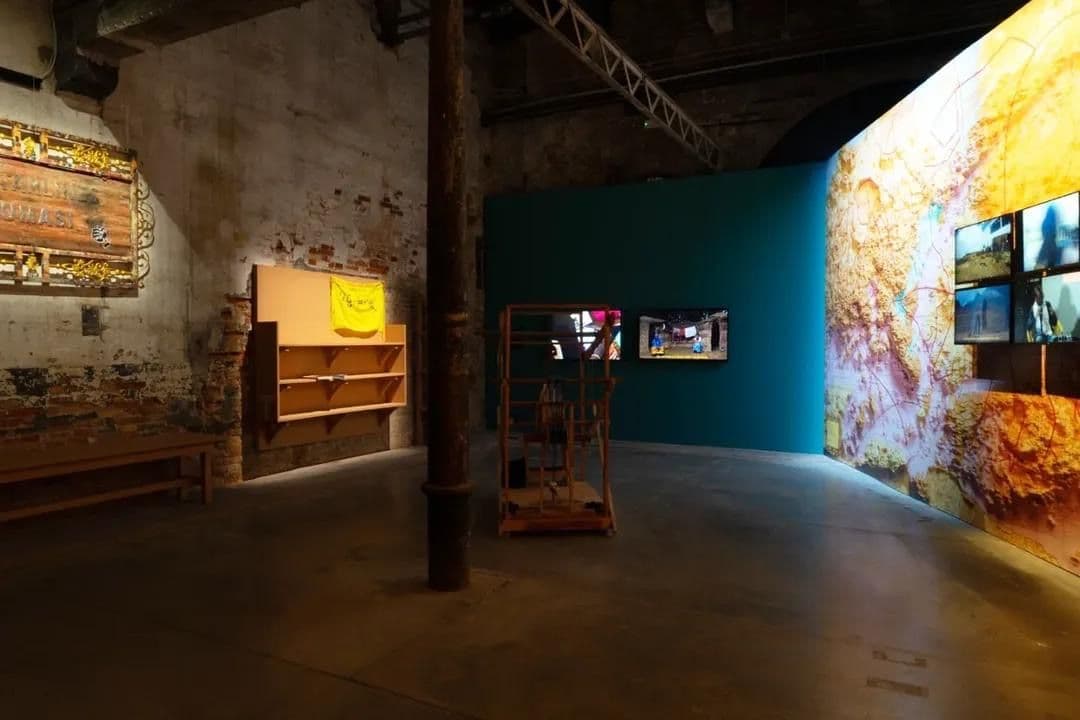
Image courtesy of blaxTarlines(At the 61st Venice Biennale)
Its growing international presence therefore represents more than the movement of Ghanaian artists into foreign institutions. It demonstrates how ideas developed within a specific local context can travel without becoming detached from the community that produced them.
This is particularly significant within the context of Venice, where national representation and international visibility have historically shaped the structure of the Biennale. A collective model such as blaxTARLINES introduces another way of thinking about artistic presence: not simply as the arrival of an individual artist on a global stage, but as evidence of a larger network of relationships and ideas.
The connection to the Biennale’s wider intellectual context also reinforces this emphasis on collective forms of knowledge and cultural production. The questions surrounding memory, connection, shared histories, and alternative systems of understanding resonate with the kind of ecosystem blaxTARLINES has helped cultivate over the years.
What began in Kumasi has now developed into a network whose conversations extend across Ghana and into wider international contexts. Artists and collaborators associated with the community continue to participate in exhibitions, museum programmes, residencies, and biennales across Africa, Europe, and North America.
Yet the significance of blaxTARLINES KUMASI should not be measured only by how far it has travelled.
Its more important contribution may be the model it offers for thinking about how contemporary art is made. The collective demonstrates that artistic movements do not have to wait for international institutions to validate them before they begin producing knowledge, creating opportunities, and shaping cultural conversations.
They can build their own infrastructures.
They can create their own platforms.
And they can develop from sustained communities of practice rather than from the pursuit of individual recognition alone.
From Kumasi to Venice, blaxTARLINES KUMASI is therefore part of a larger shift in contemporary African art. The question is no longer simply whether African artists can enter the global conversation. Increasingly, artists and artistic communities from across the continent are helping determine what that conversation looks like, how it is organised, and whose forms of knowledge are allowed to shape its future.
In that sense, the journey from Kumasi to Venice is not simply a story about international recognition. It is a reminder that some of the most consequential changes in contemporary art begin locally — in communities willing to imagine different ways of working together.
September 30, 2026
September 11, 2026
September 8, 2026

September 2, 2026