
Connect
© 2026 Kyekyekule Africa. All rights reserved.
kyekyekule.africa
© 2026 Kyekyekule Africa. All rights reserved.
kyekyekule.africa

Emmanuel Agyapong
Author
Published on:
September 30, 2026
Vlisco is marking its 180th anniversary by bringing six contemporary African artists into conversation with some of its most recognisable textile designs.
To mark its 180th anniversary, Dutch textile house Vlisco is bringing together six contemporary African artists to reinterpret some of its most recognizable fabric designs. The collaboration brings together artists from the Democratic Republic of Congo, Nigeria, Togo, Ghana, Côte d’Ivoire and Benin, turning familiar textile patterns into sculpture, woven works, installations and other forms of contemporary art.
Founded in 1846, Vlisco has a long history with West and Central Africa. While the company produced the fabrics, African women, especially merchants and customers, gave many of the designs their cultural meaning. They created names, proverbs and social meanings around the prints, allowing the fabrics to become part of everyday life, identity and cultural memory.
For its 180th anniversary, Vlisco selected six iconic designs and invited six artists to respond to them through their own practices. The resulting works explore memory, family, identity, heritage, trade, community and the changing meaning of materials.
Prisca Tankwey, Democratic Republic of Congo
Kinshasa based multidisciplinary artist Prisca Tankwey works across themes of religion, spirituality, cultural identity, memory and belonging.

Village Molokai. Image courtesy of Vlisco
For the project, she selected the Village Molokai design, one of Vlisco’s recognizable prints in the Democratic Republic of Congo.
The design is closely connected to Congolese culture, style and self expression, including the tradition of La Sape. Tankwey was particularly inspired by Congolese musician Papa Wemba, who founded Village Molokai during a period of political and social change.
“I made this creation in memory of Papa Wemba, and it refers to issues surrounding spaces and who has the right to go towards them and who does not. It is these dynamics that I have tried to express in the creation, with these patterns that go a little in every direction and try to find where to settle,” Tankwey said.

Prisca Tankwey transformed Village Molokai into Kaokoko Korobo. Image courtesy of Vlisco
Her resulting work, Kaokoko Korobo, combines Village Molokai fabric with colored transparent plastics in a sculptural installation inspired by stained glass. The work looks at belonging, exclusion, power and collective identity.
“Stained-glass windows create this distance between what is easy to touch and what is higher and one cannot reach. I started from the opacity of the cloth in order to meet the transparent aspects that we find in my creation. And so, there is a dialogue between opacity and transparency,” she added.
Ayobami Ogungbe, Nigeria
Nigerian artist Ayobami Ogungbe works with photography, weaving and collage to explore identity, connection and memory.

Fertility. Image courtesy of Vlisco
His selected design, Fertility, is associated with life, growth, abundance and new beginnings, with motifs including babies, eggs, chicks and fruit.
Ogungbe transformed the design into a woven portrait of a mother and daughter, bringing together fabric and photography.

Ayobami Ogungbe transformed Fertility into a woven portrait of a mother and daughter. Image courtesy of Vlisco
“My practice includes photography, weaving, and some collage techniques. With this piece, I was able to treat the fabric the same way as my photographs, priming then splicing and finally incorporating it into the photograph via weaving,” he said.
The work also became a personal reflection on family and shared identity.
“Looking at the iconography of the ‘Fertility’ fabric inspired me to share this fabric with my mother and my sister. It was also an opportunity to talk about how we identify with a fabric and with each other by wearing outfits cut from the same cloth,” Ogungbe said.
Atisso Goha, Togo
Togolese sculptor Atisso Goha works with discarded materials, giving overlooked objects a new life while drawing from Togolese mythology, spirituality and the natural world.

Mama Benz. Image courtesy of Vlisco
He selected Mama Benz, a design associated with the influential women traders who helped shape the wax print industry across West Africa. Known as Nana Benz in Togo, these women became symbols of entrepreneurship and success, with the name referring to the Mercedes Benz cars they acquired through their businesses.

Atisso Goha transformed Mama Benz into Mianô N’Dôkusu (Our Mother Sun). Image courtesy of Vlisco
Goha’s response is Mianô N’Dôkusu, meaning “Our Mother Sun” in Ewe. The monumental sculpture is made from salvaged materials and pays tribute to the independence, influence and resilience of the Nana Benz.
“I’m a Togolese artist making every piece by hand. My craftsmanship has enabled me to give new life to material that tells stories, stories that speak of our culture and our heritage,” Goha said.
The number 1968, incorporated into the sculpture, refers to an important moment in the history of the Nana Benz in Togo and their influence on the country’s textile trade.
Yaw Owusu, Ghana
Ghanaian artist Yaw Owusu is known for using discarded materials and low denomination coins to examine trade, labour, value and economic systems.

Money Tap. Image courtesy of Vlisco
For the collaboration, he worked with Money Tap, a Vlisco design associated with prosperity, abundance and the flow of good fortune.
Owusu uses thousands of Ghanaian pesewa coins in his sculpture, creating a surface built around repetition and circulation.
“Vlisco prints have always been informed by African heritage, so using the fabric in my artwork felt like recollecting and reinterpreting my heritage,” Owusu said.

Yaw Owusu transformed Money Tap using thousands of Ghanaian pesewa coins Image courtesy of Vlisco
He also connects the repeated use of currency to the way cultural stories are passed on.
“This artwork communicates the idea of repetition, circulation, and abundance through the use of currency and repetitive motifs. The design also preserves a part of our culture, one where we are part of how our stories are written and how our heritage is presented to the world,” he said.
Through the work, Owusu reflects on changing ideas of monetary value while also considering the lasting cultural value of African textiles.
Jean Servais Somian, Côte d’Ivoire
Ivorian designer and sculptor Jean Servais Somian is known for his handcrafted furniture and sculptural works made from sustainable coconut wood. His practice draws from West African woodcarving traditions and natural materials.
His selected Vlisco design, carries a message about unity and shared strength. Also known as Zaire, the design was introduced in 1933 and features the Twi proverb, “Dua kuro gye enum a obu,” meaning “One tree alone cannot stand the wind.”

Fallen Tree. Image courtesy of Vlisco
The image of the fallen tree led Somian to think about regeneration and what happens after something breaks.
“I was struck by this fabric featuring a broken tree. How is this broken tree going to stand again? We will have to recover the seeds from this tree in order to replant them. And it is those seeds that will give us other trees again. That was really my starting point,” Somian said.

Jean Servais Somian created a sculptural work in hand-carved coconut wood. Image courtesy of Vlisco
His resulting work, Standing Tree, Broken Tree, is hand carved from sustainable coconut wood. Hollowed forms and wooden and bronze spheres represent seeds emerging from a fallen tree, pointing to renewal, growth and the continuation of life.
Sébastien Boko, Benin
Beninese artist Sébastien Boko works across sculpture, painting, installation and performance, often drawing from Beninese cultural traditions, identity and spirituality.

Mari Capable. Image courtesy of Vlisco
For the collaboration, he chose Mari Capable, one of Vlisco’s most recognizable designs. Inspired by the form of an Ottoman chair and often interpreted as lips, the design is also known in some communities as “My Husband Is Able.” Across West and Central Africa, it has become associated with appreciation, prosperity and pride.
For Boko, the choice was also personal.
“The Vlisco fabric I chose to work with represents something that, over generations, people in Benin have embraced so deeply that it has become part of their culture,” he said.
Boko recalls seeing the fabric worn by his mother, sister and cousins, as well as by members of the wider Cotonou community.

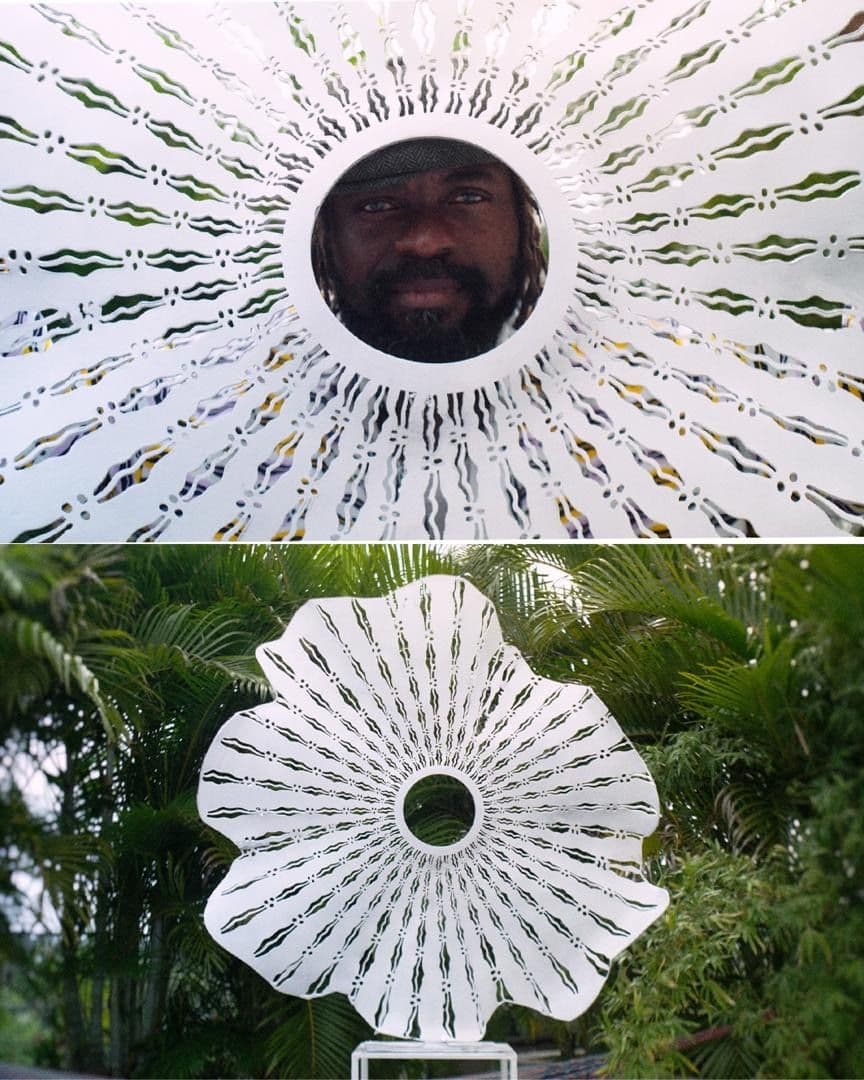
Sébastien Boko transformed motifs from ‘Mari Capable’ into a sculptural form crafted from painted stainless steel. Image courtesy of Vlisco
He transformed its motifs into The World in Motion, a painted stainless steel sculpture that explores renewal, movement and cultural exchange.
“By taking this material and shaping it into an upright metal sculpture, it is as if the material, which exists through time, has become timeless,” Boko said.
From Textile Archive to Contemporary Art
Together, the six works demonstrate how a textile can become much more than something worn on the body. Village Molokai, Fertility, Mama Benz, Money Tap, Fallen Tree and Mari Capable each carry histories shaped by the people who wore them, traded them, named them and attached meanings to their patterns.
The artists do not approach these designs simply as historical motifs. They use them as starting points for questions that remain contemporary: who belongs to a community, how family histories are transmitted, how women have shaped economies, how money circulates, how materials are regenerated and how cultural identities persist through everyday objects.
Their voices make clear that the project is not only about translating fabric into other materials. For Tankwey, the textile opens questions of access and exclusion. For Ogungbe, it becomes a way of thinking through family and shared identity. Goha connects material reuse to cultural heritage; Owusu links textile and currency through circulation; Somian turns a broken tree into a proposition about regeneration; and Boko considers what happens when a familiar textile pattern is removed from the body and given another physical life.
Vlisco will retain all six artworks as part of its permanent heritage collection, with plans to present them in future international exhibitions. The six designs will also be available through Vlisco retail locations and its online platform.
The anniversary project places contemporary African artists in conversation with a textile archive that has been embedded in African social and cultural life for generations. Their different materials and approaches demonstrate how a familiar pattern can become a record of family, commerce, spirituality, labour, identity and memory.
After 180 years, Vlisco’s archive is being revisited not only through the history of its designs, but through what those designs have become in the hands of the people and communities who gave them meaning. The six artists extend that history into new materials, allowing patterns shaped by generations of use to enter another phase of their cultural life.
September 11, 2026
September 8, 2026

September 2, 2026
September 1, 2026