
Connect
© 2026 Kyekyekule Africa. All rights reserved.
kyekyekule.africa
© 2026 Kyekyekule Africa. All rights reserved.
kyekyekule.africa

Emmanuel Agyapong
Author
Published on:
September 1, 2026
Gallery 1957 returns to Frieze Seoul for the fourth consecutive year with a presentation bringing together five artists whose practices examine memory, identity, history, and belonging.

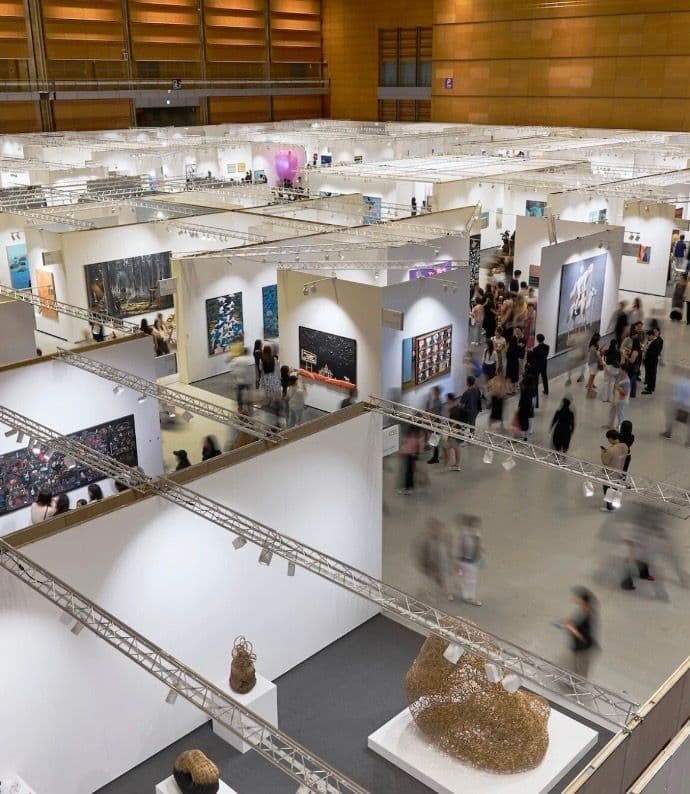
Installation view of Frieze Seoul 2025 at COEX, Seoul. Photo by WeCap Studio. Courtesy Frieze
Gallery 1957 returns to Frieze Seoul with five artists whose practices approach memory from different directions but arrive at a shared question: how do histories, identities, and experiences continue to live through the materials we keep, transform, and pass on?
The Accra- and London-based gallery is presenting works by Amoako Boafo, Rita Mawuena Benissan, Serge Attukwei Clottey, Freya Tewelde, and Kaloki Nyamai at Booth A08 during the fifth edition of Frieze Seoul, taking place at COEX in Gangnam from September 2 to 5, 2026. Together, the artists bring painting, photography, textiles, found materials, collage, and abstraction into a conversation about the many ways the past remains present.

Amoako Boafo “Black Camisole” (2026) Image courtesy of Gallery1957
For Amoako Boafo, memory and identity emerge through the human figure. Known for his distinctive finger-painted portraits, the Ghanaian artist has developed a visual language centred on Black presence, individuality, and self-possession. His portraits resist the historical traditions that often positioned Black subjects as objects to be observed, instead allowing his sitters to occupy the canvas with confidence and psychological presence. At Frieze Seoul, his presentation includes ‘‘Black Camisole” (2026), a striking portrait that reflects his unique approach to contemporary portraiture.
Freya Tewelde approaches similar questions through a very different visual language. The Eritrean-British artist uses layers of colour, pigment, gesture, and repeated marks to explore emotional and inherited memory. Her increasingly abstract paintings move away from direct representation, allowing feeling and experience to exist through rhythm and material rather than recognisable figures. The surfaces become spaces of accumulation, where marks are added, interrupted, and revisited, reflecting the way memory itself can return in fragments rather than as a complete story.

Kaloki Nyamai's "Nivaa Ninyoka Na Ni Sawa (Here Alone and Okay). Image courtesy of Gallery1957
Kaloki Nyamai brings storytelling to the centre of his practice. Working across painting, collage, and stitching, the Nairobi-based artist draws from Kamba oral traditions while exploring personal and collective histories. His densely layered works encourage viewers to move slowly across their surfaces, searching for relationships between fragments, images, and marks. Language also plays an important role in his work, with titles often drawn from Kamba expressions that carry personal and emotional meaning. At Frieze Seoul, he presents Nivaa Ninyoka Na Ni Sawa — meaning “Here Alone and Okay” — making its debut at the fair.
Rita Mawuena Benissan turns to photography and textiles to investigate the relationship between history and visibility. Her practice frequently draws on archival images and Ghanaian cultural traditions, particularly the symbolism of the Asante royal umbrella. Through stitched photographs and sculptural textile works, Benissan brings attention to histories that have often remained outside official records, including the contributions and experiences of Ghanaian women. Her work asks what happens when archives are not simply preserved but actively reinterpreted by the people who inherit them.

Serge Attukwei Clottey, “Human Consumption ” Image courtesy of Gallery1957
For Serge Attukwei Clottey, memory is embedded in the objects that circulate through everyday life. His Afrogallonism practice transforms discarded yellow plastic containers into sculptural forms and large-scale tapestries. The containers carry their own histories of trade, consumption, migration, and waste, and Clottey’s process gives those histories a new physical presence. By cutting, arranging, and stitching discarded materials together, he turns objects associated with disposal into records of social and economic life. His Frieze Seoul presentation features “Human Consumption”, a work that gives discarded materials new meaning through themes of ritual, resilience, and renewal.
Although the five artists work through distinct visual languages, Gallery 1957’s presentation finds a connection between them in the idea that memory is never fixed. It can be carried in a face, preserved in an archive, embedded in a material object, passed through storytelling, or felt through colour and gesture.
At a major international fair where hundreds of artworks compete for attention, the presentation offers a more reflective proposition. Rather than treating identity and history as settled ideas, the five artists suggest that both are constantly being shaped through acts of remembering, recovering, transforming, and retelling.
Through five different practices, Gallery 1957 brings one shared inquiry to Seoul: what remains with us from the past, and how do we continue to give it form?
September 30, 2026
September 11, 2026
September 8, 2026
September 2, 2026