
Connect
© 2026 Kyekyekule Africa. All rights reserved.
kyekyekule.africa
© 2026 Kyekyekule Africa. All rights reserved.
kyekyekule.africa

Emmanuel Agyapong
Author
Published on:
October 22, 2026
Selma Feriani Gallery and Lagos based gallery kó have been included in Artsy’s selection of the 10 best booths at Art Basel Paris 2026. The annual selection highlights notable presentations from the international art fair, with the two galleries bringing distinct perspectives on cultural memory, identity and the development of modern and contemporary art.
Selma Feriani Gallery and Lagos-based gallery kó have been named among Artsy’s 10 best booths at Art Basel Paris 2026, recognised for presentations spanning contemporary artistic practice and the histories of Nigerian modernism. Published on 21 October by Artsy writer Arun Kakar, the selection highlights Selma Feriani Gallery at booth 1.K4 and kó at booth 0.P10, each offering a distinct approach to material, cultural memory and artistic history.
Selma Feriani Gallery brings together painting, sculpture and photography by 12 artists, M'barek Bouhchichi, Jellel Gasteli, Jessica Boubetra, Sebastián Espejo, Nadia Nejma Ayari, Monia Ben Hamouda, Baya, Sara Ouhaddou, Nidhal Chamekh, Elena Damiani, Aymen Mbarki, and Yann Lacroix, while kó presents a historical survey featuring Uche Okeke, Obiora Udechukwu and El Anatsui in the fair’s Premise sector.
Selma Feriani Gallery: Material, Memory and Place

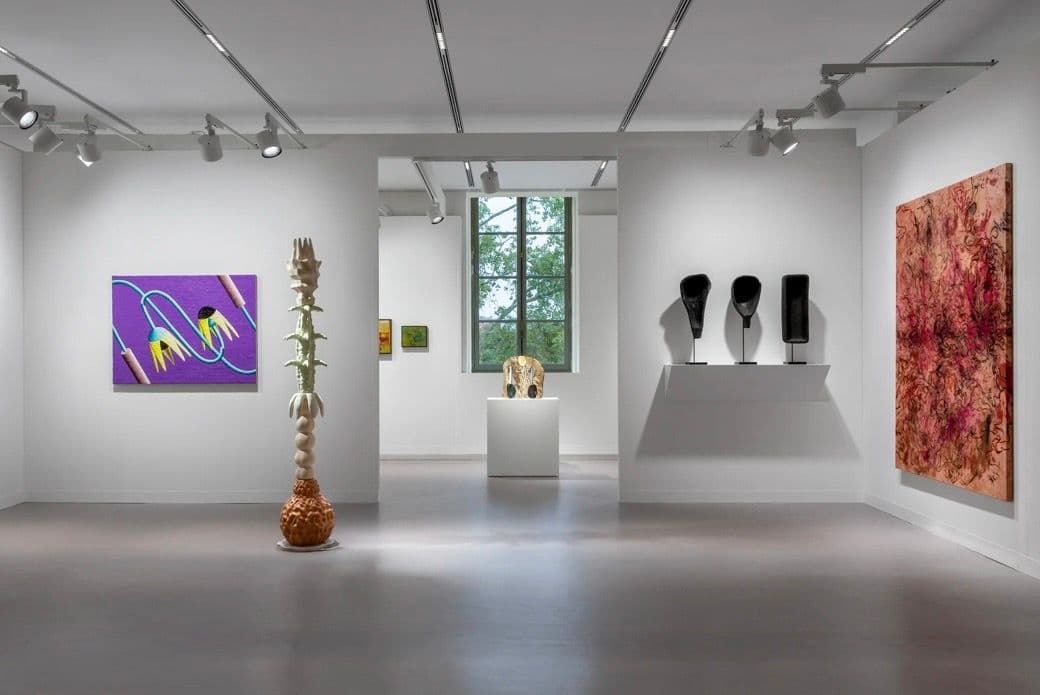
Selma Ferriani Galery at Art Basel Paris 2026. Photo by Julie Rochereau. Courtesy of Selma Ferriani Gallery.
Based in Tunisia, Selma Feriani Gallery assembles works that consider cultural memory, identity and the natural world through different materials and visual languages. Rather than follow a single medium or theme, the presentation draws connections between objects, environments and the histories they carry.
Jessica Boubetra’s Hybrid Orders I (2025), made from glazed stoneware and lacquered steel, combines organic forms with industrial material. M’barek Bouhchichi’s Stick charts 2 (2025), constructed from brass casts of eucalyptus branches and cowrie shells, turns materials associated with nature and exchange into a reflection on migration and trade across North Africa.
The booth also includes black-and-white photographs of Mediterranean gardens taken by Jellel Gasteli around 1980. Through contrasts of light and shadow, dense foliage and carefully framed spaces, the photographs introduce another way of considering the relationship between place and memory.
Together, these works connect distinct artistic practices without reducing them to a single narrative. Material becomes a point of departure for considering how identity and history are shaped by movement, environment and lived experience.
kó: Revisiting the Foundations of Nigerian Modernism

kó at Art Basel Paris 2026. Courtesy of kó.
At booth 0.P10, Lagos-based gallery kó turns to a formative period in Nigerian art through works by Uche Okeke, Obiora Udechukwu and El Anatsui. Presented in Art Basel Paris’s Premise sector, the display traces connections between artistic experimentation, indigenous visual traditions and the political circumstances of post-independence Nigeria.
The presentation centres on the Nsukka School, an influential movement associated with the University of Nigeria that developed in the years following independence in 1960. A key principle was Okeke’s concept of Natural Synthesis, which sought to bring modern artistic approaches into dialogue with indigenous Nigerian traditions rather than treat them as opposing systems.
A major source of this visual language was uli, an Igbo art form traditionally practised by women through body and wall painting. Its fluid lines, rhythmic patterns and organic forms informed artists seeking to develop contemporary modes of expression grounded in local cultural knowledge.
Okeke’s Return of the Refugees (1967) addresses displacement during the Nigerian Civil War. The conflict also shaped the work of his former student Obiora Udechukwu, whose compositions draw on uli-inspired lines to depict figures, landscapes and experiences of collective hardship. Seen together, their works connect formal experimentation to the political and social realities of their time.
El Anatsui’s contribution offers a different perspective on material transformation. The wood sculpture in the presentation departs from the artist’s widely recognised works made with discarded bottle caps, using deep chainsaw cuts to alter the surface of the wood. The process foregrounds the material’s transformation and the role of experimentation within his practice.
Rather than presenting Nigerian modernism as a fixed style, kó’s selection positions it as an evolving exchange between cultural inheritance, historical experience and new artistic possibilities.
Two Approaches to Artistic History
The recognition of Selma Feriani Gallery and kó highlights the range of approaches through which galleries can frame artistic practice at an international fair. Selma Feriani Gallery brings contemporary works into conversation through material, memory and place; kó revisits the development of Nigerian modernism and the visual traditions that helped shape it.
Their inclusion in Artsy’s selection places different artistic histories within the wider context of Art Basel Paris 2026. Together, the presentations demonstrate how gallery booths can function as more than displays of individual works: they can establish connections across generations, geographies and artistic ideas, giving audiences different ways to consider how art is made and understood.
October 30, 2026
October 16, 2026
October 10, 2026
October 8, 2026