
Connect
© 2026 Kyekyekule Africa. All rights reserved.
kyekyekule.africa
© 2026 Kyekyekule Africa. All rights reserved.
kyekyekule.africa

Emmanuel Agyapong
Author
Published on:
September 8, 2026
Nairobi is hosting the inaugural Pan African Biennale, bringing architects, designers, researchers, and creative practices from across Africa and its diaspora together for a five-day programme focused on the continent’s built environment.
The inaugural Pan African Biennale opened in Nairobi on 7 September 2026, bringing 54 exhibitors representing every African country together for a five-day program examining architecture and the built environment. Running until 11 September, the biennale brings architects, designers, researchers, and creative practices from across the continent and its diaspora to Kenya for its first edition.
Curated by Somali Italian architect Omar Degan, the biennale is presented as the first dedicated pan-African platform focused on architecture and the built environment. Its theme, “Shifting the Center: From Fragility to Resilience,” places African knowledge, climate, memory, and ways of building at the centre of the program.

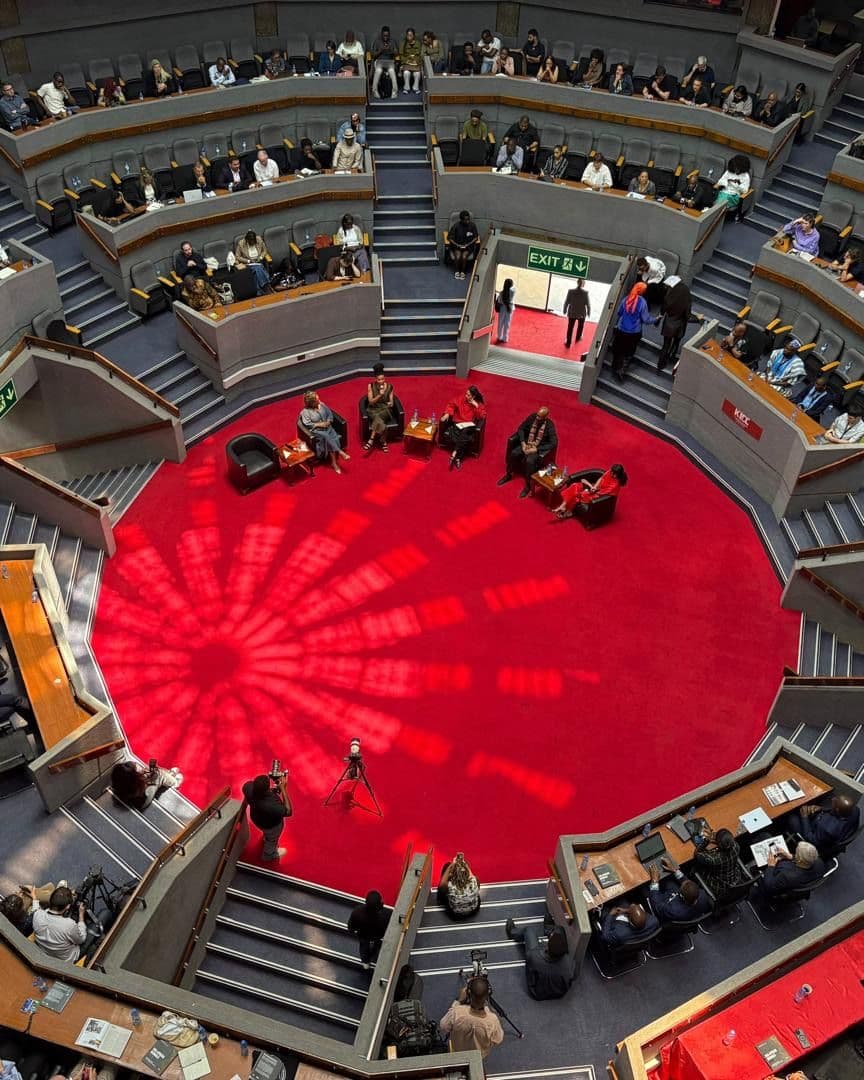
Pan-African Biennale 2026: During the Architectural Pioneering Consultants * Bauhaus Earth * Ardhi Na Mbao workshop. Courtesy of Catarina Medroa
Rather than organising the 54 exhibitors according to national borders, Degan has grouped practices around shared climates, histories, and experiences. Practices working in the Sahel, for example, are brought into conversation around common environmental conditions, while coastal practices are connected through relationships to water, migration, settlement, and climate.
The approach challenges a model in which African architecture is primarily presented through individual countries. Instead, the biennale examines issues that cross borders, including climate change, migration, urban growth, materials, and the changing relationship between people and their surroundings.
The program is organized around five themes: Shifting the Center; Ecologies of Repair; Living Archives and Embodied Knowledge; Imagining Otherwise, on African Futures; and Pan Africanism, the Centre in Motion. Together, they examine how communities build, preserve knowledge, respond to difficult conditions, and imagine alternative futures.
A central principle of the biennale is a focus on “evidence rather than image.” Exhibitors are encouraged to show the processes, materials, knowledge systems, and community practices behind their work rather than relying primarily on polished architectural photography. This creates greater space for traditional building methods, local materials, and forms of knowledge that are often overlooked within conventional architectural presentations.
The inclusion of the African diaspora further expands the framework. Practices based outside the continent are presented alongside those working in Africa, creating connections around shared histories of movement, identity, climate, and place. The result is a conversation that treats African architecture as part of a wider network of cultural and spatial exchange.

Pan-African Biennale 2026: Kenyatta International Conference Centre. Courtesy of RAAS Architects
Nairobi is also being used as more than a host city. The Kenyatta International Convention Centre serves as the main hub, while related events take place across the city. Unseen Nairobi, for instance, hosts an evening film programme selected through an international open call. By moving activity beyond a single exhibition venue, the biennale places its architectural discussions alongside the streets, buildings, communities, and urban conditions of Nairobi itself.
The five-day program includes keynote talks, institutional conversations, panels, workshops, and site-based encounters. The Re Prize, a revived initiative within the biennale, focuses on using architectural thinking to support repair and better urban development in postcolonial communities. Its winner is scheduled to be announced in Nairobi on 10 September.
The Nairobi edition is intended as the beginning of a travelling platform. Organisers plan to take the biennale to a different African city every two years, allowing each host location to introduce its own environmental, historical, and urban conditions into the conversation.
The inaugural edition consequently places African architectural knowledge at the centre of a continental exchange while questioning the borders through which that knowledge is often organised. With 54 countries represented in one program, the biennale is beginning with a broad proposition: African architecture can be understood not only through where practices are located, but through the conditions, histories, materials, and forms of knowledge they share.
September 30, 2026

September 11, 2026

September 2, 2026
September 1, 2026